


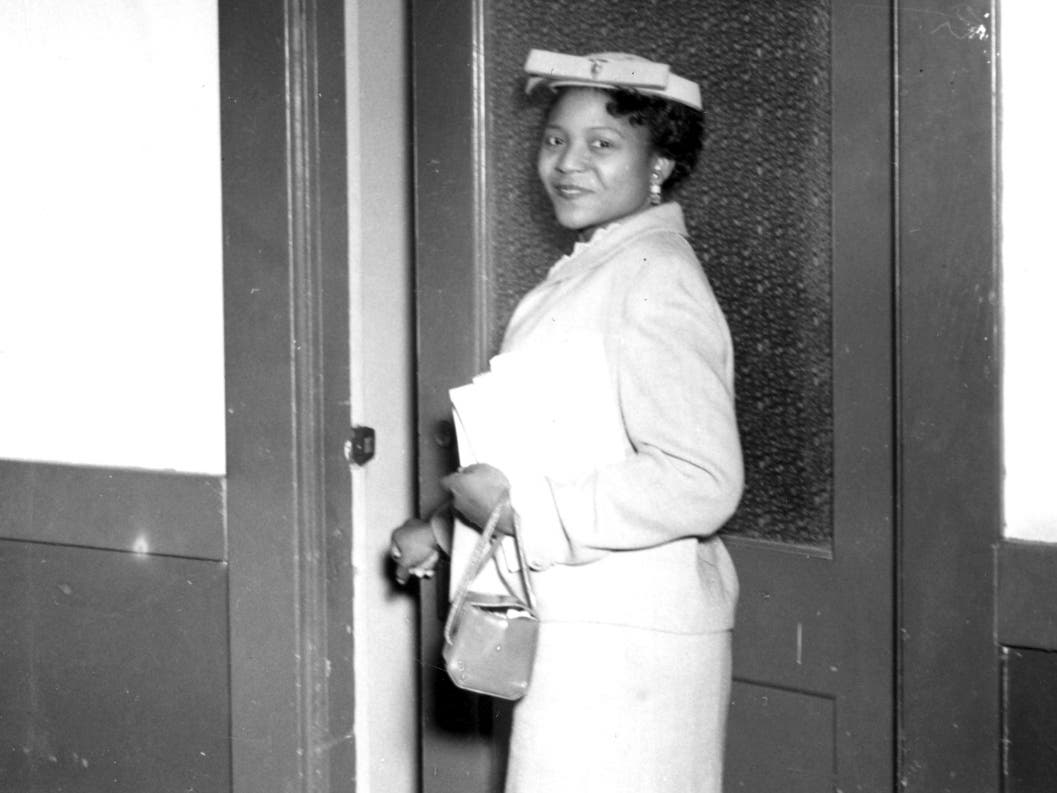
Her desire for a second undergraduate degree was cut short after just three days when a mob of racists assaulted her with food, rocks, and other items when she attempted to enter the University of Alabama.
Autherine Lucy Foster, who earned a bachelor’s degree in English from historically Black Miles College in 1952, and whose legal battle with the University of Alabama concluded two years after the landmark Brown v. Board of Education decision, has died at 92.
A critical, but sometimes overlooked figure in the civil rights movement, Foster’s case became the first to challenge the Brown ruling that allowed federal judges to implement the historic decision.
In 1992, Foster recalled her experience in a New York Times interview.
“It felt somewhat like you were not really a human being. But had it not been for some at the university, my life might not have been spared at all,” Foster said.
“I did expect to find isolation. I thought I could survive that. But I did not expect it to go as far as it did. There were students behind me saying, ‘Let’s kill her! Let’s kill her!’”
Foster visited Tuscaloosa a week before her death, cutting the ribbon on the newly named College of Education building, where she took refuge from the racist mob.
Previously known as Bibb Graves Hall, the university’s building adopted a new name called Autherine Lucy Hall.
“My staff was proud to celebrate the courage and sacrifice of Dr. Autherine Lucy Foster by presenting her with a Congressional Record,” Alabama Democratic Rep. Terri Sewell said. “The naming of the University of Alabama’s Autherine Lucy Hall will stand as a powerful reminder of her sacrifice in the name of justice and equity for all.”
Foster “was the embodiment of courage,” said Rep. Chris England, D-Tuscaloosa, who chairs the organization. “As the first Black student to attend the University of Alabama, her trailblazing determination paved the way for a more inclusive and equitable higher education system in Alabama. Her life was a testament to the power of compassion and grace in the face of unyielding adversity. We are all made better by her example.”
Many others tweeted and offered statements of condolences. Foster’s family asked for privacy, but they did release a statement about the trailblazer.
“She was known, honored, and respected around the world after she broke the color barrier at the University of Alabama,” her daughter Chrystal Foster said in a statement.
“She passed away at home, surrounded by family. We are deeply saddened, yet we realize she left a proud legacy.”