


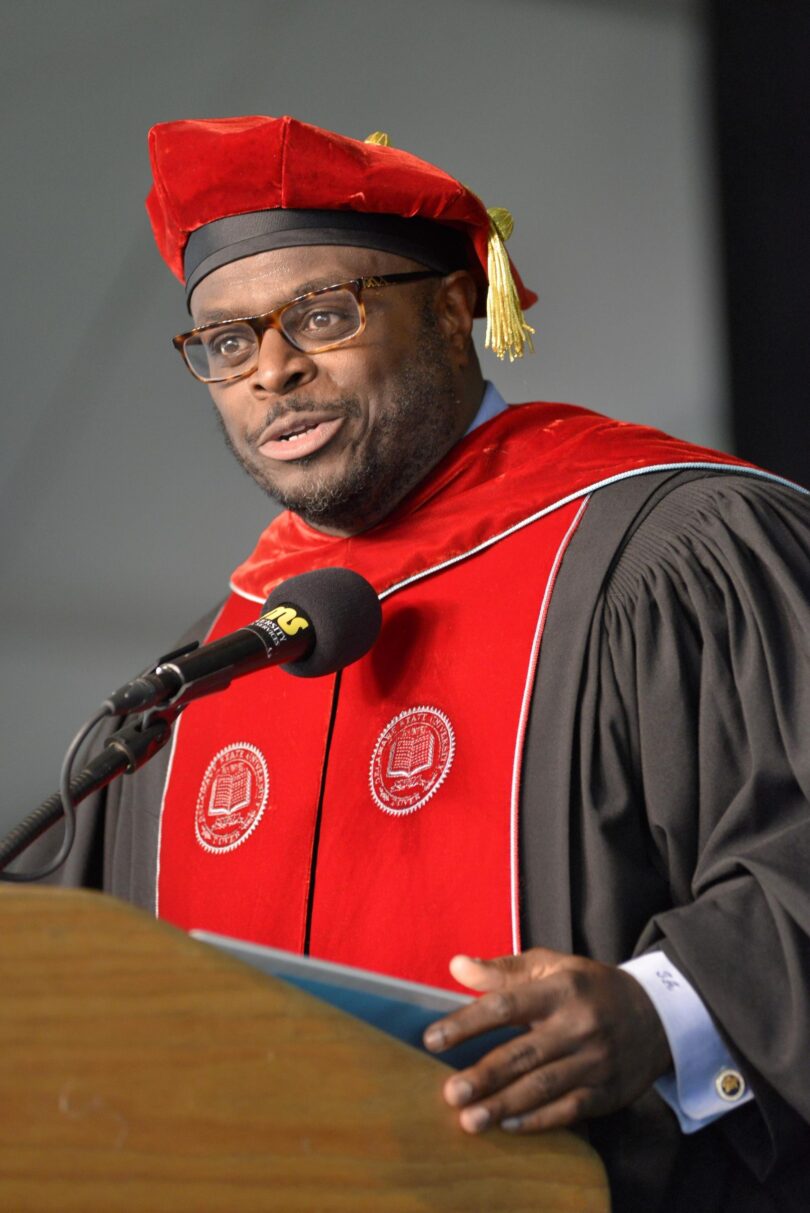
After signing an Executive Order on the White House ‘Initiative on Advancing Educational Equity, Excellence, and Economic Opportunity’ through Historically Black Colleges and Universities, President Joe Biden appointed Dr. Tony Allen to lead the White House Board of Advisors on Historically Black Colleges and Universities.
Allen, the president of Delaware State University, had already implemented part of the vision of the Biden-Harris administration attacking student loan debt.
So it proved a no-brainer for the White House to tap Allen to help lead messaging after President Biden introduced a three-part plan the administration said delivers on his promise to cancel $10,000 of student debt for low-to-middle-income borrowers.
“HBCUs do more with less,” Allen said. “Less is no longer acceptable, and the Biden administration has heard us in word and deed.”
Biden announced up to $20,000 in debt cancellation for Pell Grant recipients and as much as $10,000 to non-Pell Grant recipients.
The president also extended the current federal loan pause through December.

“The opportunity for Pell-eligible students to receive $20,000 and for non-eligible students to receive $10,000 is a significant marker for them as they are thinking about how to repay their loans and continue their career,” Allen said.
Last year, Delaware State University joined several other HBCUs in forgiving large amounts of student loan debt, using funds to cover the bills from COVID relief dollars.
He called the administration’s loan forgiveness a big deal.
“Some might see this as significant as just the first step,” Allen said during an interview on the National Newspaper Publishers Association’s flagship morning show, Let It Be Known.
“I see it as a significant step as it relates to the discussion around college affordability and student debt and what that might mean if we continue to support efforts like this over a longer time over the horizon.”
The administration said nearly 90% of relief dollars are going to borrowers earning less than $75,000 annually.
“Twenty years after first enrolling in school, the typical Black borrower who started college in the 1995-96 school year still owed 95% of their original student debt,” officials stated.
“Even before applying the additional $10,000 for recipients of Pell Grants, the typical Black borrower will see their balance cut nearly in half, and more than one in four Black borrowers will see their balance is forgiven altogether,” administration officials wrote.
In a Fact Sheet, the White House noted that since 1980, the total cost of four-year public and four-year private college had nearly tripled, even after accounting for inflation.
Federal support hasn’t kept up, administration officials stressed.
Pell Grants once covered as much as 80% of the cost of a four-year public college degree for students from working families.
Now, those grants cover only one-third of the cost.
The Department of Education reported that the typical undergraduate student with loans now graduates with nearly $25,000 in debt.
“We are a proxy for a lot of HBCUs across the country. For example, at Delaware State, 67% of our students are Pell eligible, and 90% receive some sort of federal aid,” Allen stated.
“The one fact I’ve been talking about is that 90% of all federal aid and relief as a result of this initiative will go to folks making $75,000 or less.
“That’s recent alum. The president and his team literally just made the impossible possible for millions. It’s an investment that will pay back big dividends in the American economy.”