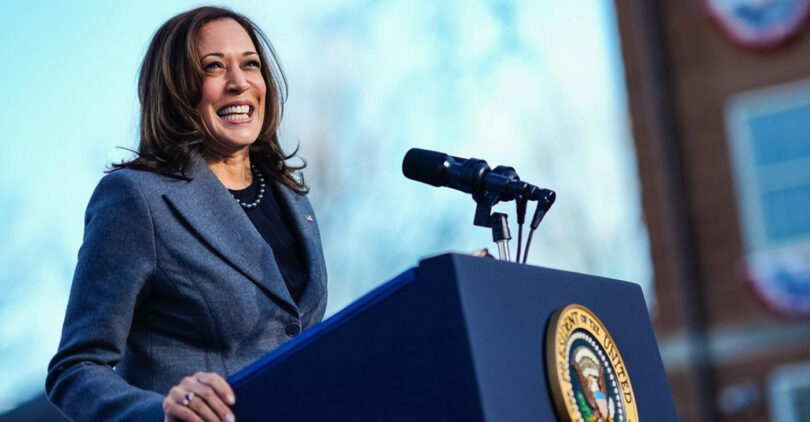
Vice President Kamala Harris on Thursday announced the Women in the Sustainable Economy (WISE) Initiative, which the White House says supports the 2023 Asia-Pacific Economic Cooperation (APEC) theme of ‘Creating a Resilient and Sustainable Future for All.’ Its goal is to strengthen women’s economic empowerment globally.
The initiative contains over $900 million in commitments from governments, private sector companies, foundations, and civil society. The funds will bolster women’s economic participation in key sectors such as clean energy, fisheries, recycling, forest management, and environmental conservation.

The WISE Initiative is a core element of the broader Biden-Harris Administration’s dedication to advancing women’s economic empowerment globally. The commitment aligns with the U.S. National Strategy on Gender Equity and Equality and the U.S. Strategy on Global Women’s Economic Security. Notably, it builds on the administration’s previous announcement in Ghana, where $1 billion was pledged to empower women globally and bridge the digital gender divide.
According to a White House Fact Sheet, the initiative operates on three foundational pillars:
- Promoting good-paying jobs: Ensuring women have the necessary skills, training, and access to decent jobs in energy, land, and water use and management.
- Supporting women-owned businesses: Facilitating increased access to banking, financial services, networks, markets, and technical assistance for women in critical sectors
- Eliminating barriers: Advancing STEM education for girls and addressing obstacles to women’s economic participation in energy, land, and water use and management.
Under the WISE umbrella, flagship initiatives include the Engendering Industries program, focusing on creating economic opportunities for women in sectors like water, agriculture, energy, and information technology.
The Climate Gender Equity Fund (CGEF), a public-private partnership under the direction of USAID, promotes financial inclusion for women-led organizations in climate finance for long-term economic growth.
Global commitments from governments include Australia, Canada, Ireland, Japan, Mexico, and Norway, each contributing significant funds to support women’s economic participation and empowerment.
Administration officials confirmed that the private sector, philanthropic organizations, and civil society are active participants. Major players such as Amazon, CARE, Citi, LinkedIn, Mastercard Impact Fund, PepsiCo, Reckitt, Unilever, and the Visa Foundation commit substantial financial resources to promoting women’s economic empowerment.
In reinforcing the U.S. commitment, Harris announced a contribution of $163 million to advance women’s economic security domestically and globally. Collectively, partners are pledging over $900 million, marking a historic step towards fostering women’s participation in the sustainable economy. “This initiative not only aligns with the APEC theme but also represents a bold stride in the global pursuit of gender equality, economic empowerment, and sustainable development,” administration officials said in a release.