




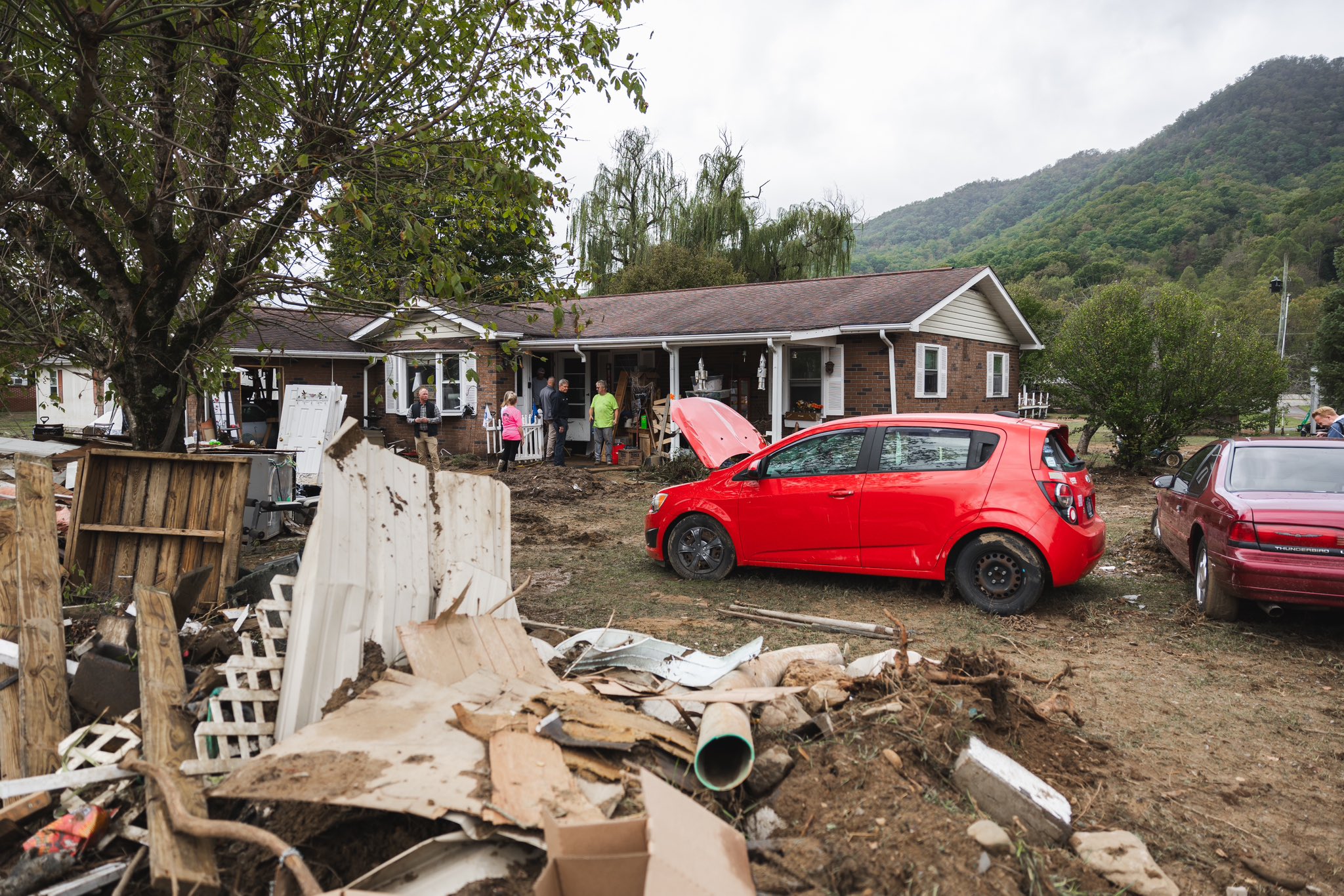
Tennessee Gov. Bill Lee has unveiled the Helene Emergency Assistance Loans (HEAL) Program, a $100 million fund to directly serve the health and well being of Tennesseans in the aftermath of Hurricane Helene. Counties eligible for assistance include Carter, Claiborne, Cocke, Grainger, Greene, Hamblen, Hawkins, Jefferson, Johnson, Sevier, Sullivan, Unicoi and Washington.
“Hurricane Helene was an unprecedented disaster for Tennessee, and many local communities don’t have the resources to recover on their own,” said Gov. Lee. “Federal dollars will be available later, but these communities need immediate relief. Tennessee’s record of fiscal conservatism has placed us in a strong financial position to make government work for the people and step up to help in this time of need.”
Gov. Lee has met with flood survivors, emergency operations personnel, and local law enforcement in Northeast Tennessee to identify the greatest needs. Work to remove dangerous debris and repair water and wastewater systems must begin immediately. Unfortunately, the damage is too extensive, and expense is too great for local jurisdictions to cover the cost of repairs and wait for FEMA reimbursement.
The HEAL Program allocates $35 million to address water and wastewater system damage across eligible counties. These systems experienced extensive damage in most counties and were destroyed in others. Utilities are central to the health and well being of the Tennesseans living in the affected areas, as well as the first responders and volunteers who are temporarily deployed to help with the rebuilding process. As a result, $65 million will be divided equally among eligible economically at-risk and distressed counties to address dangerous debris removal.
Eligible counties may opt-in for the no-interest loans, which are funded by TennCare Shared Savings. Tennessee Emergency Management Agency (TEMA) will distribute funds accordingly.
Rep John Ray Clemmons: Lee’s ‘loan’ to disaster-stricken East Tennessee counties adds insult to injury

Clemmons says governor’s proposed use of vital TennCare funds raises questions
Funding for Gov. Bill Lee’s ‘Helene Emergency Assistance Loan Program’ would be pulled from the state’s TennCare program, and the state would require the counties to repay the loans in full from their federal emergency assistance funds.
In response to this announcement, State Rep. John Ray Clemmons, chairman of the House Democratic Caucus, issued the following statement:
“Not only was Gov. Bill Lee late to request emergency assistance from the federal government on the heels of Hurricane Helene, he is now adding insult to injury by merely loaning disaster-stricken counties $100 million for necessary infrastructure investments.
“The families and counties devastated by the recent flooding caused by Hurricane Helene should be benefitting from both federal and state funding to the full extent possible. The idea that Gov. Lee is requiring these counties, which were already struggling financially and facing tens of billions of dollars in decaying infrastructure, to repay the state from badly needed federal emergency assistance funds is especially galling. Right now there is nothing more important than prioritizing the Tennessee families and local economies of East Tennessee and helping them get back on their feet as fast as possible. The last thing these folks need is the additional financial and administrative burden of a state loan looming over their head.
“We should be granting these counties all of these funds outright. This is precisely the moment and purpose for which available state reserves are intended. We have an unspent $144 million in the general fund that was set aside for Bill Lee’s voucher scam which could be used next year to replenish any funds pulled from the Rainy Day Fund or elsewhere. Notably, as of June 30, 2024, our state has only spent 15.55% of the $3,725,832,113 we received from the federal government through the American Rescue Plan Act of 2021 (ARPA). That means there is $709,408,647.21 sitting in state coffers that has yet to go out the door. The Rainy Day Fund is flush with cash also.
“Ultimately, the rationale for Gov. Lee’s fiscally irresponsible maneuver may be best described as a shell game. He is not saying what he will do with the funds once he forces the counties to repay their $100 million in loans. To the extent that the state can even legally use TennCare funds for this loan program, it appears Lee is trying to whitewash the money so that it returns to the state with no strings attached. If so, there is no guarantee that the funds will be reinvested into TennCare, undoing nearly 20 years of bipartisan work to reach a stable TennCare program and risking plunging our state into another budget crisis. Lee could then use those monies to partially fund his billion-dollar voucher scam. To think that he would loan money to these counties for disaster recovery, while at the same time scheming to drain funds from their public schools is offensive.
“Gov. Lee has established a solid reputation for fiscal mismanagement and callous decision-making during his term, but this loan program beats anything I’ve ever seen. My Democratic colleagues and I invite local public officials statewide (Democrats, Republicans and Independents) to join us in pushing for sound and responsible fiscal policies that support cities and counties, not half-baked schemes to tear them down. “









