

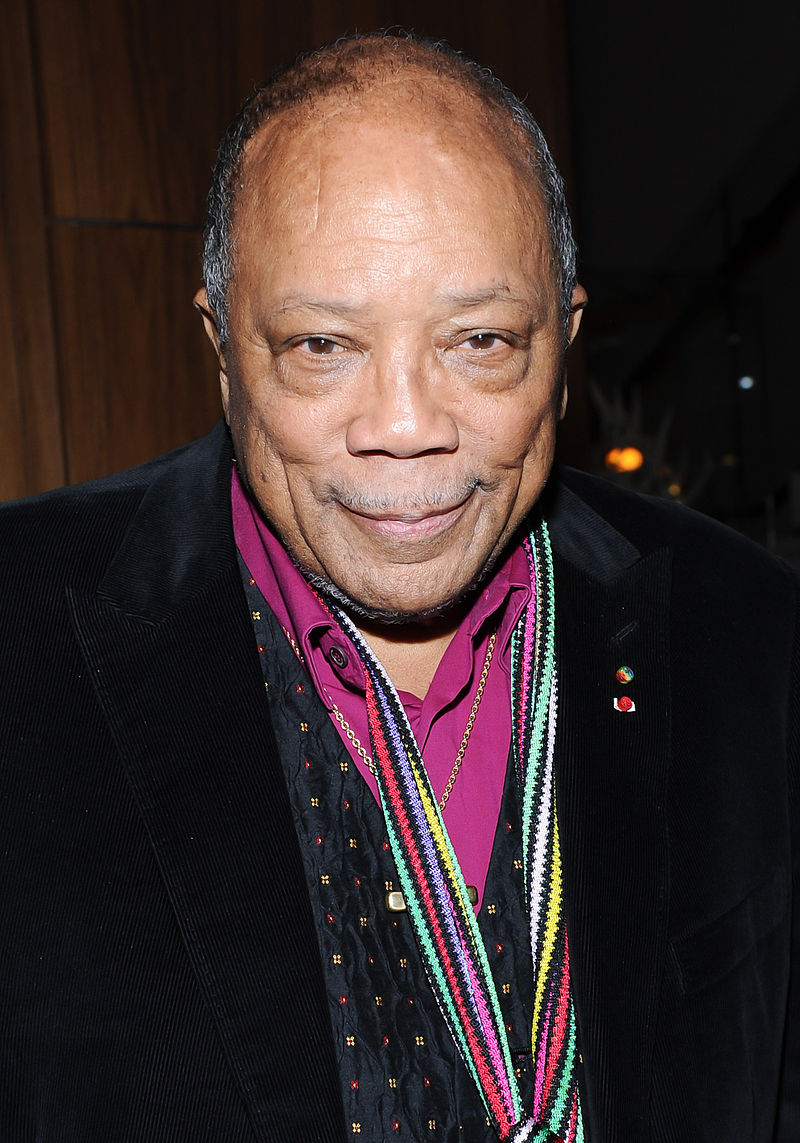
Quincy Jones, the record producer, arranger, and cultural trailblazer whose influence spanned more than seven decades, has died at 91. His publicist, Arnold Robinson, confirmed his death in a statement, noting that Jones died peacefully at his home in Bel Air. The statement did not specify the cause.
Known for producing Michael Jackson’s landmark albums, “Thriller” and “Bad,” Jones’s career far exceeded even those iconic works.
Jones transformed genres, introduced new styles, and championed Black artistry in a largely segregated industry. The Rock and Roll Hall of Fame, which inducted him in 2013, called him a “Jack of All Trades” but noted that Jones “excelled at every role he took on.” His contributions as a record producer, arranger, composer, and performer reflect a boundless curiosity that kept him at the cutting edge of music across generations. His presence shaped countless albums, film scores, and even social movements, making him a bridge between jazz, R&B, pop, and hip-hop and between Black and white audiences.
Jones began as a jazz trumpeter, arranging for bands like Count Basie’s and becoming a respected composer in his own right. His compositions for films, including The Pawnbroker and The Color Purple, displayed his extraordinary range, mixing classical, jazz, funk, and Afro-Cuban influences. His television scores, such as those for Sanford and Son and Ironside, brought Black music to mainstream audiences, shaping a generation’s auditory landscape.
The three Jackson albums Jones produced — Off the Wall, Thriller, and Bad — stand among his most famous works. The albums broke sales records and redefined the global pop music industry, bridging racial divides and setting new standards for production. But Jones’s career had already reached milestones before those records. He had become the first Black vice president at Mercury Records in 1964 and had garnered critical acclaim for his arrangement of Count Basie’s “I Can’t Stop Loving You.” Over time, he received 28 Grammy Awards from 80 nominations, a record surpassed only by a few.
Born in Chicago on March 14, 1933, Quincy Delight Jones Jr. faced a childhood filled with challenges and resilience. According to his official biography, Jones was primarily raised by his father, a carpenter, after his mother was diagnosed with schizophrenic disorder. Moving to Seattle in his early teens, he honed his craft in a music scene as diverse as his musical inclinations. By 15, Jones had already earned a spot in Lionel Hampton’s band, launching a career that would take him across the globe and into the company of jazz greats like Dizzy Gillespie and Ray Charles, who would become a lifelong friend and collaborator.
Jones’s time as a jazz bandleader and arranger in the 1950s established his name in elite music circles, but his ambitions led him into film and television scoring, where he created iconic soundtracks. Throughout the 1960s and 70s, Jones’s music could be heard in theaters and living rooms, with scores for films like In Cold Blood and The Deadly Affair and contributions to Alex Haley’s Roots, the celebrated mini-series. His soundtrack for The Color Purple in 1985, adapted from Alice Walker’s novel, remains a cultural milestone.
In 1985, Jones united more than 40 of the world’s biggest music stars for the charity single “We Are the World,” raising awareness and funds for famine relief in Africa. The project’s success further cemented his reputation as a visionary capable of bridging divides for a greater cause. His label, Qwest, produced a roster as diverse as his interests, featuring artists from George Benson to the experimental jazz saxophonist Sonny Simmons.
Through the 1990s and 2000s, Jones expanded his reach beyond music, producing television hits like The Fresh Prince of Bel-Air and the magazine Vibe. In his later years, he remained active, working on projects that celebrated his love for jazz and hip-hop alike. In 2022, he collaborated with The Weeknd on Dawn FM, delivering a spoken monologue reflecting his decades of life and artistry. His work became a rich tapestry, woven with threads from every major genre and cultural moment in modern American history.
“He always is soaring ahead and doesn’t like to look backwards,” Oprah Winfrey said of him during his Rock and Roll Hall of Fame induction.
Jones leaves behind seven children: Jolie, Kidada, Kenya, Martina, Rachel, Rashida, and Quincy III in addition to his brother Richard, sisters Margie Jay and Theresa Frank.