Frederick Douglass did not know the day he was born.
Like many enslaved people, he was denied even the dignity of documentation. Birth dates were approximations. Family lines were severed. Identity existed in property ledgers, not in public record.

His mother, Harriet Bailey, called him her “little Valentine,” and Douglass later chose February 14 as his birthday—an act of self-definition in a country that refused to define him as fully human.
That act matters.
Douglass understood something fundamental: identity is not granted by paperwork. It is asserted through presence, voice and participation. He claimed authorship over his own life in a nation structured to deny it.
Today, we are debating whether documentation should determine access to democracy.
The SAVE Act would require documentary proof of citizenship to register to vote in federal elections. Passports. Birth certificates. Paper trails. Supporters frame it as administrative protection. But the history of American democracy teaches us that administrative mechanisms are rarely neutral.
Paperwork has always been political.
After Reconstruction, when Black political participation expanded, new rules narrowed the electorate. There were literacy tests, poll taxes, ‘grandfather clauses.’ Each was presented as procedural. Each functioned as a barrier.
The methods change. The objective (control over who counts) does not.
Documentation requirements would fall hardest on those least likely to have ready access to formal records: seniors born at home in the Jim Crow South; low-income Americans without passports; married women whose legal names no longer match their birth certificates. Even producing paperwork can become a test of belonging.
Documented cases of non-citizen voting are exceedingly rare. The question is not fraud prevention. It is access.
Reconstruction was not only about emancipation. It was about participation. Black men voted. Black officials were elected. Black institutions were built. And when those gains threatened entrenched power, backlash followed.
In 1898, in Wilmington, North Carolina, a legitimately elected multiracial government was overthrown. Black political power was dismantled. The ballot was replaced by the bullet. It was not disorder. It was organized suppression.
The lesson is sobering. When participation expands, resistance emerges.
Today’s debates unfold in legislative chambers rather than in armed mobs. But the question remains: who has the authority to define citizenship?
Douglass claimed his identity in a system that denied him documentation. He did not wait for official recognition to assert his humanity. He understood that democracy depends not on perfect records, but on inclusive participation.
When paperwork becomes a prerequisite for political voice, we should ask whether we are strengthening democracy—or narrowing it.
The struggle over the ballot has never been merely procedural. It has always been about power.
Douglass defined himself when the state would not.
The question now is whether we will let the state decide who counts.
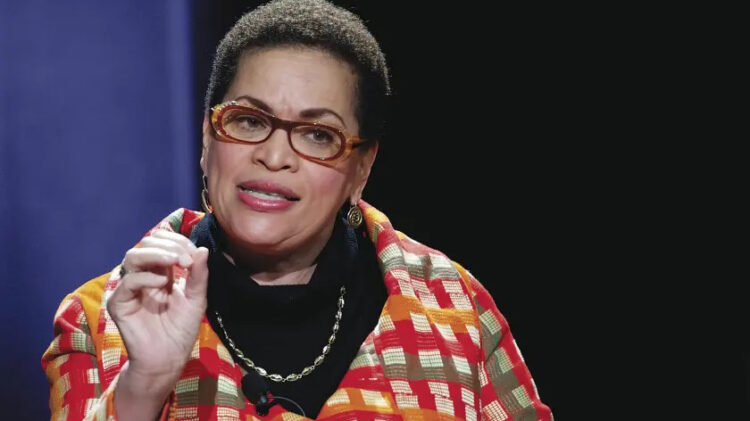
(Dr. Julianne Malveaux is a Washington, D.C.-based economist and author.)