


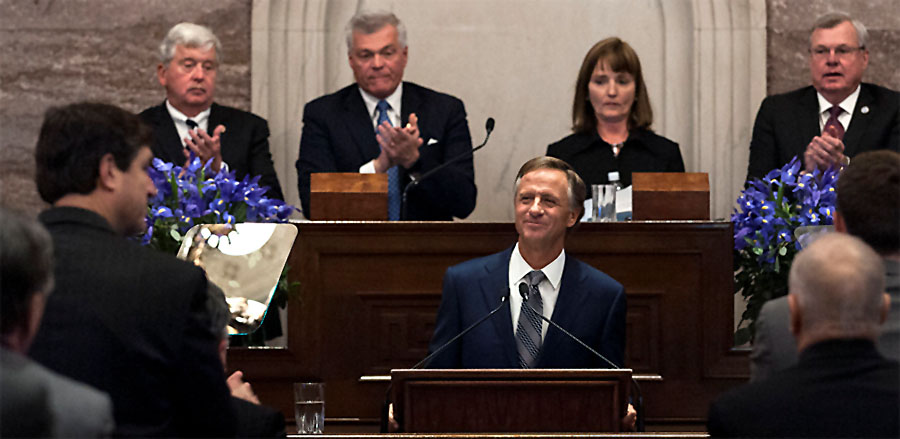
Gov. Haslam took a ‘victory lap’ during his final State of the State address to the General Assembly on Monday evening.
Haslam challenged all Tennesseans to lead the nation in creating high-quality jobs, improving the education of our students, and providing the most efficient and effective state government services.
“Seven years ago we raised our expectations. We became the kind of leaders who didn’t just talk about cutting taxes and enhancing services, we actually did lower taxes while growing our economy and providing access to high quality education. We cannot lose the momentum we have worked so hard to build,” Haslam said.
Haslam reflected on the past seven years, working with the General Assembly to create a strong commitment to jobs, education and conservative fiscal policy.
Among his accomplishments, Haslam touts: the fastest-improving students in the nation, across math, reading and science, and the highest high school graduation rates the state has ever seen; more than $500 million in tax cuts to Tennesseans, including a 30% cut on groceries; and a cut in year-to-year spending by more than a half billion dollars.
Perhaps Haslam’s greatest milestone is that Tennessee has the lowest unemployment rate in the state’s history.

However, Haslam’s critics claim that a large part of the unemployment rate being down is because people have stopped looking for work.
The governor is taking a victory lap on low unemployment, but economists in Tennessee largely understand that it’s because people have stopped looking for work,” said Tennessee Senate Democratic Caucus in a released statement.
“The state’s unemployment rate was three percent in October, a historic low for Tennessee and a decline of two percentage points in just 12 months, according to the Labor Department. But the recession pushed many Tennesseans out of the workforce, and the workforce participation rate has trended down since. Almost 65% of the state’s population was in the workforce a decade ago. In 2017, that number was less than 61%.
This would mean that Tennessee’s unemployment rate has fallen, “but largely because many people in the state stopped looking for work.”
Democrats also questioned the governor’s plan to end the opioid crisis. Called Tenn. Together, the plan focuses on prevention, treatment and law enforcement.
The governor’s FY 2018-19 budget includes nearly $15 million in new state funds ($30 million total) for Tenn. Together.
“Sadly, the governor’s paltry $25 million opioid plan represents a business-as-usual approach to the opioid crisis. Our communities are facing a dire emergency and we need to take bold action to stem the tide of opioids that is destroying Tennessee’s families and communities,” said Democratic House Caucus Chair Mike Stewart. “The governor was willing to eliminate a hundred million dollars a year when they repealed the estate tax on Tennessee’s richest families but proposes to spend a quarter of that amount on Tennessee’s most pressing health crisis. We can obviously do much better,” Stewart said.
“This disagreement isn’t politics, its math,” Democratic Senate Caucus Chair Jeff Yarbro said.
“If you look at the numbers, we would get a fraction of the people who need it into treatment, when we had 21,000 overdoses that led to death or hospitalization last year. We believe this is a fight we could actually win, if the governor’s hands weren’t tied behind his back by the super-majority leadership.”