by Trinity Webster-Bass, Special from the Howard University News Service and Trice Edney News Wire
CHICAGO, Ill. (HUNS) — Agitated and disillusioned are two words to describe the national mood when the Democratic National Convention gathered in Chicago during the summer of 1968. Civil rights activist Martin Luther King, Jr. was assassinated in April 1968 after marching with striking sanitation workers in Memphis. Eight weeks later, Democratic presidential candidate Robert F. Kennedy was murdered moments after winning California’s primary election.

Their deaths sent the country into a state of both grief and heightened racial tension. This was on top of political turmoil that led nearly 10,000 anti-war demonstrators to gather at the convention to protest the Vietnam War. The unpopular Vietnamese conflict lasted from 1955 to 1975 with a death toll that overshadowed President John F. Kennedy’s concerns about the spread of Communism and that continued to haunt President Lyndon B. Johnson long after JFK’s assassination in 1963.
“What’s happening in that period is that it is a bit more turbulent than most points in American political history,” said Keneshia Grant, an associate professor of political science at Howard University.
“And not only more turbulent, but when we compare it to today, it is a little bit more violent than what we experience today, because they’re also coming off a string of assassinations to prominent individuals in American society and life.”
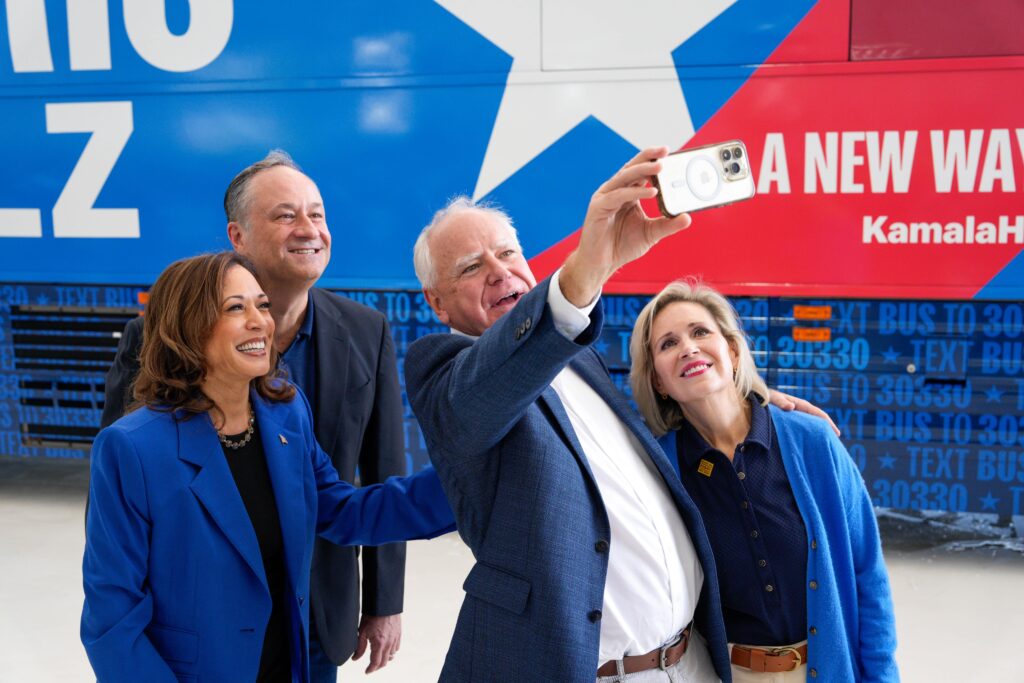
So what’s different now? More than 50 years later, Vice President Kamala Harris and Minnesota Gov. Tim Walz are taking the stage as the Democratic Party’s nominees for president and vice president. This is the first time in U.S. history that a Black and Asian American woman will be at the top of the ticket, and her running mate is a military veteran and former school teacher. This new pairing is generating excitement among Democratic voters.
However, on the horizon of this year’s DNC lies some of the same issues, just with a different spin. The Chicago metropolitan area is home to the nation’s largest population of Palestinian Americans. Pro-Palestinian protests occurred throughout the week, but not to the extent expected. The Biden Administration’s support for Israel has been a point of contention, causing many to question their vote for the Harris-Walz ticket.
But on the DNC floor, New York Rep. Alexandria Ocasio-Cortez said that Vice President Harris is “working tirelessly to secure a ceasefire in Gaza.”
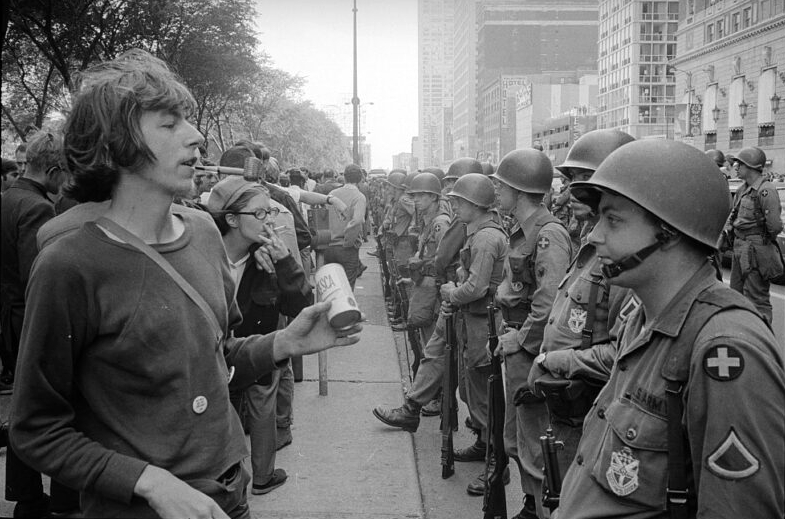
Lorenzo Morris, Ph.D., professor emeritus of political science at Howard, cautioned against drawing direct parallels between the anti-war protests of 1968 and the Pro-Palestinian protests of 2024.
“Many American men were drafted and died in that war. And so there is a war now, yes, but the Vietnam conflict should not be thought to be the same as the conflict in Palestine. War is bad. America was directly involved in Vietnam and not directly involved in the war in Gaza. So, the war protest was about like this idea that Kennedy started, but then Johnson perpetuated the war in Vietnam that didn’t seem to have a point. Then, why were we sending all our young people to die? Why were we pulling folks out of college to die in this war? That was kind of a question there.”
Although some would argue that the Democratic Party has adopted a more left-leaning standpoint, the issues that Americans were concerned about in the 1960s still resonate with Democrats today.
The Roe v. Wade lawsuit was filed in 1970, just two years after the convention. Reproductive rights is still a key issue that influences the vote of many Democrats. Likewise, in the summer of 1968, the Poor People’s Campaign, an initiative to improve the economic conditions of blue-collar workers, drew thousands to Washington, D.C. Today, workers’ rights and the protection of labor unions sets the foundation of the Democratic Party’s economic policies.
For the first time since the 1968 DNC in Chicago, the Democratic presidential nominee was not the initial pick. In the spring of 1968, President Lyndon Johnson announced that he would not seek reelection. Similarly, President Biden dropped out just weeks before the convention and endorsed his vice president for the top of the ticket.
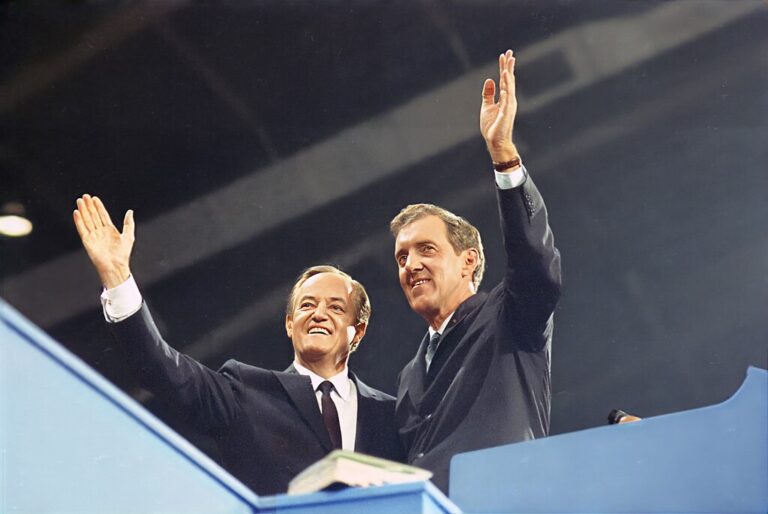
During the 1968 convention, Democrats nominated former Vice President Hubert Humphrey for president and Sen. Edmund Muskie of Maine as vice president. Humphrey was a “decades-long familiar face hobbled by his support for the hugely unpopular domestic and foreign policies that animated the protests” at the convention, Morris said. In the fall, he lost the election to Republican and former Vice President Richard Nixon,
The violence that occurred during the four days of the 1968 convention was substantial. Businesses in downtown Chicago were destroyed, and hundreds of protesters and civilians were injured. It was a reflection of the political state of the nation. Today’s political climate remains tumultuous in the aftermath of the Jan. 6 insurrection, the challenges to Supreme Court rulings and the use of excessive force on unarmed Black Americans. But as a new choice for Democrats in November, Vice President Harris has an opportunity to maintain the peace and unite the Democratic Party.
“Donald Trump’s candidacy, Project 2025, will roll back rights like it is 1968,” said Aprill Turner, communications director of Higher Heights of America, referring to the conservative blueprint to dismantle the federal government that was prepared by the Heritage Foundation and members of Trump’s inner circle.
“We are excited for Vice President Kamala Harris, because she represents the future,” Turner said. “She represents change.”
And as Texas Rep. Jasmine Crockett said: “We deserve a bright light in a sea of darkness. Because we won’t go back.”
(Trinity Webster-Bass is a reporter for <HUNewsService.com>.)