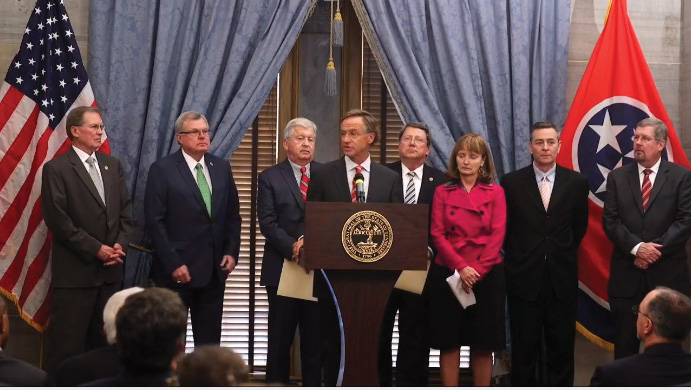
Tennessee Gov. Bill Haslam has announced a plan to end the opioid epidemic in Tennessee by focusing on three major components: prevention, treatment and law enforcement. Naming the initiative ‘Tennessee Together,’ Haslam plan addresses the issue of opioid addiction through legislation, proposed funding in the governor’s 2018-19 budget, and executive actions. Tenn. Together is a collective effort and has been designed in partnership with the General Assembly through the Ad Hoc Opioid Abuse Task Force established by Speaker Beth Harwell and chaired by Speaker Pro Tem Curtis Johnson and a working group established by Haslam that included Harwell and Lt. Gov. Randy McNally’s appointee, Speaker Pro Tem Ferrell Haile.
“This is a crisis that knows no boundaries and impacts many Tennesseans regardless of race, income, gender or age. Our approach will be aggressive with provisions to limit the supply of opioids and significant state and federal dollars to provide treatment to those in need,” Haslam said. “I applaud the collaboration and the considerable work of the House and Senate on the Tenn. Together plan, as well as the judicial branch’s leadership through the Regional Judicial Opioid Initiative and National Opioid Task Force, and I ask all stakeholders around this issue to work together to achieve real reform and action that will save lives.”

The three components of Tenn. Together include prevention, treatment and law enforcement. Specifically, the plan includes:
• Legislation to address prevention by limiting the supply and the dosage of opioid prescriptions, with reasonable exceptions and an emphasis on new patients. Initial prescriptions will be limited to a five-day supply of drugs with daily dosage limits of 40 MME (morphine milligram equivalent).
• Limiting coverage for TennCare enrollees to an initial five-day supply with daily dosage limits.
• Increasing prevention education in grades K-12 through revisions to the state’s health education academic standards.
• An executive order, establishing a special commission to formulate current, evidenced-based pain and addiction medicine competencies for adoption by the state’s medical and health care practitioner schools.
• Identifying women of childbearing age who are chronic opioid users and providing targeted outreach about risks and treatment in order to aid in the prevention of Neonatal Abstinence Syndrome (NAS) births.
• Investing more than $25 million for treatment and recovery services for individuals with opioid use disorder. These services will include an increase in peer recovery specialists in targeted, high-need emergency departments to connect patients to treatment immediately.
• Improving the state’s data systems to better and more timely identify critical hot spots for targeting resources and increasing information about patient and community risks.
• Legislation that expands residential treatment and services for opioid dependence within the criminal justice system and creates incentives for offenders who complete intensive treatment programs while incarcerated—a best practice that is proven to reduce recidivism, improve lives and communities and save taxpayer dollars.
• Attacking the illicit sale and trafficking of opioids by providing additional resources to the Tennessee Bureau of Investigation for rapid response teams and, through legislation, penalizing the use and unlawful distribution of dangerous and addictive drugs, including those that mimic the effects of fentanyl, a drug that is up to 100 times more potent than morphine and is linked to an alarming number of overdose deaths.
• Providing every Tennessee state trooper with naloxone for the emergency treatment of opioid overdose.
In total, Gov. Haslam’s FY 18-19 budget proposal will include a $30 million investment (state and federal funds) to support Tenn. Together.
State Democrats say opioid proposal doesn’t go far enough
Leaders of Tennessee’s legislative delegation praised the plan presented by Gov. Bill Haslam to combat the state’s opioid crisis. The proposal features a three-pronged approach that focuses on prevention, treatment and law enforcement. Democratic leaders today said the plan is a step in the right direction, but add the most effective thing Tennessee lawmakers can do to combat the crisis is to pass Medicaid expansion in the state.
House Democratic Caucus Chair Mike Stewart said: “I applaud the governor for his efforts, however, we all know that he’s hamstrung by the Republican super majority in the state legislature and their continued efforts to serve as a roadblock to his Insure Tennessee plan. Tennesseans deserve access to the treatment programs that can only happen with expanded cove-rage.”
“Tennessee is drowning in opioids, and it’s having a generational impact that’s literally changing the trajectory of communities,” Senate Democratic Caucus Chair Jeff Yarbro said. “This is no time for a standard-issue, incremental plan. We should treat the opioid epidemic like the public health crisis it is. We’re either going to send people to doctors or dealers. And it seems clear that we’re leaving Medicaid expansion dollars on the table and making some easier political choices at the expense of getting more Tennesseans into the treatment everyone knows is desperately needed.”
“I stand with anyone who wants to fight the opioid crisis, but by not expanding Medicaid, we are fighting with our hands tied,” said House Minority Leader Craig Fitzhugh. “Opioid related emergency visits increased nearly 100% between 2000 and 2014 (according to the Kaiser Family Foundation, Expanding Medicaid-eligible population coverage to help battle their addictions.”
Senate Minority Leader Lee Harris said: “With overdose deaths on the rise, last year Leader Fitzhugh and I passed legislation requiring those treated for an opioid overdose to be taken to the hospital. We have seen over and over again that people need actual treatment to fight this horrible addiction. In 2016, Shelby County lost 150 lives from drug overdoses involving opioids. Our bill was one small step to combat this very real problem, but on that could save lives.”