Fisk University’s ambitious plan to build a $400 million innovation and data center as part of a sweeping $1 billion campus transformation is drawing increasing scrutiny from alumni and community members who fear the project could negatively impact North Nashville.
The controversy comes as Nashville leaders are considering some of the strictest local regulations on data centers in Tennessee amid growing concerns about energy consumption, noise, water use and environmental impacts associated with the rapidly expanding industry.

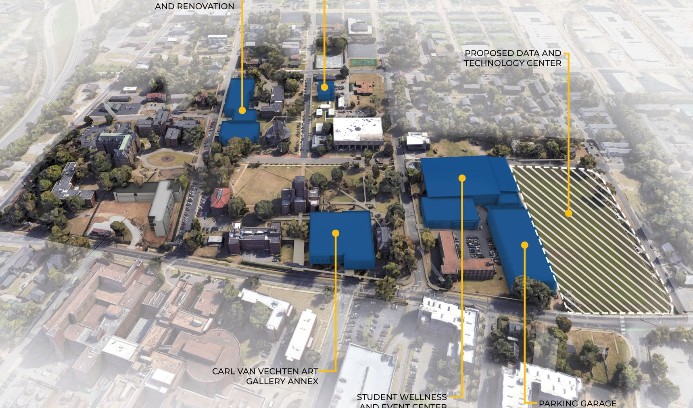
At the center of the debate is Fisk’s recently unveiled ‘Quantum Leap’ master plan, a decade-long initiative that university leaders describe as the most significant investment in the institution’s 160-year history. The proposal includes a new arena, student center, renovated residence halls, expanded academic facilities and a 100,000-square-foot innovation center anchored by a large data and technology facility.
University officials say the project will help position Fisk as a national leader in technology, workforce development and innovation while creating educational opportunities for students and economic benefits for North Nashville.
“For more than 160 years, Fisk University has played a leading role in shaping some of the nation’s brightest minds,” said Fisk President Dr. Agenia W. Clark when announcing the plan in May. “Quantum Leap represents our commitment to building upon our storied legacy while paving the way for sustained growth to ensure Fisk continues to empower its students, faculty and community.”
According to the university, the innovation center will be built on five undeveloped acres on the southern portion of campus and will feature 30,000 square feet of academic space and 70,000 square feet dedicated to technology infrastructure. The facility is expected to require approximately 30 megawatts of power.
Fisk officials have emphasized that the project is designed to be environmentally responsible and will incorporate advanced technologies intended to reduce energy and water consumption while limiting greenhouse gas emissions.
The university says the facility will support research, workforce development and technology-focused academic programs while helping bridge the digital divide and create new career pathways for students.
But not everyone is convinced.
Two online petitions opposing the project have emerged in recent weeks, reflecting growing concerns among alumni and neighborhood residents about the long-term consequences of locating a large data center in the heart of a historic Black community.
One petition launched by Fisk alumnus Winston Wright had gathered more than 2,800 signatures by Sunday evening.
Wright said his concerns grew after learning more about the scale of the project and the nationwide debate surrounding data centers, particularly those supporting artificial intelligence technologies.
“The unprecedented growth of data centers built for generative AI across the country has been met with furious pushback from communities that have been adversely impacted by the current development boom,” Wright wrote in the petition.
Wright also drew comparisons to previous battles over development in North Nashville, including the controversial construction of Interstate 40 through predominantly Black neighborhoods during the 1960s.
“We come from a legacy of getting into good trouble,” the petition states, “even if that means pushing back against our alma mater.”
Speaking with local media, Wright said he understands Fisk’s desire to strengthen its financial future but believes the university should explore alternatives that do not potentially place additional burdens on surrounding neighborhoods.
“It’s embarrassing because, again, our historic legacy,” Wright said. “We have always been an institution that has produced people who would typically fight against something like this—harmful infrastructure in Black communities.”
The debate at Fisk mirrors broader concerns emerging across Nashville and Middle Tennessee. Data centers have become increasingly important to the nation’s digital economy, particularly with the rapid growth of artificial intelligence, cloud computing and advanced research applications. However, critics argue that the facilities often place substantial demands on electrical grids and water systems while generating noise from cooling equipment and backup generators.
Those concerns have prompted Metro Council member Rollin Horton to introduce legislation that would establish Nashville’s first comprehensive regulations governing data centers. The proposal would impose strict setback requirements, environmental standards and operating conditions while limiting where larger facilities can be located.
Supporters of the legislation say the rules are necessary to protect neighborhoods and infrastructure. Critics argue overly restrictive regulations could discourage investment and technological growth.
For Fisk University, the challenge now is balancing its vision for innovation with concerns from some of the very communities it hopes to serve.
University officials maintain that the innovation center is designed to create educational opportunities, strengthen workforce development and ensure Fisk remains competitive in an increasingly technology-driven economy.
Meanwhile, opponents are calling for greater transparency, more community engagement and a fuller examination of the project’s potential impacts before construction moves forward.
As Nashville continues to debate the role of data centers in its future, Fisk’s proposal has become a focal point in a larger conversation about economic development, environmental responsibility and the future of historically Black communities in a rapidly changing city.