

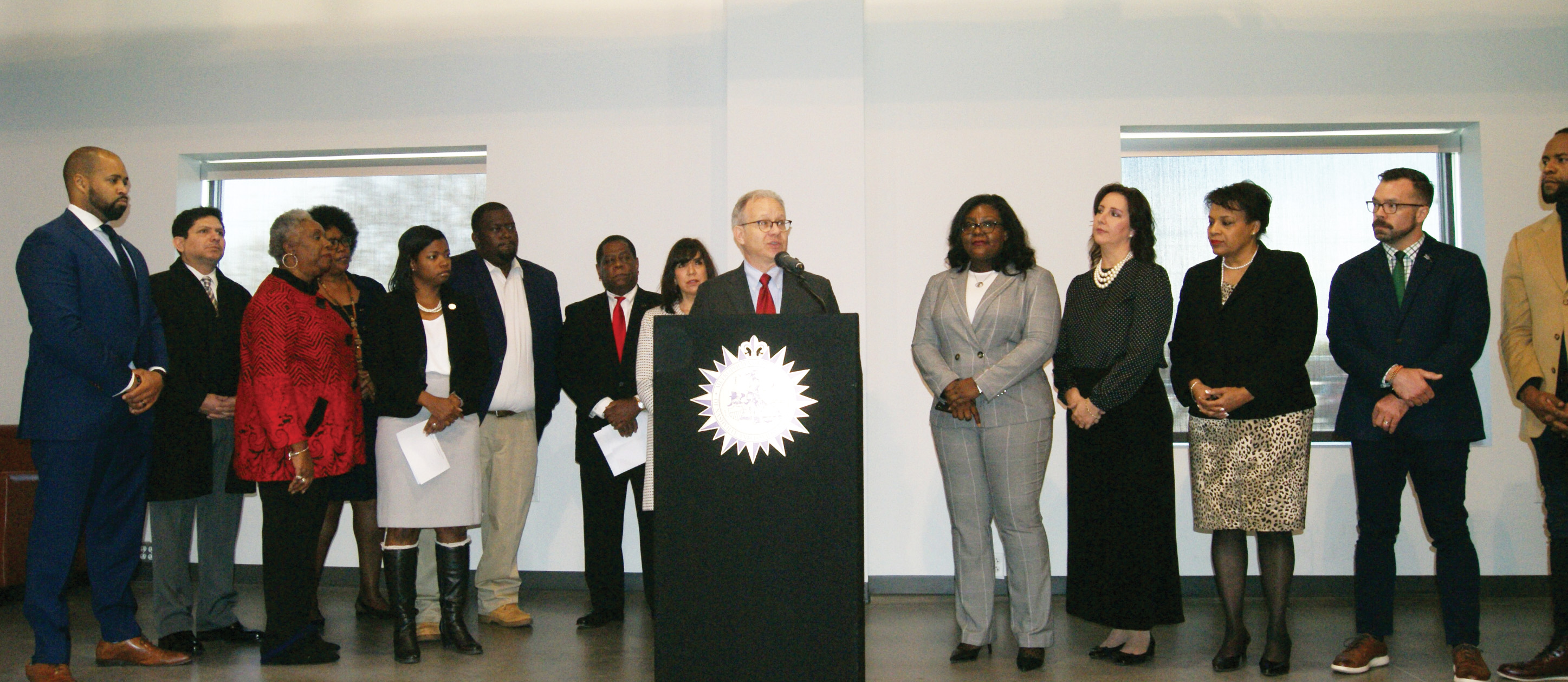
Mayor David Briley held a press conference Tuesday to formally announce a number of major policy changes that address race and gender disparities in how Metro contracts have been awarded to date, including recently filed legislation sponsored by Councilmembers Tanaka Vercher, Sharon Hurt and Scott Davis.
He was joined at the podium by African-American and female business owners, members of the Mayor’s Minority Business Advisory Council and leaders of the city’s black, Hispanic and LGBT chambers of commerce, as well as representatives from the Nashville Area Chamber of Commerce.

The proposed policy changes stem from a 2017 Metro-commissioned Disparity Study conducted by consultants Griffin and Strong. The study’s findings were presented to Metro Council on Sept. 17 and identified a lack of meaningful Minority and Women-Owned Business Enterprise (MWBE) inclusion efforts. Griffin and Strong went on to propose remedial measures for the core aspects of the Equal Business Opportunity ordinance now before the Council.
“Without exception, all potential contractors deserve equal access to Metro projects, regardless of race or gender,” said Mayor Briley. “Unfortunately, this study – the first since 2005 – found that the playing field has not been equitable over time. These measures will seek to change that. For our city to continue to thrive, everyone needs to be at the table.”
The recommendations set forth require implementation actions that fall into four broad categories: legislative action, procurement regulation changes, operational modifications, and the establishment of partnerships/collaborations with external entities.
Griffin and Strong made 10 such recommendations. Notably, these changes include but are not limited to:
· Adding race- and gender-conscious inclusion tools in place of the existing race- and gender-neutral tools in Metro’s Procurement Non-discrimination Program. To reflect this change and others, the program will be renamed the Equal Business Opportunity Program (EBO).
· Adding annual goals – express race and gender targets for the EBO – which are based on the availability statistics identified in the Disparity Study.
· Establishing a Small Business Reserve Program. Through procurement regulation changes, Nashville will implement a race- and gender-neutral program that establishes a contract threshold, under which certain contracts become eligible for designation to only be bid on by small business in accordance with SBA guidelines. The program will also provide more time for prime contractors and subcontractors to plan for and prepare timely bids. This is to increase the ability for firms to form joint ventures or teaming arrangements and to obtain any needed support services.
· Metro is developing an enhanced communications plan for how it will better assist the W/MBE Business community in understanding its programs, implementations and how to prepare for future procurement opportunities.
“Today is a long time coming for many of us,” said Councilwoman Vercher. “Historically, minority and woman-owned businesses have simply not been given a fair shake when it comes to bidding on and earning Metro contracts. These measures seek to make real change. I want to thank my legislation co-sponsors, Mayor Briley and his team, and the many others who worked so hard to get us to this point.”
According to the Nashville Black Chamber of Commerce, the new measures are a step in the right direction.
“We are elated to see Mayor David Briley make this positive move on behalf of women, and minority-owned businesses in the Nashville area,” said Nashville Black Chamber of Commerce President Carolyn Waller. “Our membership is filled with scores of capable, qualified, and willing businesses that have traditionally been shut out of award processes. The measures announced today let our membership know that the Office of the Mayor is in support of the viability and growth of small, women, and minority owned businesses.”