
Footage from Tyre Nichols’ fatal traffic stop found that police officers issued a barrage of confusing, conflicting and sometimes impossible-to-obey commands.
If Nichols did not comply, or even if he did, the police would respond with increasing force.
According to the footage analyzed by the New York Times, police officers shouted a total of at least 71 orders in the roughly 13 minutes before they radioed in that Nichols was in custody.
The orders were given in two separate places: one near Nichols’ vehicle, and another where he had run to avoid being beaten severely.
The video revealed that often the officers shouted conflicting orders, making it difficult for Nichols to understand and obey. Nichols was ordered by officers to display his hand, even as officers held the young man’s hands. At one point, they shouted for him to get down on the ground while he was already on the ground.
And when they had his body under their control, the officers still made him change positions.

The experts agree that the actions of the Memphis police officers were a blatant illustration of a widespread problem in policing, in which officers physically punish civilians for perceived disrespect or disobedience, a phenomenon known as “contempt of cop,” according to the Times.
Professor of criminology and criminal justice at the University of South Carolina Geoffrey Alpert said: “It was far more rampant in the ‘80s when I started doing police work than in the ‘90s or 2000s.”
Before body cameras, police officers were becoming more professional and less likely to take things personally, as appeared to have happened with Nichols, Alpert said.
Because of the potential for escalation and confusion during police encounters, modern police training typically calls for a single officer to be present at the scene to issue clear and specific commands.
It also necessitates that police officers respond professionally and proportionally to any perceived act of defiance.
The review by the Times, however, shows that the Memphis officers consistently did the opposite.
There is no evidence in the footage that the present officers did anything to prevent the excessive use of force. Actually, it seems to prove the opposite.
After Nichols attempted to flee the scene, an officer can be heard on camera saying: “I hope they stomp his ass.”
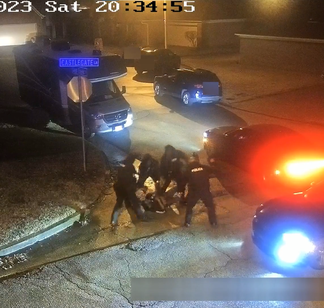
The Times noted four “crucial instances” in which police officers reprimanded Nichols for disobeying incorrect orders.
An officer is seen pulling up to the intersection where Nichols’ car was trapped between two unmarked police cars at the start of the footage.
The cop sprang out of the car, gun drawn, to join two others who are racing toward Nichols.
When one of the officers pulled Nichols out of the car, the other two immediately began shouting: “On the ground!”
These are the initial instructions in a series of contradictory directives that threw Nichols off. Nichols noted that the police officers had ordered him to sit on the ground.
However, several officers are heard yelling the same order with growing anger and threats of violence.
One shouted: “Get down on the ground! I am going to tase your ass.”
It appears that the officers’ tension rises when Nichols repositioned himself, yet still assured the officers that he’s no threat.
“You guys are really doing a lot right now,” Nichols said. “I’m just trying to go home. I am on the ground!” as officers pinned his arms down, pressed a Taser against his leg, and barked increasingly threatening words at him.
Now one of the officers gave more detailed instructions: ‘On your stomach.’
Nichols was hit in the face with pepper spray three seconds later by one of the officers.
Nichols was then surrounded by officers who demanded to see his hands.
However, one of them had a hold on his left arm, while another cop had a hold on his right. The police still hadn’t made it clear how they wanted Nichols to behave.
A third officer rushed up with pepper spray.
then he warned: “You’re about to get sprayed good.”
The other officers began punching Nichols in the face.
Nichols reacted by pulling his hands back to cover his face. As the punching got more intense, the pepper spray was released.
Nichols again tried to reassure the officers that he was attempting to cooperate, all the while he attempted to wipe the pepper spray from his eyes.
“Okay,” Nichols pleaded. “All right. All right.”
While one of the officers had a firm grip on Nichols, a second officer arrived and made the same demand—that he show his hands.
Once again, Nichols appeared confused by the competing instructions.
As he flailed about, the police officers issued even more conflicting commands and applied more physical punishment. Again, he was hit with pepper spray.
After being pepper-sprayed three more times, Nichols lay on his side and rubbed his eyes as two officers stood over him.
An officer then kicked Nichols in the face.
At this point, Nichols was barely conscious or coherent, but the police were treating him as though he was actively resisting them.
“Lay flat, goddamn it,” one officer said.
As he lay there, Nichols groaned and writhed in pain, having repeatedly been tased, kicked in the head, punched, and pepper sprayed.
When another officer yelled “Lay flat!” they behaved as if Nichols was refusing to comply.
One officer lifted Nichols off the ground and forced him to kneel by grabbing his handcuffed arm. Another officer then repeatedly hit him with a baton while saying: “Give us your hands!”
He tried to avoid being hit with the baton as he was surrounded by four police officers.
“Give me your [bleeping] hands!” another officer said.
But Nichols, because of having an officer pin his arms behind his back, another grip his handcuffed wrist, and a third punch him in the face, simply couldn’t comply.
He collapsed to the ground and cried for his mom, but the brutality continued.
In total, six officers have been dismissed and five stand accused of second-degree murder. In a press conference last week, attorneys for two of them said their clients would be entering not guilty pleas.