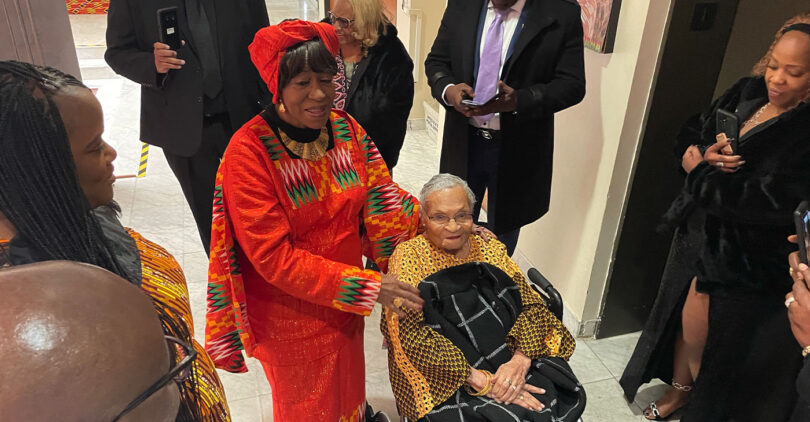
Lessie Benningfield Randle, Viola Fletcher, and Hughes Van Ellis, Sr., the last three known survivors of the 1921 Tulsa Race Massacre, have continued their pursuit of justice.
They have appealed to the Oklahoma Supreme Court, urging a swift reversal of Tulsa County District Judge Caroline Wall’s controversial dismissal of their lawsuit.
At a press conference held at the Oklahoma Supreme Court, the legal team representing the survivor expressed confidence in the likelihood of the Oklahoma Supreme Court overturning Judge Wall’s ruling.
“The facts of this case align with the long-standing property-based limitations of Oklahoma’s public nuisance statute,” said Damario Solomon-Simmons, the lead attorney for the survivors and founder of Justice for Greenwood.
“The District Court’s imposition of a heightened pleading standard on the survivors is unprecedented in Oklahoma’s legal history. Our clients have sufficiently pleaded a public nuisance claim, as defined by the Oklahoma Supreme Court in its landmark decision on Johnson & Johnson in November 2021.”
Randle, 107, Fletcher, 108, and Van Ellis, 102, are the remaining survivors of the horrific massacre, which destroyed the thriving Greenwood District in Tulsa and caused the loss of countless lives and property, has long been overlooked, and the survivors have been denied justice.
Their legal team contends that Judge Wall’s ruling imposes an unjust and burdensome requirement on parties alleging public nuisance claims.
The court mandated that the survivors provide a specific abatement remedy to address the issue before any discovery, trial, or liability determination occurs.
The survivor’s co-counsel, Randall Adams, a Schulte Roth & Zabel LLP litigation partner, said this unusual pleading standard lacks any foundation in Oklahoma’s notice pleading code or prior case law.
Further, he said the District Court allowed the defendants to violate an agreement made in open court, promising not to file new motions to dismiss the survivors’ unjust enrichment claims.
Despite the agreement, the defendants filed a second motion to dismiss the unjust enrichment claims, and to the dismay of the survivors’ legal team, the District Court granted these baseless motions.
“It is imperative to recognize that allowing Judge Wall’s decision to stand will have severe implications for individuals and businesses across Oklahoma seeking to uphold their legal rights,” Solomon-Simmons said.
He claimed that a favorable decision by the Oklahoma Supreme Court would “uphold the values of justice and fairness for all state residents and resolve the complaints of those who had suffered because of the Tulsa Race Massacre.”