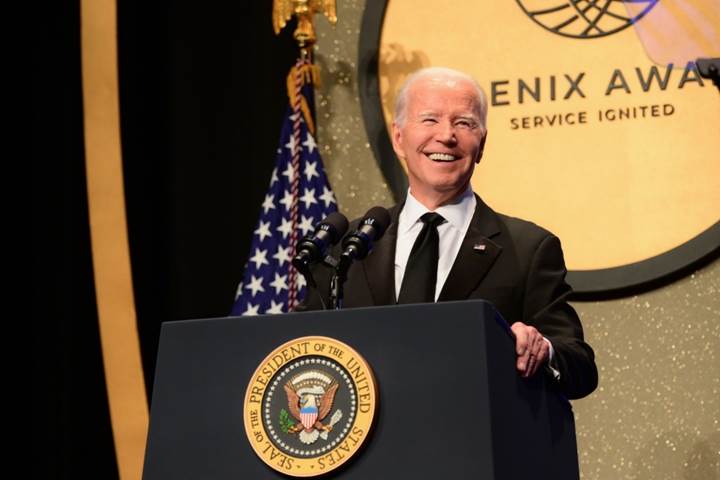
With every move, every statement and every misstep, President Joe Biden makes under the heaviest of microscopes and considering all that’s at stake, his flub at the Phoenix Awards has many again focusing on the president’s age and some on his continued battle to maintain support from African Americans.
Following his blunder during the introduction of superstar and hip-hop icon LL Cool J and the most embarrassing attempt at making amends, the on-again, off-again trust that Black Americans have shown Biden has resurfaced. First, Biden mistakenly referred to him as “LL J Cool J” and then used the term “boy.” Charlamagne tha God, the Breakfast Club host, and a prominent figure in African American media, promptly called out what he viewed as a cultural misstep, awarding the president and his writing staff the “Donkey of the Day.”

Charlamagne said some blame should fall on Biden’s writing team, but the president’s age suggests he knows better than to call a Black man “boy.” After mis-stating LL’s name, Biden attempted a rebound, observing that “By the way that boy, that man’s, got biceps bigger than my thighs.”
It underscored Biden’s up and down relationship with the African American community, which remains notable due to several note worthy accomplishments. Many believe (and history should reflect) that Biden has accomplished more in his presidency for African Americans than any president in U.S. history, including Barack Obama, the only Black commander-in-chief. None of that is lost on Biden, who has often acknowledged that his 2020 election victory was primarily because of the Black vote. Also, to the president’s credit, he has taken substantial steps to honor that trust.
The historic appointments he’s made are central to Biden’s legacy with the African American community. Kamala Harris, the first Black and female Vice President, and Ketanji Brown Jackson, the first Black woman U.S. Supreme Court Justice, stand as trailblazers in the highest echelons of American leadership. Beyond these groundbreaking appointments, Biden’s federal bench selections have diversified the judiciary, ensuring a more representative legal system with more African Americans and Black women.
The administration has also prioritized Black representation within its ranks. Karine Jean-Pierre serves as the first Black White House Press Secretary, while African Americans hold numerous other high-profile positions and are prominent throughout the West Wing. Biden’s appointments have won praise as emblematic of his administration’s broader commitment to inclusivity.
Biden’s impact on the economic front is undeniably significant. Black unemployment rates reached historic lows, while overall employment rates reached levels not seen since November 2000. Initiatives like the Thrifty Food Plan have reduced the Black child poverty rate by over 12%, positively affecting the lives of more than 200,000 children. The president has overseen the fastest creation rate of Black-owned small businesses in over 25 years, fostering entrepreneurship and economic empowerment.
The president’s infrastructure and connectivity investment has also benefited underserved communities. A $4 billion commitment aims to reconnect communities previously cut off from economic opportunities, while an ambitious goal seeks to provide reliable, affordable, high-speed internet access to every American by 2030.
However, as his most recent LL Cool J gaffe demonstrates, Biden’s relationship with the African American community has its share of problems. His past comments, including the controversial assertion in 2020 that “if you don’t vote for me, you’re not Black,” stirred anger within the community, as many overlooked the racism that permeated the country during the previous administration and how former President Donald Trump denigrated African Americans, especially Black women.
Remaining among the biggest detractors is Biden’s sponsorship of the 1994 Violent Crime Control and Law Enforcement Act, which is often criticized for contributing to an era of tough-on-crime policies that disproportionately affected Black Americans, remains a contentious point of discussion. As the 2024 election draws closer, it remains to be seen how the White House will respond to the multifaceted concerns and aspirations of the African American community and whether administration officials, speech writers, and others can help avoid an LL Cool J level misstep which draws quick and harsh responses from influential individuals like Charlamagne.
“This is a prime example of it doesn’t matter how many Black people you are around, it doesn’t matter how many Black people you have in your administration,” Charlamagne said. “If it’s not authentic to him, then it won’t come off as authentic to anyone.”