The Trump administration has launched a full-scale and racist assault on diversity, equity, and inclusion (DEI) in education, threatening to strip federal funding from schools that offer race-conscious programs, scholarships, and student resources. Inside Higher Ed first reported that the Department of Education’s Office for Civil Rights (OCR) declared these programs illegal late Friday night, giving institutions just 14 days to comply with or face a federal investigation.
In a definitive move to erase decades of civil rights progress, Acting Assistant Secretary for Civil Rights Craig Trainor issued a sweeping ‘Dear Colleague’ letter, wildly expanding the 2023 Supreme Court ruling in Students for Fair Admissions v. Harvard. That decision struck down affirmative action in college admissions, but the Trump administration is weaponizing it to eliminate all race-conscious policies across universities—an attack that directly targets Black and other marginalized students.
“In recent years, American educational institutions have discriminated against students on the basis of race, including White and Asian students,” Trainor said, pushing the right-wing narrative that White students are somehow victims of systemic racism. He went further, calling DEI efforts “pervasive and repugnant race-based preferences,” effectively criminalizing programs that promote equity and access to higher education.
The letter outlines a draconian crackdown on everything from race-conscious hiring and financial aid to student housing, graduation ceremonies, and campus life. Universities that so much as consider race in their policies could face immediate scrutiny and funding cuts. The administration also moved to ban universities from factoring in a student’s racial identity through personal essays or extracurriculars, attempting to close any remaining pathways for schools to acknowledge systemic barriers facing Black, Latino, Indigenous, and other underrepresented students.
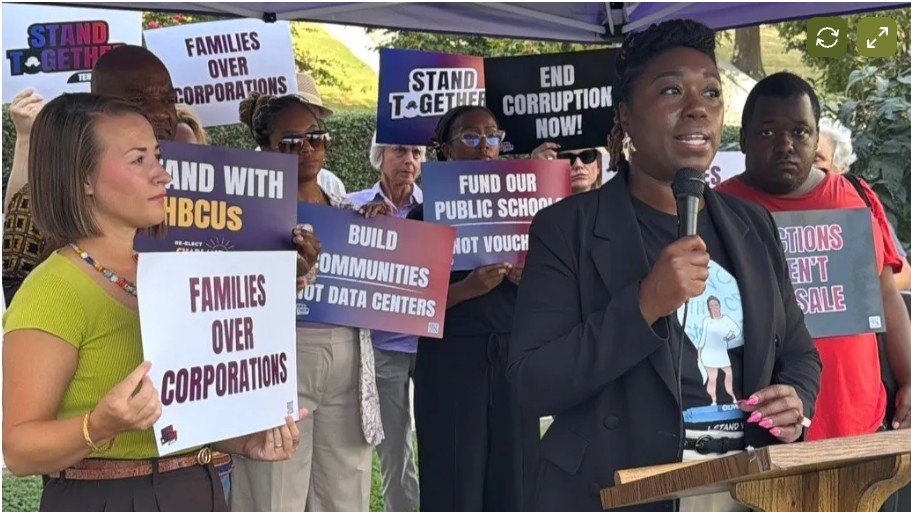
The move was met with immediate outrage from lawmakers, civil rights groups, and education leaders.
“This threat to rip away federal funding from public schools and colleges flies in the face of the law,” said Sen. Patty Murray (D-Wash.). “While it’s anyone’s guess what falls under the Trump administration’s definition of ‘DEI,’ there is simply no authority or basis for Trump to impose such a mandate.”
Brian Rosenberg, former president of Macalester College and a visiting professor at Harvard’s Graduate School of Education, called the directive “truly dystopian.”
“It goes well beyond the Supreme Court ruling on admissions and declares illegal a wide range of common practices,” he told Inside Higher Ed. “In my career, I’ve never seen language of this kind from any government agency in the United States.”
The administration’s letter also targets university programs that acknowledge racial inequities, warning schools that even discussing systemic racism could violate federal law. Trainor outrageously compared modern diversity initiatives (such as cultural centers and graduation ceremonies honoring Black and Latino students) to Jim Crow-era segregation, a false and inflammatory claim meant to justify dismantling programs designed to support students of color.
“A lot of these diversity programs and multicultural centers were founded to support students who had been historically shut out of higher education for centuries,” said Adam Harris, a senior fellow at New America who studies racial discrimination on college campuses. “To penalize institutions for taking those steps to help students is actually very much an echo of the segregation era.”
While the directive is expected to face legal challenges, its immediate impact could devastate diversity efforts in universities nationwide. Harris pointed out that in red states like Texas and Missouri, colleges have already begun dismantling DEI initiatives in response to right-wing crackdowns.
“In Texas, colleges first renamed centers for marginalized students, then shut them down entirely,” he said. “Scholarships were frozen or eliminated. In Missouri, race-conscious scholarships were systematically erased.”
If enforced, Trump’s latest power grab would represent an unprecedented escalation of federal control over universities, dictating not just admissions policies but the full spectrum of student life.
Even Edward Blum, the man behind the Students for Fair Admissions case, admitted the ruling does not apply to scholarships and student programs.
“The SFFA opinion didn’t change the law for those policies,” Blum told Inside Higher Ed before the OCR letter was issued.
Despite that, Trump’s administration has pressed forward with a unilateral purge of DEI initiatives, circumventing Congress and ignoring the courts to force its radical, racist agenda onto the nation’s education system.