
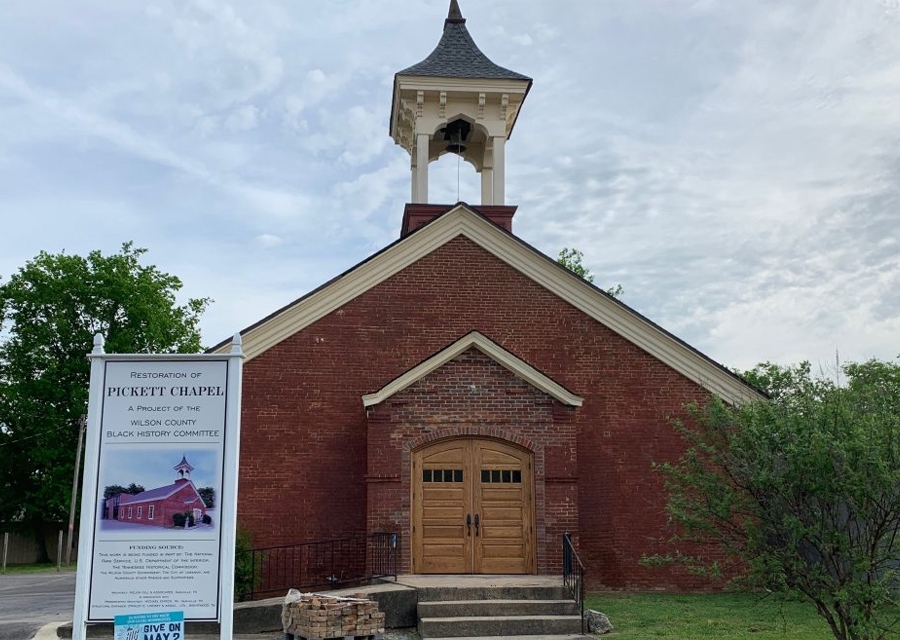
LEBANON, Tenn. — Believed to be the oldest standing historically Black Methodist church building in Tennessee, Pickett Chapel stands as a monument to faith, resilience, and the enduring legacy of those who built it. Constructed in 1827 by enslaved Africans for a white congregation, the Chapel’s bricks hold more than just the structure—they carry the fingerprints of the hands that formed them.
“…the fingerprints of an enslaved person who formed the brick, stacked the brick, left their fingerprints,” said Gratia Strother, United Methodist Archivist. “The people who ultimately bought Pickett Chapel, bought the building, I believe were buying a building they built and their ancestors built so that they could worship on their own. And they very likely, the people who built this building, worshipped inside this building in the balcony as their slaveholders sat on the main floor and were members of the church. Those fingerprints, they tell a story. They tell a story of bondage and they tell a story of freedom.”

The history of Pickett Chapel traces back to the first Methodist congregation in Lebanon, organized in 1812. By 1827, the congregation built a permanent meeting house on Market Street. Though the architect is unknown, the labor was performed by enslaved African Americans, many of whom would worship there in the balcony while white congregants sat below. Known simply as “the Methodist Church,” the congregation outgrew the Chapel in 1856 and relocated, leaving the building behind.
For nearly a decade, little is documented about the Chapel’s use, but in 1866, it became a place of worship for a newly emancipated community. Thirty freedmen purchased the building for $1,500, renaming it Pickett Chapel Methodist Episcopal Church in honor of Calvin and James Pickett, Methodist preachers who helped facilitate the sale. For 107 years, the African American congregation worshipped at Pickett Chapel, until they too outgrew the building and relocated. Today, both congregations—Lebanon First United Methodist Church and Pickett-Rucker United Methodist Church—still exist, with Pickett Chapel geographically situated between them.
Following its use as a church, Pickett Chapel changed hands several times. Local historians Richard and Virginia Lawlor purchased the building, aiming to establish a Wilson County history museum. While that vision never materialized, their efforts led to Pickett Chapel’s listing on the National Register of Historic Places in 1977. Over the years, the Chapel housed community theater troupes before falling into disrepair by the early 2000s.
In 2007, the Wilson County Black History Committee (WCBHC), many of whom are descendants of the original 1866 congregation, acquired the Chapel and initiated extensive restoration efforts. With support from Middle Tennessee State University’s Center for Historic Preservation and the Tennessee Historical Commission, structural stabilization and exterior renovations have been completed. The work included securing the walls, restoring the roof and cupola, and installing new custom-milled doors and windows.
Rev. Erin Beasley emphasized the significance of visiting the site: “We often talk about what happened, but here you can see what happened and you can actually touch what happened. And I think that’s why it’s so important for everyone to make a pilgrimage and take this opportunity to touch the brick themselves.”
With the exterior restored, the WCBHC now turns its focus to the Chapel’s interior. The committee has expanded its Board of Directors and assembled a team to guide the next phase of restoration. More than just a historic site, Pickett Chapel stands as a living testament to the faith and perseverance of those who built it—both in bondage and in freedom.