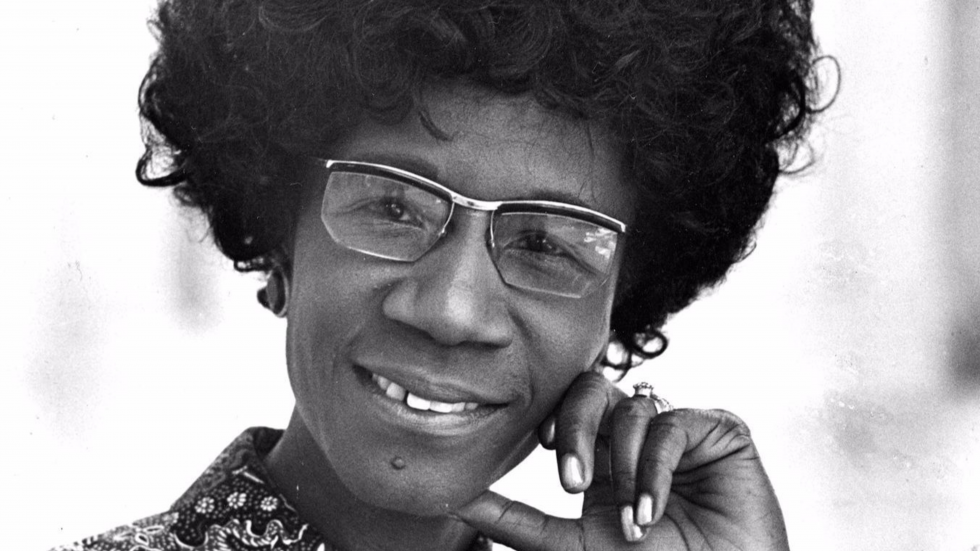
Shirley Anita St. Hill Chisholm was the first African American woman in Congress (1968) and the first woman and African American to seek the nomination for president of the United States from one of the two major political parties (1972). Her motto and title of her autobiography, Unbought and Unbossed, illustrates her outspoken advocacy for women and minorities during her seven terms in the U.S. House of Representatives.
Born in Brooklyn, New York, on November 30, 1924, Chisholm was the oldest of four daughters to immigrant parents: Charles St. Hill, a factory worker from Guyana; and Ruby Seale St. Hill, a seamstress from Barbados. She graduated from Brooklyn Girls’ High in 1942 and from Brooklyn College cum laude in 1946, where she won prizes on the debate team. Although professors encouraged her to consider a political career, she replied that she faced a “double handicap” being both Black and female.

Initially, Chisholm worked as a nursery school teacher. In 1949, she married Conrad Q. Chisholm, a private investigator (they divorced in 1977). She earned a master’s degree from Columbia University in early childhood education in 1951. By 1960, she was a consultant to the New York City Division of Day Care. Ever aware of racial and gender inequality, she joined local chapters of the League of Women Voters, the National Association for the Advancement of Colored People (NAACP), the Urban League, as well as the Democratic Party club in Bedford-Stuyvesant, Brooklyn.
In 1964, Chisholm ran for and became the second African American in the New York State Legislature. After court-ordered redistricting created a new, heavily Democratic, district in her neighborhood, in 1968 Chisholm sought and won a seat in Congress. There, ‘Fighting Shirley’ introduced more than 50 pieces of legislation and championed racial and gender equality, the plight of the poor, and ending the Vietnam War. She was a co-founder of the National Women’s Political Caucus in 1971, and in 1977 became the first Black woman and second woman ever to serve on the powerful House Rules Committee. That year she married Arthur Hardwick, Jr., a New York State legislator.
Discrimination followed Chisholm’s quest for the 1972 Democratic Party presidential nomination. She was blocked from participating in televised primary debates, and after taking legal action, was permitted to make just one speech. Still, students, women, and minorities followed the ‘Chisholm Trail.’ She entered 12 primaries and garnered 152 of the delegates’ votes (10% of the total)—despite an under-financed campaign and contentiousness from the predominantly male Congressional Black Caucus.
Chisholm retired from Congress in 1983. She taught at Mount Holyoke College and co-founded the National Political Congress of Black Women. In 1991 she moved to Florida, and later declined the nomination to become U.S. Ambassador to Jamaica due to ill health. Of her legacy, Chisholm said: “I want to be remembered as a woman who dared to be a catalyst of change.”