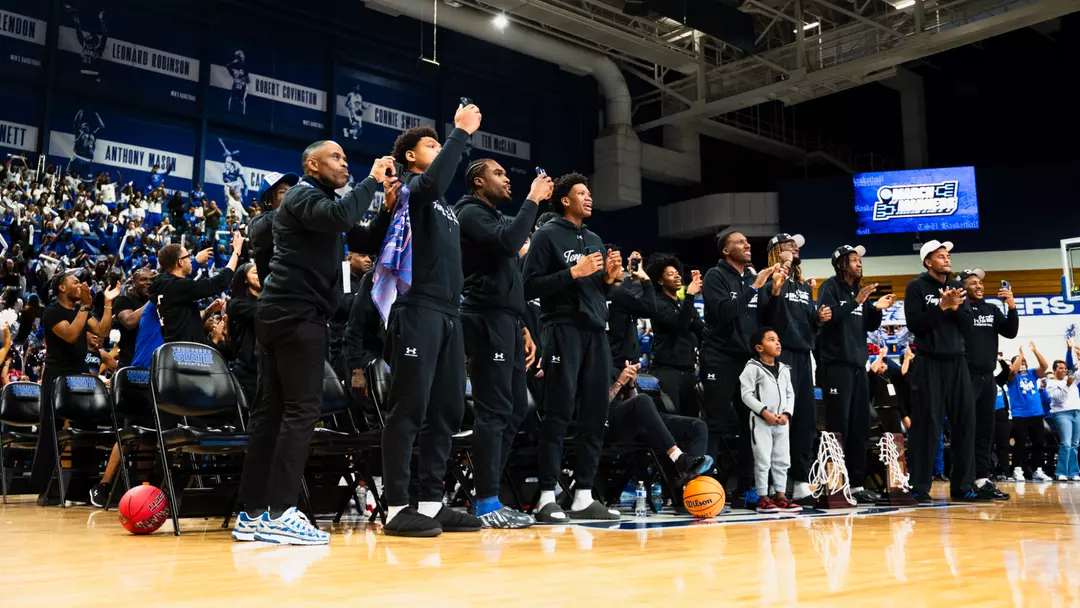
The Tennessee State men’s basketball team has earned a berth in the 2026 NCAA Division I Men’s Basketball Championship and will face No. 15 seed Iowa State on Friday, March 20, at Enterprise Center in St. Louis in the Midwest Region.
The Tigers enter the NCAA Tournament after a historic season under head coach Nolan Smith, who was named Ohio Valley Conference Co-Coach of the Year. Tennessee State secured a share of the OVC regular-season championship and earned the No. 1 seed in the OVC Tournament, marking the program’s first top seed in 30 years.
Tennessee State is led by OVC Player of the Year Aaron Nkrumah, who paced the Tigers throughout the season while ranking among the national leaders in steals and serving as the team’s primary scoring threat. Nkrumah headlines a group of three All-OVC selections for TSU. Travis Harper II earned All-OVC First Team honors, while Dante Harris was named to the All-OVC Second Team and OVC All-Newcomer Team.
The trio combined to average 46.8 points per game during the regular season, helping power Tennessee State to one of its most successful campaigns in decades.
This appearance marks Tennessee State’s first NCAA Tournament berth since the 1993–94 season and the program’s third trip to the NCAA Tournament in the Division I era. The Tigers previously reached the tournament in 1992–93 and 1993–94, earning back-to-back OVC Tournament championships.
In 1992–93, Tennessee State entered the NCAA Tournament as a No. 15 seed and faced No. 2 seed Seton Hall at Orlando Arena in Orlando, Florida, falling 81–59. The following season, the Tigers returned to the tournament as a No. 14 seed, matching up with No. 3 seed Kentucky in a game played in Knoxville, Tennessee, where TSU battled before falling 83–70.
Those teams were led by Carlos Rogers, who was named OVC Player of the Year in both 1992–93 and 1993–94 and remains the only two-time recipient of the honor in program history. Nkrumah joins Rogers as the only Tigers to claim the award.
Tennessee State has produced four All-OVC First, Second and Newcomer Team selections in a single season four times in the Division I era — 1992–93, 2010–11, 2015–16 and 2025–26 — marking the program’s highest single-season total of All-Conference honorees.
Smith’s impact in his first season has also been recognized nationally. He has been named a finalist for the Ben Jobe Award, Joe B. Hall Award and Hugh Durham Award, honors that recognize the nation’s top coaches at historically Black colleges and universities, first-year head coaches and mid-major programs.