

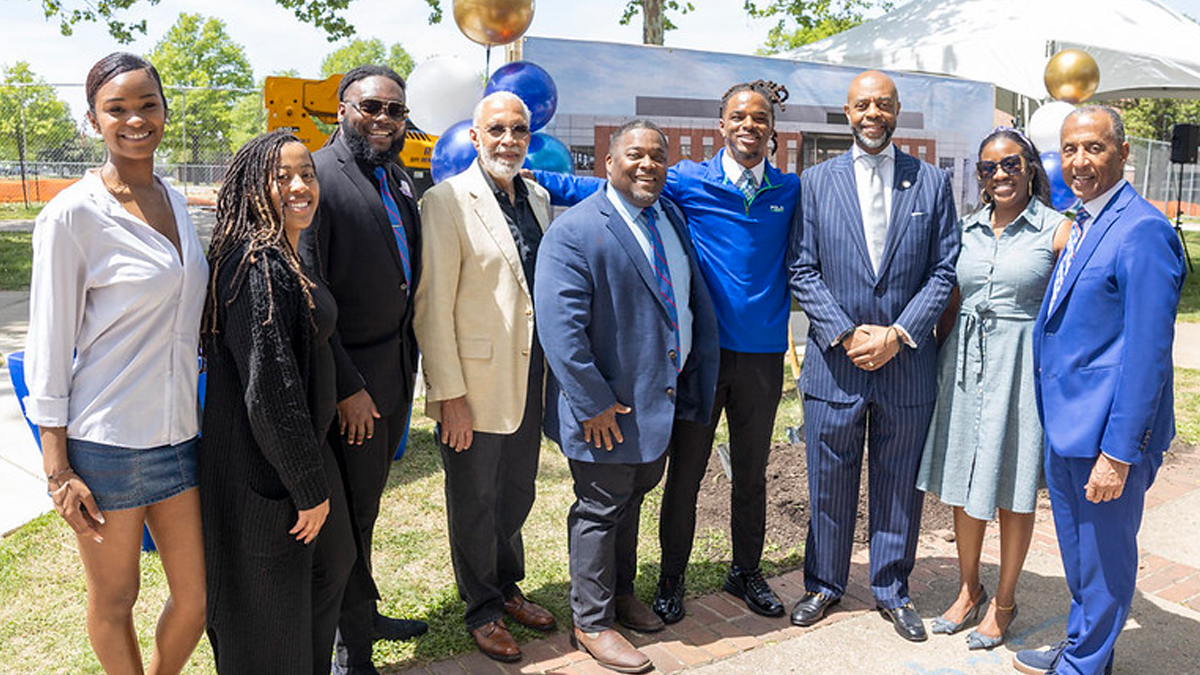
Tennessee State University has taken a major step toward expanding its academic and workforce development footprint with the groundbreaking of a new $60 million engineering building on campus.
University leaders, state officials and community stakeholders gathered for the ceremony, marking the start of construction on a nearly 70,000-square-foot facility designed to enhance hands-on learning and position students for careers in high-demand fields.
The new building, funded by the state of Tennessee, will be located on the site of the former Clay Hall and is expected to open for the 2027–2028 academic year. The project represents the second major campus expansion under TSU President Dwayne Tucker in just over a year, following the groundbreaking of a $90 million agriculture facility in 2025.
“Today represents a transformative moment in the history of Tennessee State University,” Tucker said during the ceremony. “This facility will unify our engineering and applied technology programs into one interdisciplinary hub designed to foster collaboration, creativity and discovery.”
University officials say the new space will provide students with immersive, real-world learning experiences that reflect the industries they are preparing to enter. The facility will feature modern classrooms, teaching and research labs, maker spaces and advanced simulation environments across a range of disciplines, including robotics, drone technology and transportation systems.
Dr. Julie A. Roberts of the Tennessee Higher Education Commission emphasized the broader impact of the project, noting its role in strengthening both student opportunities and the state’s workforce pipeline.
“This state-of-the-art facility will expand opportunities for students, strengthen workforce readiness and support the kind of innovation that will shape Tennessee’s future,” Roberts said.
Students and alumni in attendance described the moment as a sign of progress and investment in TSU’s future. Civil engineering student Mark Gray called the groundbreaking “a true revolution,” while mechanical engineering and computer science major Tarik Williams said the building represents more than just a physical space.
“This will be more than classrooms and labs,” Williams said. “It will be a place where ideas are tested, collaboration thrives and future engineers discover what’s possible.”
Dr. Lin Li, dean of the College of Engineering, said the facility will replace Torrence Hall, which has housed the program for decades, and will serve as a central hub for innovation and research.
“This is not just an investment in a building,” Li said. “It’s an investment in people, in ideas and in the belief that engineering can change the world.”
Designed with collaboration in mind, the facility will include more than 30 teaching and research labs, a central atrium for student engagement and spaces intended to encourage interdisciplinary work. University officials say the design reflects a broader effort to align academic programs with the evolving needs of the workforce.
With construction now underway, TSU leaders say the project signals a continued commitment to expanding access to high-quality education while preparing students to compete in a rapidly changing, technology-driven economy.