


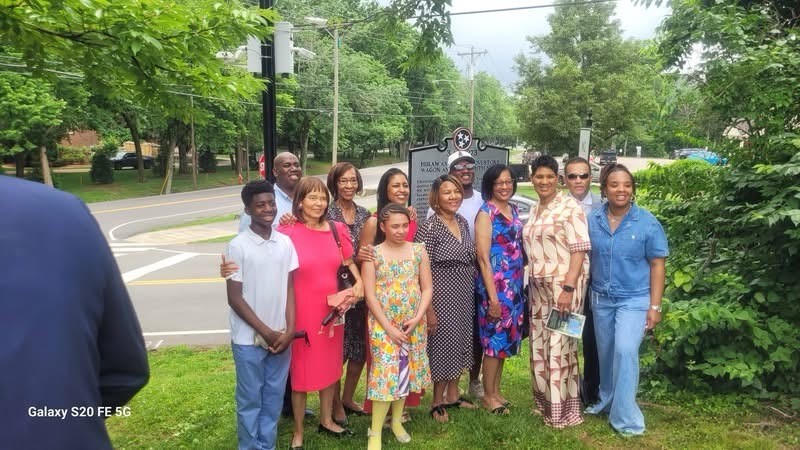
More than 150 years after Hiram and Eveline Overton established a thriving blacksmith shop in rural Davidson County, their descendants gathered May 30 to celebrate the unveiling of a Tennessee historical marker recognizing the couple’s contributions as entrepreneurs, land owners and community builders in the years following emancipation.
Installed near the intersection of Granny White Pike and Otter Creek Road, the marker commemorates the Overtons’ blacksmith shop, which opened by 1869 and served residents in Davidson and Williamson counties during the post-Civil War era.
The ceremony brought together multiple generations of the Overton family, including Jesse Overton II, Jesse Overton III and family historian Dr. Aisha Francis, who have spent years researching and preserving the story of their ancestors. The Tennessee Historical Commission’s Monuments and Markers Committee approved the marker after extensive documentation of the family’s role in Middle Tennessee history.
Born into slavery, Hiram Overton (1835-1911) and Eveline Bradford Overton (1841-1917) lived and worked at Travelers Rest, the historic plantation founded by John Overton in what is now the Crieve Hall area of Nashville. Hiram worked as a blacksmith and farmer, skills that would later become the foundation of the family’s economic independence.
After the Civil War, the couple rented a small farm and established a blacksmith shop along Granny White Pike. As Nashville and surrounding communities rebuilt after the war, Overton’s Wagon and Blacksmith Shop became an important business providing horse shoeing, wagon maintenance, tool repair and other services to farmers and residents throughout the region.
Within just a few years, the Overtons had accumulated enough resources to purchase farmland adjacent to the property they had been renting, an extraordinary achievement for a formerly enslaved family during Reconstruction.
Their impact extended beyond business ownership. Using their financial resources and standing within the community, the Overtons helped establish a school for African American children at a time when educational opportunities for Black families were limited and often met with resistance.
The historical marker notes that the couple became prominent African American farmers and entrepreneurs in what is now Forest Hills. It also recognizes their role in expanding educational opportunities for Black children despite significant opposition.
For descendants such as Dr. Francis, president/CEO of the Benjamin Franklin Cummings Institute of Technology in Boston, the recognition carries special meaning. Francis said her work leading a technical and trade-focused institution reflects a direct connection to the legacy of her ancestors, whose livelihood was built through skilled trades and entrepreneurship.
The marker serves as a reminder that the story of Reconstruction was not only one of survival, but also one of determination, innovation and community building. Through hard work and perseverance, Hiram and Eveline Overton transformed the opportunities afforded by freedom into a lasting legacy that continues to inspire generations more than a century later.