

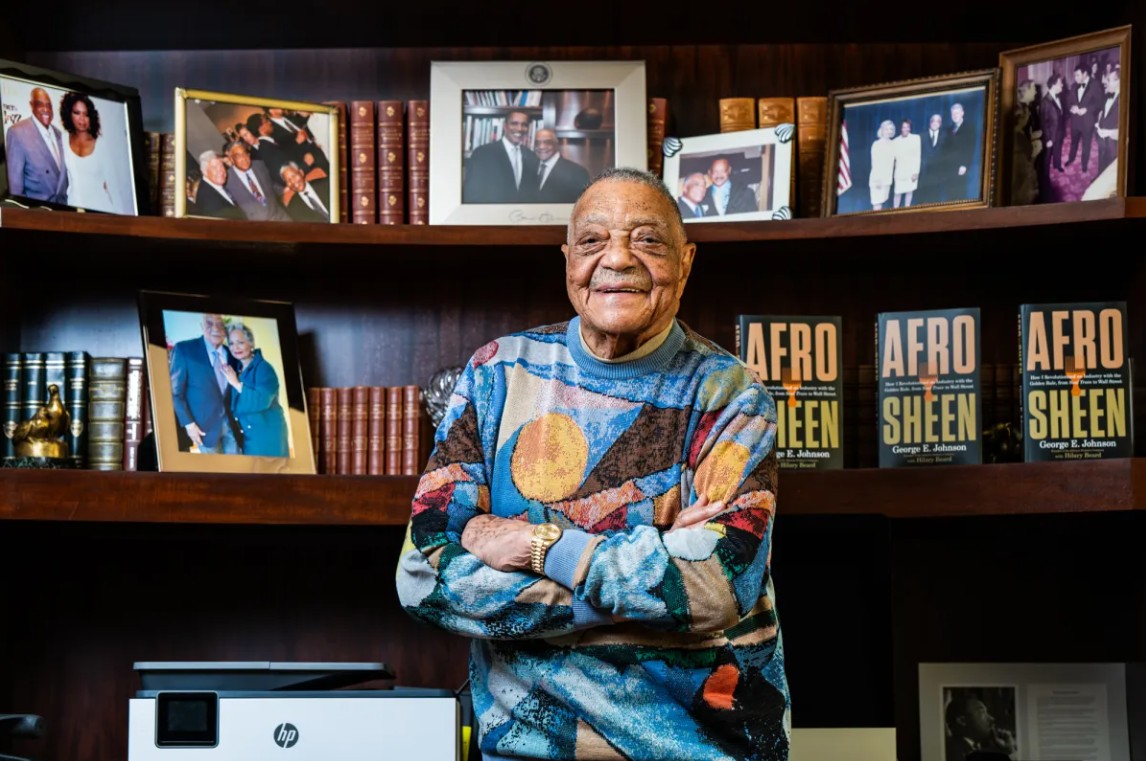
George E. Johnson, Sr., the visionary entrepreneur who transformed the Black hair care industry and built one of the nation’s most successful Black-owned businesses, died Monday, July 6, at his Chicago home. He was 99.
Johnson founded Johnson Products Company in 1954 with just a few hundred dollars and a bold vision to create hair care products specifically designed for African Americans. Over the next several decades, he built the company into an international cosmetics empire whose iconic brands (including Ultra Sheen, Afro Sheen, Ultra Wave, Classy Curl and Curly Perm) became household names in Black communities across America.

His success extended far beyond cosmetics. In 1971, Johnson Products became the first Black-owned company listed on the American Stock Exchange, marking a milestone in American business history and opening doors for future generations of Black entrepreneurs.
Born June 12, 1927, in Richton, Mississippi, Johnson’s life embodied the American dream. He was born in a three-room sharecropper’s shack before moving to Chicago with his mother at the age of two after his parents separated. From an early age, he worked a variety of jobs (including shining shoes, delivering newspapers, waiting tables and collecting milk bottles) to help support his family.
Although he never completed high school, Johnson’s determination and work ethic led him to a position with Fuller Products, a Black-owned cosmetics company founded by entrepreneur Samuel B. Fuller. Beginning in sales before moving into the company’s laboratory, Johnson gained invaluable experience in product development and the cosmetics business.
When Fuller declined to pursue a new hair straightening formula proposed by a Chicago barber, Johnson recognized an opportunity. Working with a chemist during evenings and off-hours, he helped develop a gentler hair relaxer that would become the company’s first product, Ultra Wave.
Securing financing proved to be one of his earliest challenges. After initially being denied a small business loan, Johnson eventually obtained the funding that allowed him and his wife, Joan, to launch Johnson Products. The company introduced Ultra Wave for men before revolutionizing the market for women with Ultra Sheen in 1957, an at-home hair straightener that became immensely popular.
As hairstyles evolved during the late 1960s and 1970s, Johnson Products introduced Afro Sheen, a product line that celebrated the natural Afro hairstyle during the height of the Black Pride movement. The company not only manufactured products but also invested heavily in training cosmetologists and beauty professionals throughout the country.
Johnson was equally innovative in marketing. Recognizing the importance of reaching Black audiences through culturally relevant platforms, Johnson Products became the exclusive sponsor of the nationally syndicated television program Soul Train. The partnership helped elevate both the company and the groundbreaking music and dance show into cultural institutions.
His business accomplishments extended into banking as well. In 1964, Johnson founded Independence Bank, further expanding opportunities for economic empowerment within the African American community. The same year Johnson Products went public, he also became the first African American elected to the board of directors of Commonwealth Edison.
Johnson’s corporate headquarters on Chicago’s South Side became a symbol of Black excellence. The facility welcomed visitors from around the world and hosted notable figures including Rev. Dr. Martin Luther King, Jr. and boxing champion Muhammad Ali. Public tours showcased Black professionals working as scientists, executives, managers and salespeople, reinforcing Johnson’s belief that representation mattered.
By the mid-1970s, Johnson Products had grown into a multimillion-dollar enterprise with annual sales exceeding $30 million. His achievements demonstrated that Black-owned companies could compete successfully on the national stage.
Beyond business, Johnson was known for his philanthropy, donating millions of dollars to educational initiatives that helped minority students attend college. He frequently emphasized the importance of creating opportunities for others, believing success should be shared with future generations.
Johnson stepped down as chairman and chief executive officer in 1988 as part of a divorce settlement with his wife, Joan, who assumed a controlling interest in the company. The couple, who had married in 1950 after meeting as students at Wendell Phillips High School, later remarried in 1995. Joan Johnson died in 2019. In 2022, Johnson married Madeline Murphy Rabb.
Johnson Products was sold in 1993, and ownership changed several times over the years. Despite those changes, Johnson’s influence on the beauty industry and Black entrepreneurship remained unmistakable. The company helped reshape how Black consumers were served and proved that products created specifically for African Americans could achieve national and international success.
Johnson chronicled his remarkable journey in his 2025 memoir, Afro Sheen: How I Revolutionized an Industry with the Golden Rule, from Soul Train to Wall Street, reflecting on a life that carried him from poverty in Mississippi to the pinnacle of American business.
He is survived by his wife, Madeline Murphy Rabb; his children, Eric George Johnson, Joan Marie Johnson, John Edward Johnson and George Ellis ‘Petey’ Johnson, Jr.; grandchildren; and other family members.
George E. Johnson, Sr.’s legacy reaches far beyond the products that lined store shelves. He leaves behind a blueprint for Black entrepreneurship, economic empowerment and corporate leadership that continues to inspire business owners and innovators across the country.