by Heather Hahn
At a time when Americans are deeply divided, United Methodists gathered to explore ways to heal the nation’s fractures and reclaim the church’s role as a force for peace.
The Peace Conference, held April 4–6 at the Lake Junaluska Conference and Retreat Center in North Carolina, brought together about 200 clergy, laity, and college students. The event, revived after a five-year hiatus, focused on peacemaking in an era marked by political division, racism, and church schisms.
The conference challenged attendees to actively dismantle the social and spiritual barriers that fuel mistrust and division. “For Christ is our peace, and he has broken down the dividing walls, which is the hostility between us,” Ephesians 2:14.
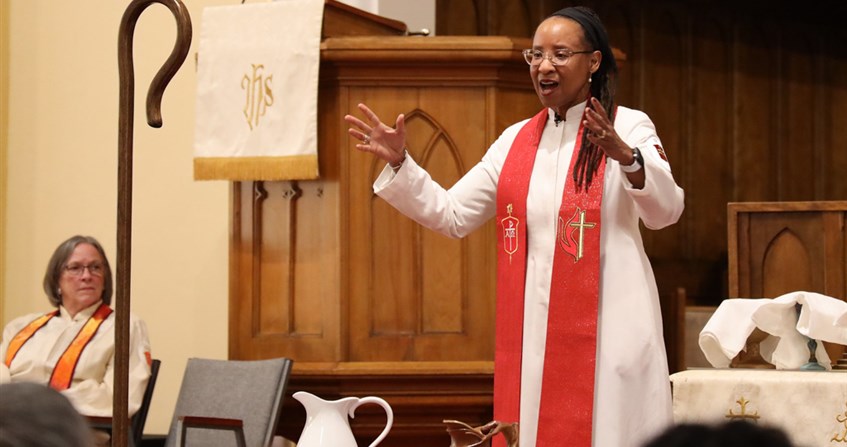
Bishop Kennetha Bigham-Tsai, who leads the Iowa and Illinois Great Rivers conferences, delivered a powerful opening sermon. She warned that Americans are in “deep peril” because of metaphorical walls being built around race, gender, sexual orientation, and class.
“These walls are being built through restrictions on health care, through layoffs and attacks on funding, through violent and dehumanizing speech,” she said. “But Christ shows another way, one of healing and solidarity with the marginalized.”
The bishop emphasized that peacemaking does not mean silence or complacency. “I am not the pastor of anyone’s racism. I am not the pastor of anyone’s misogyny. I will not pastor anyone’s homophobia or hatred and disrespect toward immigrants,” she said. Instead, she called on Christians to recognize the divine in others and love across barriers of difference.
The revival of the Peace Conference comes at a critical time for the United Methodist Church, especially in the Southeastern Jurisdiction, which has experienced the brunt of denominational splits. From 2019 to 2023, over 7,600 U.S. congregations disaffiliated from the denomination (half of them from the Southeastern region) largely due to disputes over LGBTQ inclusion.
Rev. Beth Crissman, a district superintendent and peace ministries director in the Western North Carolina Conference, helped relaunch the conference in response to both church and national divisions. “Our goal is to reclaim our call as ambassadors for peace, particularly in our highly polarized political environment,” she said.
The revamped conference addressed broader social issues beyond its original focus on global war and interfaith peace building. Attendee Rev. Jonathan Marlowe noted the new emphasis on racism, saying: “This Peace Conference is more holistic.”
Other speakers brought deep insights from their work in global conflict resolution, U.S. democracy, and historical reconciliation. Kristen Wall, a former advisor to the U.S. Institute of Peace, described how polarization weakens democratic systems by making cooperation nearly impossible and enabling leaders to exploit division for political gain.
“If we can’t communicate or coordinate to solve shared problems, then democracy itself starts to erode,” she said.
Derrick Scott III, a Florida-based campus minister and historian, emphasized the importance of confronting painful history, including America’s legacy of slavery and genocide. Referencing Luke 4, he warned against “cheap solidarity” that ignores historical trauma and avoids discomfort.
“We cannot have unity without reckoning with the historic hostility that still affects people today,” he said.
Other speakers cautioned against weaponizing faith to suppress marginalized voices. Rev. Ismael Ruiz-Millán urged attendees to avoid using religious rituals, like prayer, to silence expressions of pain from people of color. “We need to be careful of using means of grace as a weapon to silence the lament of the oppressed,” he said.
The conference also tackled the dangers of Christian nationalism. Rev. Gary Mason, a Methodist minister known for his role in Northern Ireland’s peace process, shared how religion can be misused to justify violence. He urged United Methodists to engage with even the most radicalized individuals, not in support of their views but to build relationships and foster change.
“Engagement is not endorsement,” he said. “But relationships are key to changing hearts and minds.”
Despite the challenges, Mason urged attendees not to give in to despair. “The oxygen of hope is one of the most essential mechanisms the Christian church can actually bring,” he said.
As the conference concluded, its message was clear: building peace requires courage, honesty, and active love—not just within the church, but in the heart of a divided nation.