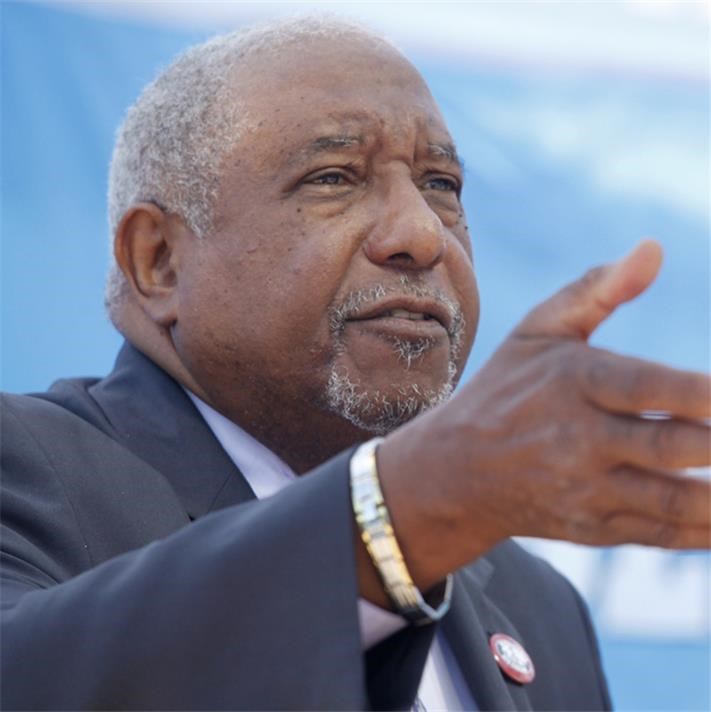
Dr. Bernard LaFayette, Jr., a key strategist in the Civil Rights Movement who helped lay the groundwork for the historic Selma voting rights campaign that led to the Voting Rights Act of 1965, died March 5, 2026, after suffering a heart attack. He was 85.
Though often working behind the scenes, LaFayette played a central role in many of the movement’s most significant moments. As a Freedom Rider, co-founder of the Student Nonviolent Coordinating Committee (SNCC), and close associate of Dr. Martin Luther King, Jr., he devoted his life to advancing nonviolence, civil rights and social justice.

LaFayette was born July 29, 1940, in Tampa, Florida, the oldest of eight children. A childhood experience helped shape his lifelong commitment to confronting racial injustice.
At age seven, while riding a trolley with his grandmother, he watched her fall when the driver pulled away before she could board. Like many Black passengers during segregation, she had been required to pay at the front of the trolley before walking to the back entrance. The driver did not wait for her.
Years later, LaFayette wrote that the moment felt as if “a sword cut me in half,” inspiring a promise to one day challenge the injustice he had witnessed. By age 12, he had joined the NAACP.
His path soon led him to American Baptist Theological Seminary in Nashville (now American Baptist College) where he studied theology and met fellow student John Lewis, who would later become a congressman and civil rights icon. At the school, LaFayette joined the Nashville Student Movement, where he trained in nonviolent direct action alongside Lewis and other future leaders including Diane Nash and James Bevel.
Together, they helped organize the Nashville lunch counter sit-ins, which ultimately led Nashville to become the first major Southern city to desegregate its downtown lunch counters.
In 1961, LaFayette joined the Freedom Rides, which challenged segregation on interstate buses throughout the South. When the group arrived in Montgomery, Alabama, they were attacked by members of the Ku Klux Klan. LaFayette was later arrested and spent 40 days imprisoned at Parchman Penitentiary in Mississippi.
Despite the violence and arrests, he continued his work.
As a founding member of SNCC, LaFayette was later assigned to lead voter registration efforts in Alabama. In 1963, he moved to Selma with his wife at the time, Colia Liddell, to organize and train local residents in nonviolent activism.
Those early efforts helped lay the groundwork for the Selma voting rights campaign that would later draw national attention and lead to the passage of the Voting Rights Act of 1965.
During that time, LaFayette himself narrowly escaped death. On the night of June 12, 1963 (the same evening civil rights leader Medgar Evers was assassinated in Mississippi), LaFayette was attacked outside his Selma home and beaten. When a neighbor emerged with a rifle to defend him, LaFayette urged him not to retaliate with violence.
He later wrote that in that moment he felt “an extraordinary sense of internal strength instead of fear.”
LaFayette went on to help train activists in the Chicago Freedom Movement, where he worked to build tenant unions and advocate for housing protections that would influence future housing laws.
In 1968, he became the national coordinator of the Poor People’s Campaign, the economic justice initiative launched by Dr. King shortly before his assassination.
LaFayette was at the Lorraine Motel in Memphis the morning King was killed. According to LaFayette, King’s final words to him emphasized the need to make nonviolence a permanent global institution.
That charge became LaFayette’s life mission.
After the civil rights era, he continued his education, eventually earning both a master’s degree and doctorate from Harvard University. He later served as president of American Baptist College in Nashville from 1992 to 1999, returning to the same campus where his activism began.
He also directed the Center for Nonviolence and Peace Studies at the University of Rhode Island from 1999 to 2009 and later served as Distinguished Senior Scholar in Residence at Emory University’s Candler School of Theology.
Civil rights leader and former Atlanta mayor Andrew Young, who worked closely with LaFayette for decades, once described him as “a global prophet of nonviolence.”
In 2013, LaFayette published his memoir, In Peace and Freedom: My Journey in Selma, co-written with Kathryn Lee Johnson. The book received the 2015 Lillian Smith Book Award and reflected on the philosophy that guided his life.
“The value of life lies not in longevity,” LaFayette wrote, “but in what people do to give it significance.”
American Baptist College, where LaFayette studied and later served as president, issued a statement mourning his passing and honoring his legacy.
“Dr. Bernard LaFayette, Jr. was a towering giant of justice,” the college said. “His life embodied the mission of educating, serving and pursuing justice in the world. The flame he lit on this Hill will never go out.”
Throughout his life, LaFayette remained committed to teaching future generations the power of nonviolent change.
Those who knew him say his quiet leadership helped shape some of the most important victories of the Civil Rights Movement—and inspired countless others to continue the work.