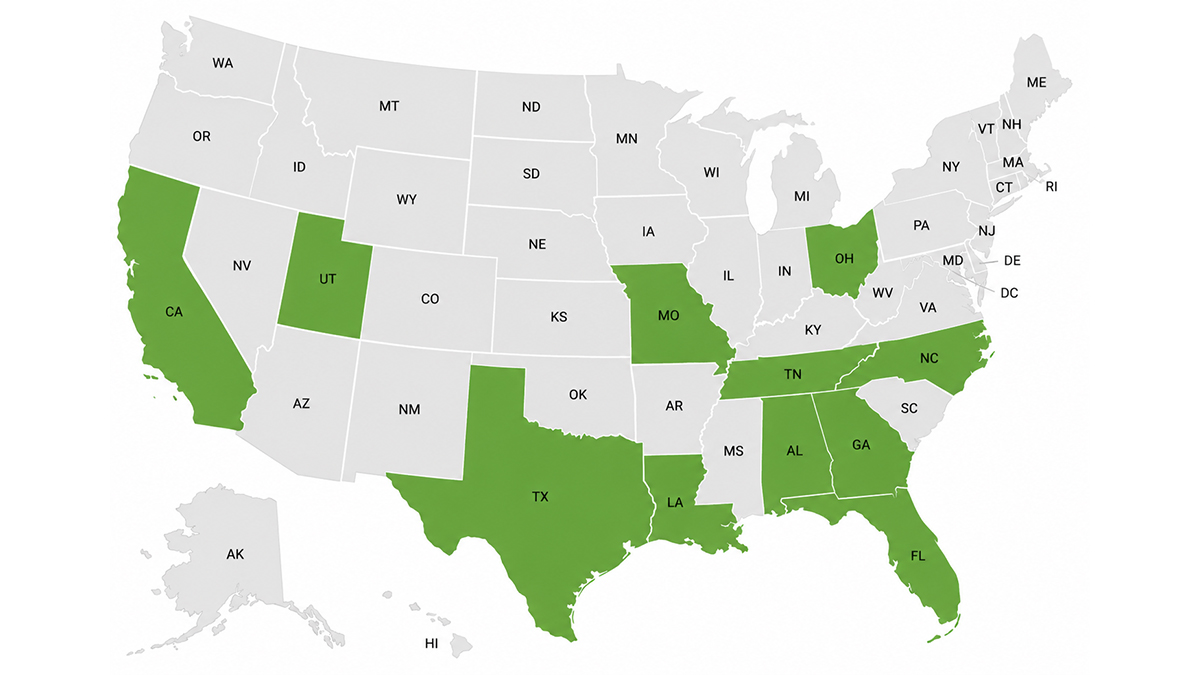
With control of the U.S. House of Representatives expected to be fiercely contested in the 2026 midterm elections, a growing number of states have redrawn congressional district boundaries, potentially altering the political balance of power in Washington. As of May 2026, nine states have adopted new congressional maps, while litigation in additional states could further reshape the electoral map before voters head to the polls.
The most recent change came in Louisiana, where Gov. Jeff Landry signed a new congressional map into law on May 29. The map redraws one of the state’s two majority-Black congressional districts and could shift Louisiana’s delegation from a 4-2 Republican-Democrat split to a 5-1 Republican advantage. The measure passed both chambers of the Louisiana Legislature largely along party lines.

Critics of the Louisiana map argue that the Legislature’s actions go beyond complying with recent court rulings and instead weaken minority voting power. In a statement released following the map’s passage, opponents of the plan said:
“The congressional map passed by the Louisiana Legislature is a flagrant effort to consolidate political power in the hands of the White majority and deny communities across the state, especially Black Louisianians, an equal opportunity to participate in the political process. Nothing in the Supreme Court’s ruling in Louisiana v. Callais compelled the Legislature to forgo procedural norms, forsake community input, devalue traditional redistricting criteria, or push forward a map that aims to roll back hard-won strides towards fair representation. But that is exactly what the Legislature did. Gov. Landry should immediately veto the map.”
Supporters of the map contend that the changes are necessary to comply with recent court decisions and to establish districts that satisfy constitutional requirements. The debate highlights the ongoing national tension between competing interpretations of voting rights protections, racial representation and redistricting authority.
Louisiana joins California, Florida, Missouri, North Carolina, Ohio, Tennessee, Texas and Utah as states that have enacted new congressional maps since the 2024 election cycle. According to available projections, the combined effect of these redistricting efforts could result in Republicans gaining a net nine congressional seats nationwide. If Alabama’s pending litigation ultimately allows a previously blocked map to take effect, Republicans could gain an additional seat, bringing the potential total to 10.
The significance of those gains is amplified by the current makeup of the U.S. House. As of May 2026, Republicans hold a narrow 217-212 majority, with five vacancies. Even relatively small shifts in district boundaries could influence which party controls the chamber after the midterm elections.
Alabama remains one of the most closely watched states. A federal court recently blocked the state’s 2023 congressional map, ruling that it constituted an unconstitutional racial gerrymander. That map had been drawn after the U.S. Supreme Court previously ruled against an earlier version that contained only one majority-Black district. The case is now moving through the appeals process, and its outcome could determine which map is used in 2026. If the Legislature’s map is ultimately reinstated, Republicans could expand their congressional delegation from 5-2 to 6-1.
Georgia also remains subject to ongoing litigation that could result in changes before the election.
Meanwhile, efforts to redraw congressional boundaries in South Carolina appear to have stalled. On May 26, the South Carolina Senate voted against ending debate on a proposed map and subsequently adjourned a special session called by Gov. Henry McMaster. The proposal would have made the state’s lone Democratic-held congressional district more favorable to Republicans. That district has been represented by Congressman James Clyburn since 1993. As a result of the Senate’s action, no new congressional map is expected to be in place before the 2026 elections.
Redistricting typically occurs every 10 years following the U.S. Census to ensure districts contain roughly equal populations and comply with federal voting rights laws. However, the current cycle is unusual because many states are revisiting district boundaries in the middle of the decade through legislative action or court intervention. Before 2025, only two states had voluntarily undertaken mid-decade congressional redistricting since 1970.
Political observers from both parties are closely monitoring the developments. With congressional control potentially hanging on a handful of seats, the outcome of redistricting battles in states such as Louisiana, Alabama, Georgia and Texas could have national consequences extending well beyond state borders. As lawmakers, courts and advocacy groups continue to clash over representation and voting rights, the fight over district lines is likely to remain one of the most consequential political stories leading into the 2026 midterm elections.