

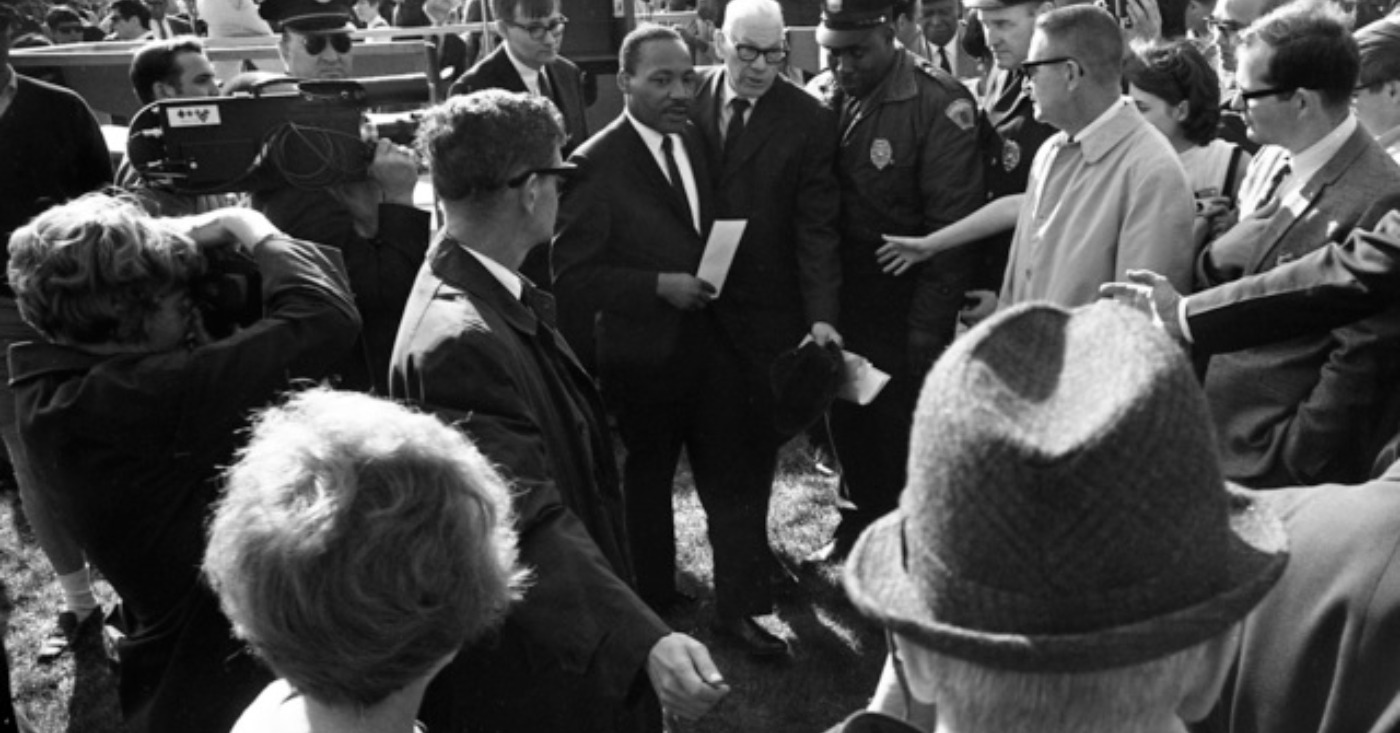
(photo courtesy of the Minnesota Historical Society).
Gathering at the Rivers: Martin Luther King, Jr. and Civil Rights in Minnesota, by researcher Jeff Olson, will chronicle King’s Jan. 21, 1957, sermon at Gloria Dei Lutheran Church in St. Paul, his first Minnesota visit, just after the Montgomery Bus Boycott. Rev. Dr. Floyd Massey, Jr. of Pilgrim Baptist Church helped bring King to the state and hosted a reception at his Rondo home. The book’s ‘Twenty Treasures’ chapter profiles figures including Roy Wilkins, Dred Scott, Cap Wigington, Nellie Francis, Nellie Stone Johnson and MSR founder Cecil Newman. Afton Press plans a late 2027 or early 2028 release and is seeking donor support for the $100,000 project.
Nearly 70 years after Dr. Martin Luther King, Jr. stepped into the pulpit at Gloria Dei Lutheran Church in St. Paul, publisher Afton Press aims to tell the story of that night and of the people and places that shaped it.

Gathering at the Rivers is in the early stages of publishing. Former St. Paul Mayor Melvin Carter III, the city’s first Black mayor, is writing the foreword.
The book frames the visit as a turning point. King, who had turned 28 just days earlier, was fresh off the Montgomery Bus Boycott and stepping into a national leadership role. In St. Paul, Olson writes, King found himself in the hometown roots of two of his biggest supporters: NAACP leader Roy Wilkins, who grew up in St. Paul’s Frogtown neighborhood, and Ralph Helstein, president of the United Packinghouse Workers of America. Both organizations gave major support to the boycott.
The visit itself came together through local clergy. According to the book, Rev. Dr. Floyd Massey, Jr., pastor of Pilgrim Baptist Church and program chair of the Minnesota Pastors Conference, played a central role in bringing King to the state. After King’s evening sermon at Gloria Dei, Massey and his wife, Ethel, hosted a reception for him at their home in the Rondo neighborhood.
At the heart of the book is a chapter Olson calls the ‘Twenty Treasures of Civil Rights in Saint Paul.’ It profiles of the people, places and institutions that made the city fertile ground for King’s message. The list stretches from Dred Scott, who married Harriet Robinson at Fort Snelling in 1837 and later took his fight for freedom to the U.S. Supreme Court, to Pilgrim Baptist Church, founded in 1863 as Minnesota’s first Black church.
It includes architect Clarence ‘Cap’ Wigington, who Olson notes was the nation’s first Black municipal architect; Nellie Francis, who led the campaign for Minnesota’s 1921 anti-lynching law; attorney Frederick McGhee; labor and civil rights leader Nellie Stone Johnson; and Carl Rowan, whose civil rights reporting for the Minneapolis Tribune won national journalism honors in the 1950s. It also includes Cecil Newman, who founded the Minneapolis Spokesman and St. Paul Recorder in 1934 and led the papers until 1976.
Olson argues that these civil rights firsts are striking given Minnesota’s small Black population at the time, compared with states and cities whose Black communities were many times larger.
Olson said he became fascinated by the research because he kept uncovering stories that had gone untold.
Ian Graham Leask, Afton Press’ publisher, told the MSR the book matters at a time when literacy rates are declining. A book that shows readers from marginalized communities the history of the very streets they walk today could give schools and institutions a way to spark engagement, he said, especially because the story has never been told this way before.
Bringing the book to print is expected to cost about $100,000, Leask said, and Afton Press is open to support from donors.
Afton Press has a long record of publishing Minnesota stories about people, places and events, including Overcoming: The Autobiography of W. Harry Davis (2002), the memoir of the prominent Black civic leader from Minneapolis.
Olson is the author of several books on hockey history and of Kindred Spirits, about the conservation work of Theodore Roosevelt and John Muir.
(For more information or to support the book, visit <aftonpress.com/>. You can also contact Afton directly at <aftonpress@gmail.com> or 651-436-8443. Jasmine McBride is an editor at the Minnesota Spokesman-Recorder.)