
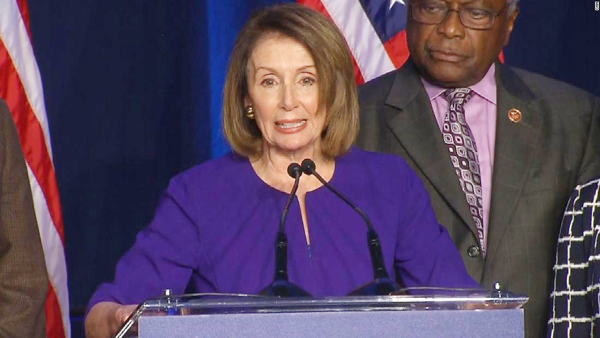
(TriceEdneyWire.com) — Democrats took over the U.S. House of Representatives in Tuesday’s midterm elections, which will boost the power and influence of representatives.
Under the new order, Waters, a California Democrat, will become chair of the Financial Services Committee, and Elijah Cummings, a Maryland Democrat, is expected to become chair of the House Oversight Committee. This gives Democrats sweeping new powers, including the power to subpoena President Trump’s tightly held income tax records if they so choose.
Congressman John Lewis, a Georgia Democrat, is a member of the Ways and Means Committee and he is the ranking House member on the Subcommittee on Oversight.
President Trump has spoken by phone to current House Speaker Nancy Pelosi, calling her to acknowledge the Democratic win.
Also, at least four African Americans were elected to Congress for the first time. They include Colin Allred, who defeated an incumbent Republican in Texas’s 32nd District in Dallas and Ayanna Pressley, the first Black woman elected to Congress from Massachusetts. Pressley, a Chicago native, will represent Massachusetts’ 7th Congressional District, which includes sections of Boston. She ran unopposed. All of the newly elected members of the House are Democrats.
The Democratic Party now controls 230 seats to the Republican Party’s 205. A political party needs only 218 votes to control the House of Representatives. Republicans maintained control of the Senate, adding several seats.
Four Senate races were still undecided on Wednesday morning.

In Mississippi, former U.S. Secretary of Agriculture Mike Espy, an African American Democrat, will compete in a runoff election against Republican Cindy Hyde for Mississippi’s U.S. Senate seat.
Democrats winning the House smoothed over some big disappoints in state governor’s races. Stacey Abrams, still trailing, has strategically refused to concede her contest to become Georgia’s first Black woman governor. With 99% of ballots counted, she is at 48.6% and her opponent, Secretary of State Brian Kemp is at 50.5%. Kemp, secretary of state, had been widely criticized for refusing to step down from his oversight of the election, giving an appearance of a conflict of interest.
Technical failures in majority Black precincts caused the NAACP to initiate court action to extend balloting for three hours, until 10 pm.
Abrams is hoping additional absentee and provisional ballots will bring the vote count close enough to warrant a run-off vote on Dec. 4. Andrew Gillum lost his hard-fought campaign to become Florida’s first Black governor. In Maryland, incumbent Republican Governor Larry Hogan defeated Democrat Ben Jealous, the former president/ CEO of the NAACP.