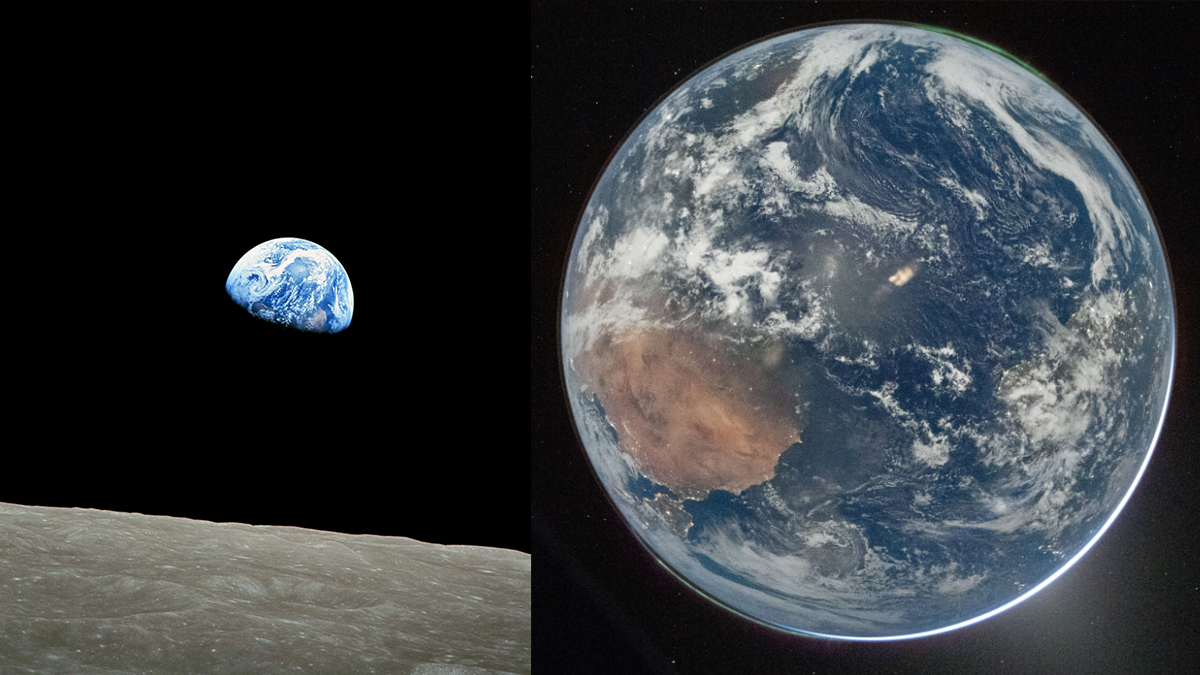
Happy Earth Day! April 22, 2026… The 1968 “Earthrise” photo, taken by Apollo 8 astronaut William Anders, is widely credited with catalyzing the modern environmental movement and inspiring the first Earth Day in 1970. By showing Earth as a fragile, colorful “blue marble” against the barren moon, it fostered global unity and sparked urgent action to protect the planet. Taken on Christmas Eve during the first human-crewed mission to orbit the Moon, it was the first color photo of Earth from space, showing a delicate, finite planet rather than a vast, indestructible one.
On December 24, 1968, Apollo 8 astronaut Bill Anders looked out the window of his spacecraft as it orbited the Moon and saw something no human had ever seen before. Earth, rising over the lunar horizon. He grabbed his Hasselblad and snapped one of the most famous photos in history. Anders mused: “We came all this way to the moon … and yet the most significant thing we’re seeing is our own home planet, the Earth.” 58 years later, on April 6, 2026, the Artemis II crew gave us the opposite view.

The 2026 Artemis II “Earthset” photo mirrors the 1968 “Earthrise” photo by framing a fragile blue planet against the lunar surface, but it showcases a crescent Earth and a shadowed Moon, captured with modern, high-dynamic-range technology.
While “Earthrise” inspired the environmental movement, “Earthset” highlights a planet impacted by 58 years of climate change, emphasizing a “chosen” rather than simply “found” home, reminding viewers of the significant rise in greenhouse gases and global temperatures, making the “grand oasis” a more vulnerable, urgently threatened home.
On Monday, April 6, 2026, six days into the Artemis II mission, NASA astronauts Reid Wiseman, Victor Glover, and Christina Koch, and CSA (Canadian Space Agency) astronaut Jeremy Hansen surpassed the record for human spaceflight’s farthest distance from Earth, which was previously set by the Apollo 13 mission in 1970. As Orion swung around the far side of the Moon, the crew watched Earth slowly slip below the lunar horizon and disappear from sight. They called it “Earthset.” This was the first time humans have ever captured this view with their own eyes and cameras.
Two photos. Two missions. Almost six decades apart. Both taken from “the same neighborhood,” as Jim Lovell would call it. Both reminders of how small, fragile, and beautiful our home really is from out there. “Earthset” is different from “Earthrise” because the moon is farther away, and because Earth is only partially sunlit. While Artemis II swept round the moon in a leisurely, gravity-powered slingshot five thousand miles away, Apollo 8 orbited the moon ten times from just 70 miles up. This gives us a small crescent Earth rising and setting behind an almost full lunar disk.
The 1972 Blue Marble image resonated among environmentalists. It was replicated by NASA’s deep space telescope DSCOVR 50 years later. A side-by-side comparison between the 2022 DSCOVR image and the 1972 photo highlights the effects of environmental degradation. In the intervening years, much of Madagascar had turned from tropical green to brown from deforestation, the Sahara had expanded, the Antarctic ice had retreated, and ancient snows had disappeared from the mountains of Iran.
It remains to be seen whether the images from Artemis II will have a comparable impact on the global environmental consciousness. However, the title of “Earthset” is perhaps the perfect name in an era where societies are threatened by climate change.
Celebrate the planet at Nashville Earth Day, Saturday, April 18, 2026
Nashville Earth Day will take place on Saturday, April 18, 2026 from 11 AM to 5 PM at the Centennial Park Bandshell. This free family-friendly event brings the Nashville community together to celebrate our planet, inspire positive environmental change, and support sustainability in Middle Tennessee. Nashville Earth Day features engaging and educational activities from more than 75 exhibitors, including local growers and makers, nonprofits, sustainable small businesses, state / metro government agencies, food trucks, and vendor partners.
Enjoy live music throughout the day with performances by The Watson Twins (4pm), Phillip-Michael Scales (3pm), Rico Del Oro (2:05pm), Alex Wong (1:15pm), and Bonner Black (12:30pm) Savor the tastes of delicious food provided by local food trucks along with craft beer, wine, and cocktails, water and juice options. Nashville Tree Foundation will distribute 1,500 free trees at the event, one per household, on a first-come, first-serve basis, including mix of flowering, fruiting, and shade trees. A diverse lineup of a dozen speakers, local experts, will speak on a variety of environmental issues, including home composting, sustainable cooking, gardening, recycling, and more (nashvilleearthday.org/stageschedule).