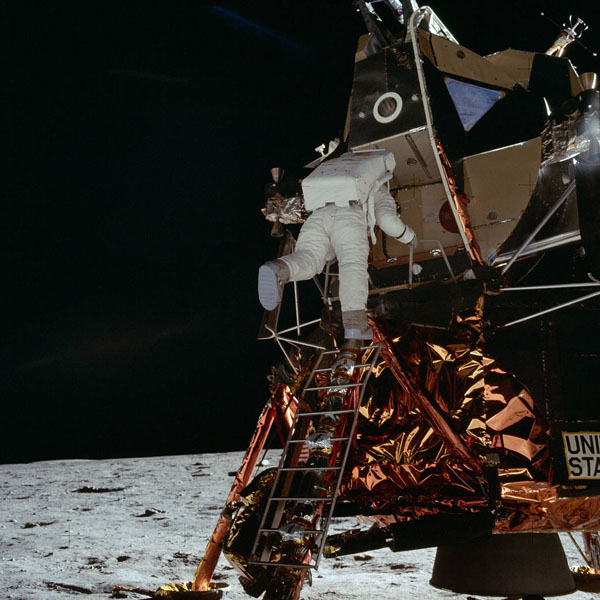
Welcome to Part Four of this year’s series on NASA, focusing on the 50th Anniversary of man’s first lunar landing during the Apollo 11 mission, July 16-24, 1969. This final week we will look at how massive scientific innovations required for the mission have benefited all of mankind in making this magnificent achievement possible a half-century ago.
With the success of the Apollo program, NASA delivered great progress in the fields of rocketry and aeronautics, as well as the fields of civil, mechanical, and electrical engineering. Lesser known accomplishments are some of the many spinoffs that came from the Apollo program—partnerships created between NASA and industry to commercialize the technologies developed for the historic missions to the Moon.

Space exploration gave us Velcro, glaucoma surgery, and so much in between. Businesses interested in NASA technology can look at NASA’s entire intellectual property portfolio. More than 1,000 patented technologies are currently available for license. There’s also a comprehensive software catalog, where anyone (not just businesses) can find tools they need. Almost all the software is free upon application.
Many of the technologies we use today began on the Apollo missions, including a variety of everyday technologies we may rarely even notice, from the roofs of today’s football stadiums to the packaging around our food. The 1958 Space Act charged NASA with finding the widest practical application of its technologies, and sharing the benefits of the results of its missions as widely as possible.
The camera in your cell phone is a NASA spinoff. Memory foam was actually developed out of a NASA project that was looking at safety in aircraft; now it’s in beds, pillows, and theater seats. The idea of having a flight computer came about to enable the Apollo Guidance Computer and developed the first fly-by-wire aircraft; every flight you take, every commercial aircraft is using fly-by-wire.
Here are just a few of the products created from those technologies: Cool suits, Kidney dialysis machines, Athletic shoe design, Insulation barriers, Water purification technology, Freeze-dried food, Hospital food service systems, Retroreflectors, and Bonding dry lubricant; Green buildings employing space suit textiles, and flame-resistant textiles safeguarding firefighters and soldiers.
Many spinoffs have a software or digital component. Satellites are now a huge part of the space program, particularly Earth-observing satellites. Nowadays, satellites are used for weather, for GPS, and other areas. Earth observation satellites give farmers all over the world benefits, as software from NASA satellites gives them predictions of crop yields, and farmland is worked by self-driving tractors, thanks to NASA software which makes GPS data accurate down to inches rather than feet. All that’s infrastructure that didn’t really exist back then. These and other technologies have a global reach we owe to Apollo.
For a more detailed look at some spinoffs, read the online version of this article on the official PRIDE website. For much more detailed information about NASA Spinoffs, visit the official website at spinoff.nasa.gov.