

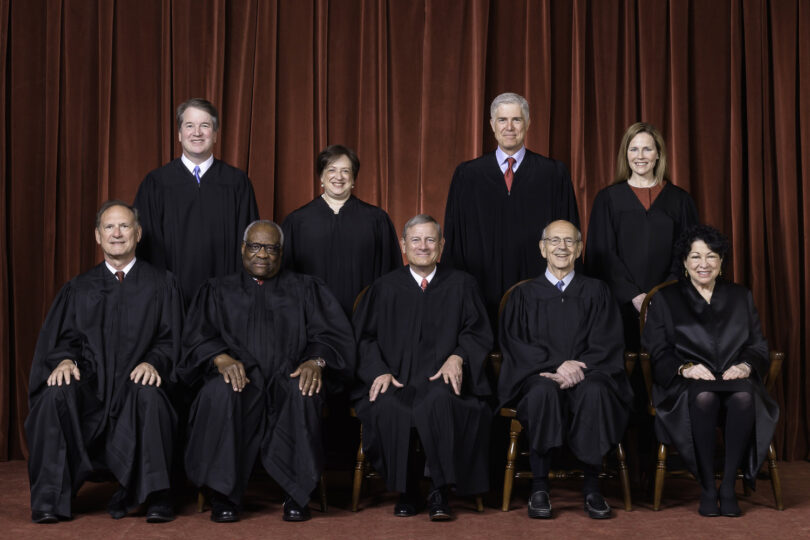
Although Justice Sonia Sotomayor called the decision perverse and illogical, the U.S. Supreme Court ruled on May 23 that state prisoners may not present new evidence in federal court to support claims that their counsel was ineffective in violation of the Constitution.
“This decision is perverse. It is illogical,” Sotomayor wrote in a scathing dissenting opinion.
The high court’s ruling severely diminishes opportunities for inmates to claim ineffective assistance of counsel even if attorneys failed to represent their clients properly.
“It makes no sense to excuse a habeas petitioner’s counsel’s failure to raise a claim altogether because of ineffective assistance in post-conviction proceedings, as [the case of] Martinez and Trevino did, but to fault the same petitioner for that post-conviction counsel’s failure to develop evidence in support of the trial-ineffectiveness claim,” Sotomayor wrote.
Justice Clarence Thomas wrote the majority opinion in the 6-3 vote.
He determined that allowing claims of ineffective counsel go forward would result in delays, much of which federal courts “must afford unwavering respect to the centrality of the trial of a criminal case in state court.”

The ruling defeats petitions from two death row inmates who asserted they had compelling claims that their state lawyers failed to pursue.
It should also make it more difficult for inmates to win claims of ineffective counsel at the state court level during appeals.
“Serial re-litigation of final convictions undermines the finality that is essential to both the retributive and deterrent functions of criminal law,” Thomas wrote, citing previous case law. “Further, broadly available habeas relief encourages prisoners to sandbag state courts by selecting a few promising claims for airing on state post-conviction review while reserving others for habeas review should state proceedings come up short.”
However, the majority opinion “reduces to rubble many inmates’ Sixth Amendment rights to the effective assistance of counsel,” Sotomayor said. “The Sixth Amendment guarantees criminal defendants the right to the effective assistance of counsel at trial. Today, however, the court hamstrings the federal courts’ authority to safeguard that right.”
Arizona officials had referred to a federal law they interpreted to mean that an inmate could not develop a claim in federal court if it hadn’t been raised in state court.
Lawyers for the inmates countered that the state misread the law because the inmate couldn’t face blame for the mistake of their state-appointed lawyer.
Barry Jones, one of the inmates at the center of the Supreme Court ruling, argued that ineffective assistance of counsel robbed him of a just and fair verdict. Jones, who maintains his innocence, had earned relief from the 9th Circuit Court of Appeals before the Supreme Court ruling.
The second Arizona inmate, David Ramirez, claimed that his attorney failed to investigate his intellectual disability.
“State prisoners already have a strong incentive to save claims for federal habeas proceedings to avoid the highly deferential standard of review that applies to claims properly raised in state court,” Sotomayor wrote. “Permitting federal fact-finding would encourage yet more federal litigation of defaulted claims.”