




1929
January 15
Michael King, later known as Martin Luther King, Jr., is born at 501 Auburn Ave. in Atlanta, Georgia.
1941
Summer
The King family, including: Martin Luther King, Sr. (Daddy King), Alberta Williams King, Willie Christine King, Martin Luther King, Jr., and Alfred Daniel Williams King (known as A. D. King) moves from 501 Auburn Avenue to 193 Boulevard in Atlanta.
1944
September 20
King begins his freshman year at Morehouse College in Atlanta.
1946
August 6
The Atlanta Constitution publishes King’s letter to the editor stating that Black people “are entitled to the basic rights and opportunities of American citizens.”
1948
February 25
King is ordained and appointed assistant pastor at Ebenezer Baptist Church in Atlanta.
June 8
King receives his bachelor of arts degree in sociology from Morehouse College.
September 14
King begins his studies at Crozer Theological Seminary in Chester, Pennsylvania.
1951
May 6-8
King graduates from Crozer with a bachelor of divinity degree, delivering the valedictory address at commencement.
September 13
King begins his graduate studies in systematic theology at Boston University.
1953
June 18
King and Coretta Scott are married at the Scott home near Marion, Alabama.
1954
September 1
King begins his pastorate at Dexter Avenue Baptist Church in Montgomery, Alabama.
1955
June 5
King is awarded his doctorate in systematic theology from Boston University.
November 17
Yolanda Denise King, the Kings’ first child, is born.
December 1
Rosa Parks is arrested for refusing to vacate her seat and move to the rear of a city bus in Montgomery, Ala. to make way for a White passenger. Jo Ann Robinson and other Women’s Political Council members mimeograph thousands of leaflets calling for a one-day boycott of the city’s buses on Monday, December 5.
December 5
At a mass meeting at Holt Street Baptist Church, the Montgomery Improvement Association (MIA) is formed. King becomes its president.
1956
January 27
According to King’s later account in Stride Toward Freedom, he receives a threatening phone call late in the evening, prompting a spiritual revelation that fills him with the strength to carry on in spite of persecution.
January 30
At 9:15 pm, while King speaks at a mass meeting, his home is bombed. His wife and daughter are not injured. Later, King addresses an angry crowd that gathers outside the house, pleading for nonviolence.
November 13
The U.S. Supreme Court affirms the lower court opinion in Browder v. Gayle, declaring Montgomery and Alabama bus segregation laws unconstitutional.
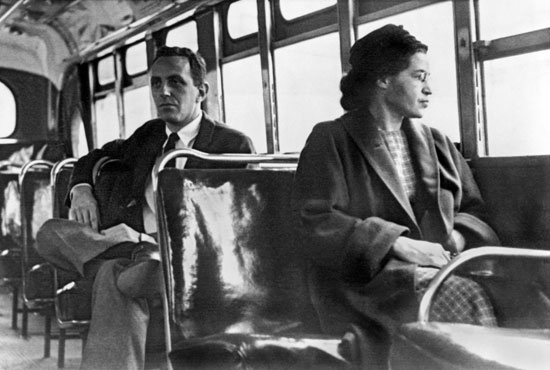
December 21
Montgomery City Lines resumes full service on all routes. King is among the first passengers to ride the buses in an integrated fashion.
1957
January 10-11
Southern Black ministers meet in Atlanta to share strategies in the fight against segregation. King is named chairman of the Southern Negro Leaders Conference on Transportation and Nonviolent Integration (later known as the Southern Christian Leadership Conference, SCLC).
February 18
King appears on the cover of Time magazine.
March 6
King attends the independence celebrations of the new nation of Ghana in West Africa and meets with Prime Minister Kwame Nkrumah.
May 17
At the Lincoln Memorial in Washington, D.C., King delivers his first national address, ‘Give Us The Ballot,’ at the Prayer Pilgrimage for Freedom.
June 13
King and Ralph D. Abernathy meet with Vice President Richard M. Nixon and issue a statement on their meeting.
October 23
Coretta King gives birth to their second child, Martin III.
1958
June 23
King and other civil rights leaders meet with President Dwight D. Eisenhower in Washington.
September 17
King’s first book, Stride Toward Freedom: The Montgomery Story, is published.
September 20
During a book signing at Blumstein’s Department Store in Harlem, New York, King is stabbed by Izola Ware Curry. He is rushed to Harlem Hospital, where a team of doctors successfully remove a seven-inch letter opener from his chest.
1959
February 3
King embarks on a month-long visit to India, where he meets with Prime Minister Jawaharlal Nehru and many of Gandhi’s followers.
1960
February 1
King moves from Montgomery to Atlanta to devote more time to SCLC and the freedom struggle. He becomes assistant pastor to his father at Ebenezer Baptist Church.
May 25-28
King is found not guilty of tax fraud by a White jury in Montgomery.
June 23
King meets privately in New York with Democratic presidential candidate John F. Kennedy.
October 19
King is arrested during a sit-in demonstration at Rich’s department store in Atlanta. He is sentenced to four months of hard labor for violating probation conditions he had received earlier that year for driving with an out-of-state driver’s license. He is released on $2000 bond on October 27.
1961
January 31
Dexter Scott, King’s third child, is born.
May 21
After the initial group of Freedom Riders seeking to integrate bus terminals is assaulted in Alabama, King addresses a mass rally at a mob-besieged Montgomery church.
October 16
King meets with President John F. Kennedy and urges him to issue a second Emancipation Proclamation to eliminate racial segregation.
December 16
King, Ralph Abernathy, Albany Movement president, William G. Anderson, and other protesters are arrested by Laurie Pritchett during a campaign in Albany, Georgia.
1962
July 27-August 10
King is arrested at an Albany, Georgia prayer vigil and jailed. After spending two weeks in jail, King is released.
September 28
During the closing session of the SCLC conference in Birmingham, Alabama, a member of the American Nazi Party assaults King, striking him twice in the face.
1963
March 28
Bernice Albertine, King’s fourth child, is born.
April 16
Responding to eight Jewish and Christian clergymen’s advice that African Americans wait patiently for justice, King pens his ‘Letter from Birmingham Jail.’ King and Abernathy were arrested on April 12 and released on April 19.
May 7
Conflict in Birmingham reaches its peak when high-pressure fire hoses force demonstrators from the business district. In addition to hoses, Police Commissioner Eugene ‘Bull’ Connor employs dogs, clubs, and cattle prods to disperse four thousand demonstrators in downtown Birmingham.
June 5
Strength to Love, King’s book of sermons, is published.

August 28
The March on Washington for Jobs and Freedom attracts more than 200,000 demonstrators to the Lincoln Memorial. Organized by A. Philip Randolph and Bayard Rustin, the march is supported by all major civil rights organizations as well as by many labor and religious groups. King delivers his ‘I Have a Dream’ speech. After the march, King and other civil rights leaders meet with President John F. Kennedy and Vice-President Lyndon B. Johnson in the White House.
September 18
King delivers the eulogy at the funerals of Addie Mae Collins, Carol Denise McNair, and Cynthia Dianne Wesley, three of the four children that were killed during the September 15 bombing of the Sixteenth Street Baptist Church in Birmingham. Carole Robertson, the fourth victim, was buried in a separate ceremony.
October 10
U.S. Attorney General Robert Kennedy authorizes the FBI to wiretap King’s home phone.
1964
January 3
King is named ‘Man of the Year’ by Time Magazine.
January 18
President Lyndon B. Johnson meets with King, Roy Wilkins, Whitney Young, and James Farmer and seeks support for his War on Poverty initiative.
February 9
Robert Hayling, leader of the movement in St. Augustine, Florida, invites King and SCLC to join the struggle.

March 26
King meets Malcolm X in Washington, D.C., for the first and only time.
June
King’s book Why We Can’t Wait is published.
June 11
King is arrested and jailed for demanding service at a White-only restaurant in St. Augustine, Florida.
July 20
King and SCLC staff launch a People-to-People tour of Mississippi to assist the Student Nonviolent Coordinating Committee (SNCC) and the Congress of Racial Equality (CORE) in the Mississippi Freedom Summer campaign.
November 18
After King criticizes the FBI’s failure to protect civil rights workers, the agency’s director, J. Edgar Hoover, denounces King as “the most notorious liar in the country.” A week later, he states that SCLC is “spearheaded by Communists and moral degenerates.”
December 1
King meets with FBI Director J. Edgar Hoover at the Justice Department.
December 10
King receives the Nobel Peace Prize at a ceremony in Oslo, Norway. He declares that “every penny” of the $54,000 award will be used in the ongoing civil rights struggle.
1965
The King family moves to their new home at 234 Sunset Avenue in Atlanta.
March 7
In an event that will become known as ‘Bloody Sunday,’ voting rights marchers are beaten at the Edmund Pettus Bridge in Selma, Alabama, as they attempt to march to Montgomery.
March 17-25
King, James Forman, and John Lewis lead civil rights marchers from Selma to Montgomery after a U.S. District judge upholds the right of demonstrators to conduct an orderly march.
August 12
King publicly opposes the Vietnam War at a mass rally at the Ninth Annual Convention of SCLC in Birmingham.
1966
January 26
King and his wife move into an apartment at 1550 South Hamlin Avenue in Chicago to draw attention to the city’s poor housing conditions.
February 23
In Chicago, King meets Nation of Islam leader Elijah Muhammad.
June 7
King, Floyd McKissick of CORE, and Stokely Carmichael of SNCC resume James Meredith’s ‘March Against Fear’ from Memphis to Jackson, Mississippi, after Meredith was shot and wounded near Memphis.
1967
April 4
King delivers ‘Beyond Vietnam’ to a gathering of ‘Clergy and Laymen Concerned About Vietnam’ at Riverside Church in New York City. He demands that the U.S. take new initiatives to end the war.
June
King’s book Where Do We Go from Here: Chaos or Community? is published.
December 4
King publicly reveals his plans to organize a mass civil disobedience campaign, the Poor People’s Campaign, in Washington, D.C., to force the government to end poverty.
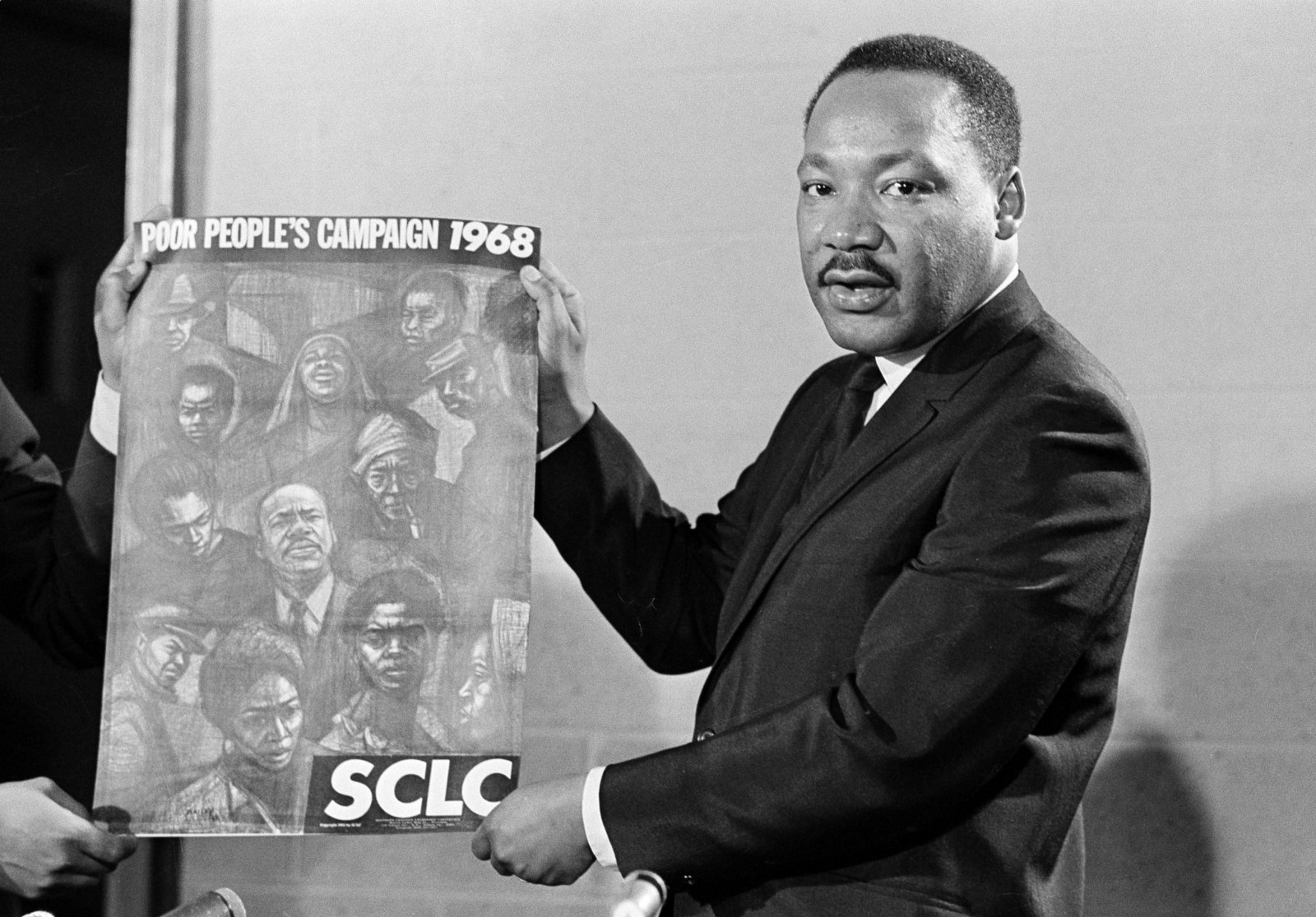
1968
March 28
King leads a march of 6,000 protesters in support of striking sanitation workers in Memphis. The march descends into violence and looting, and King is rushed from the scene.
April 3
King returns to Memphis, determined to lead a peaceful march. During an evening rally at Mason Temple in Memphis, King delivers his final speech, ‘I’ve Been to the Mountaintop.’

April 4
King is shot and killed while standing on the balcony of the Lorraine Motel in Memphis.
April 9
King is buried in Atlanta.