by Black Press USA
Three judges on the 11th U.S. Circuit Court of Appeals heard oral arguments July 22 in Atlanta in the appeal of the 2024 conspiracy convictions of Chairman Omali Yeshitela, Penny Hess and Jesse Nevel, collectively known as the Uhuru 3.

The appeal centers on whether the federal government violated the defendants’ First Amendment rights by prosecuting them for political speech after they were acquitted of acting as unregistered agents of Russia but convicted of conspiracy to do so.
The three-judge panel consisted of Chief Judge William Pryor, Judge Jill Pryor and Judge Andrew Brasher.
Federal prosecutors alleged that the defendants promoted Russian interests through speeches and political activities opposing U.S. support for Ukraine while advocating reparations for African Americans and criticizing U.S. treatment of Black communities. During the 2024 trial, however, a Tampa jury acquitted the defendants of serving as secret Russian agents before finding them guilty of conspiracy.
The case has drawn national attention from free speech advocates, civil rights organizations and political activists across the ideological spectrum, who argue it could establish an important precedent regarding the government’s ability to prosecute political advocacy. Supporters include the National Lawyers Guild, the National Conference of Black Lawyers, Dr. Cornel West and others.
During oral arguments, defense attorney Leonard Goodman argued that the case marks the first time federal law governing unregistered foreign agents has been used to prosecute political speech rather than espionage or covert foreign operations.
“This is the first case in which Section 951 has been used to directly target speech,” Goodman told the court, arguing that the indictment focused on political viewpoints rather than criminal conduct.
Chief Judge William Pryor questioned whether the statute itself is content-neutral, suggesting the registration requirement could apply regardless of the political position being expressed. He asked whether someone advocating on behalf of another foreign government would face the same legal obligation under the law.
Goodman attempted to distinguish the prosecution by arguing that organizations receiving funding from governments allied with the United States are not typically prosecuted under the same statute.
The appeal raises three primary issues: whether lawful political speech loses First Amendment protection simply because prosecutors allege a foreign connection; whether sufficient evidence existed to establish a conspiracy; and whether jurors were improperly instructed they could convict on conspiracy despite acquitting the defendants on the underlying charge.
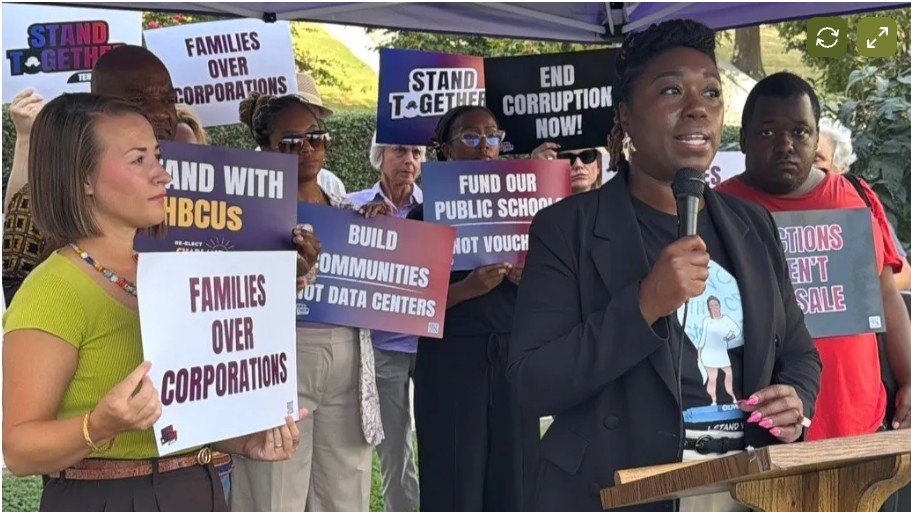
More than 80 supporters attended the hearing, filling the courtroom and an overflow room where proceedings were shown on closed-circuit television. Among those present were civil rights attorneys, community activists and members of several legal and social justice organizations.
Following the hearing, Yeshitela expressed optimism despite pointed questioning from the judges.
“The court recognized there are some issues that need resolution,” he said. “Attorney Leonard Goodman did an extraordinary job. The prosecution did not have a reasonable explanation about why we were facing conspiracy charges when the jury had found us not guilty on the foundational charge.”
Yeshitela argued that the case has implications extending beyond the defendants.
“When they came for us around free speech issues that we never had, it’s not us they’re coming for,” he said. “They’re coming for everyone.”
Defense attorney Ade Griffin described the appeal as an opportunity to establish legal precedent.
“We’re here today to change the law for generations to come,” Griffin said. “And that’s an extremely hard thing to do.”
After the hearing, supporters gathered at Georgia State University College of Law for a discussion hosted by the Black Law Students Association and the Davis Bozeman Johnson Law Group. Goodman said that if the appeal is unsuccessful, the defense intends to seek a rehearing and, if necessary, petition the U.S. Supreme Court.