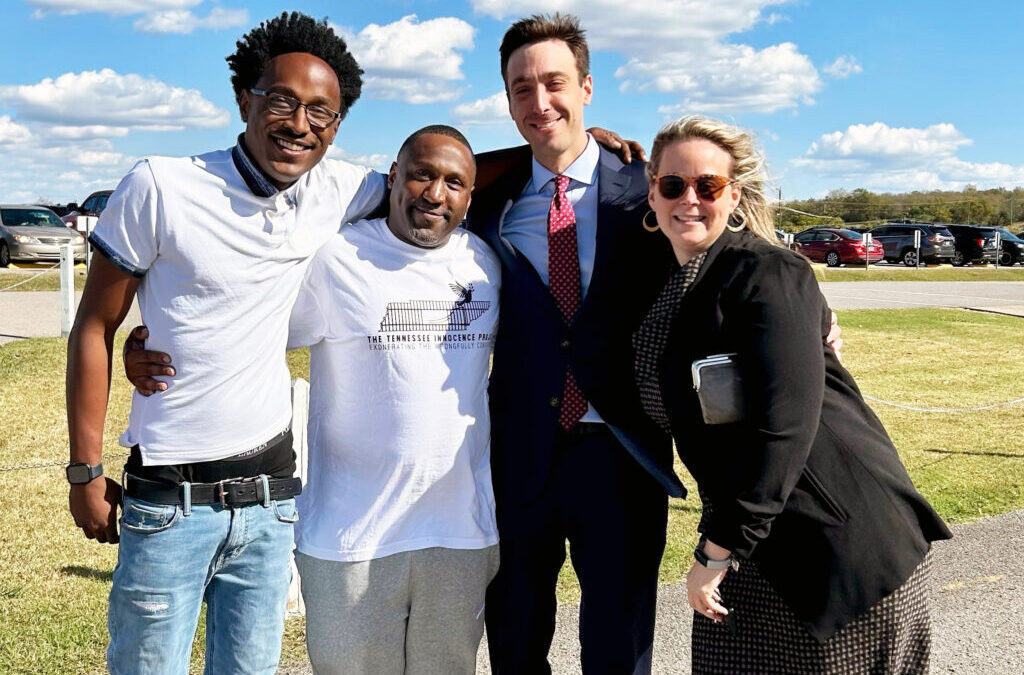
Thomas Clardy spent 17 years behind bars for a murder he has always maintained he did not commit. Freed in 2023 after a federal judge overturned his conviction, Clardy now faces the possibility of returning to prison after an appeals court reinstated his conviction and the U.S. Supreme Court declined to review his case.
Clardy was originally convicted in 2007 for a 2005 triple shooting at an auto body shop in Madison, Tennessee. One person was killed and two others injured. The prosecution’s case rested almost entirely on a cross-racial eyewitness identification (made nearly a month after the crime) by a surviving victim who admitted he only glimpsed the side of the shooter’s face in the dark. No physical evidence ever tied Clardy to the scene, and another surviving victim identified a different suspect. A decade later, ballistics linked two fire arms used in the crime to individuals with no connection to Clardy.

In June 2023, a federal district judge overturned Clardy’s conviction, citing ineffective assistance of counsel. The judge found that Clardy’s original attorney failed to present expert testimony on the known flaws in eyewitness identification. The court deemed the case against Clardy “paltry” and “exceedingly weak.”
Following that ruling, Clardy was released in October 2023 and reunited with his family. Over the next 19 months, he held steady employment, demonstrated exemplary conduct, and remained active in his community.
But in January 2025, the Sixth Circuit Court of Appeals reversed the lower court’s ruling on procedural grounds, not based on Clardy’s guilt or the strength of the evidence. The U.S. Supreme Court declined to hear his appeal, and in June 2025, the state of Tennessee filed a motion seeking Clardy’s return to prison.
“The state of Tennessee’s dogged pursuit of injustice in this case is a travesty,” said Jessica Van Dyke, executive director of the Tennessee Innocence Project (TIP), which has represented Clardy since 2014. “Despite overwhelming evidence of Thomas’ innocence, the system failed him. He deserves freedom, not further punishment.”
Clardy’s legal team (TIP and co-counsel from Bass, Berry & Sims) continues to fight for his exoneration. They have filed two clemency petitions: one for exoneration and another for commutation. Gov. Bill Lee has the authority to grant either.
“I spent 17 years in prison for a crime I did not commit, and the past 19 months rebuilding relationships with my family, while living with the possibility that at any moment I could be sent back to prison,” said Clardy. “I will continue the fight to prove my innocence until the justice system recognizes the mistake it has made and sets me free for good.”
A prayer vigil was recently held at Corinthian Baptist Church, where community members gathered in support of Clardy. “It made sense to call it a prayer vigil,” Van Dyke said. “Thomas is a man of faith, and this is a community of people deeply impacted by his story.”
Clardy’s case has now returned to the federal district court for further litigation, and his supporters remain hopeful that justice will finally prevail.