

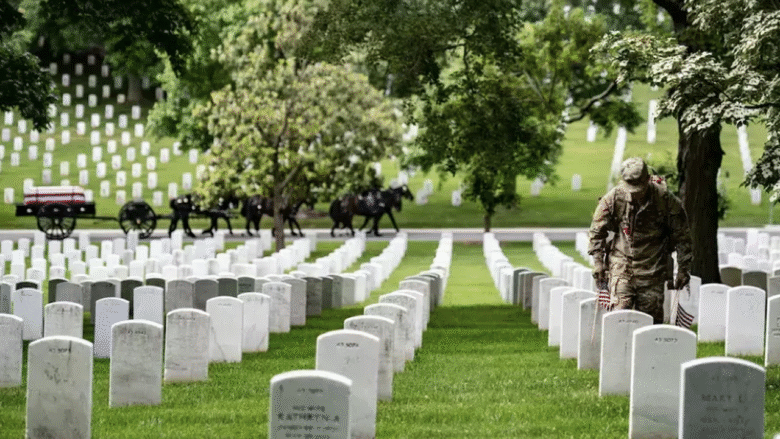
As Americans prepare to honor fallen service members during Memorial Day weekend, historians continue to debate where the nation’s first Memorial Day observance actually took place. While several cities claim the distinction, many scholars point to a ceremony organized by formerly enslaved African Americans in Charleston, South Carolina, just weeks after the end of the Civil War.
According to Yale historian David Blight, one of the earliest known Memorial Day commemorations occurred on May 1, 1865, when newly freed Black residents of Charleston organized a large public ceremony honoring Union soldiers who had died during the war.

The event took place at a former Confederate prison camp where Union troops had been buried in a mass grave after dying from disease and exposure. Formerly enslaved workers reportedly reburied the soldiers properly and organized a memorial procession attended by thousands of Black residents, teachers and Union soldiers.
The ceremony included music, speeches, flowers and a parade celebrating freedom and honoring the war dead. According to historical accounts, two symbolic floats were featured in the procession. One depicted a mock slave auction, while another carried a coffin labeled ‘Slavery’ with the words: ‘Fort Sumter dug its grave, April 12, 1861.’
Blight has argued that the Charleston event represented one of the first organized Memorial Day commemorations in the nation’s history, though for many Americans the story remains largely unknown.
“Whether of the world, the nation or the state, we know contributions of Africans and their descendants are rarely recorded or recorded with accurate attribution,” the article notes, pointing to a long history of Black Americans being excluded from historical recognition.
The debate surrounding Memorial Day’s origins continues more than 150 years later.
Several communities across the country claim to have held the first Memorial Day observance. Some historians point to ceremonies following the Battle of Gettysburg in 1863, while others highlight various postwar grave decoration traditions that emerged in both Northern and Southern states after the Civil War.
In 1966, President Lyndon B. Johnson officially recognized Waterloo, New York, as the ‘birthplace’ of Memorial Day, citing a May 5, 1866, community-wide remembrance ceremony held there. That declaration, however, did not end the historical dispute.
Supporters of the Charleston claim argue the ceremony organized by formerly enslaved African Americans deserves broader national recognition because it tied remembrance of fallen Union soldiers directly to the end of slavery and the nation’s struggle for freedom.
The Civil War remains the deadliest conflict in American history, claiming more than 600,000 lives and leaving deep scars across the country. Historians widely agree that the scale of loss and grief following the war helped shape the traditions that eventually became Memorial Day.
The holiday itself was originally known as ‘Decoration Day,’ a tradition centered around decorating the graves of fallen soldiers with flowers during the spring. Over time, the observance expanded into the national Memorial Day holiday recognized today.
For many historians and advocates, revisiting Charleston’s role in the holiday’s origins is about more than correcting historical records. It is also about recognizing the contributions of Black Americans whose efforts helped shape important moments in the nation’s history but were often overlooked or minimized.
As communities across the country gather this Memorial Day to honor military service and sacrifice, the continuing debate over the holiday’s beginnings serves as a reminder that history itself is often contested—and that some stories remain hidden long after the events themselves helped shape the nation.