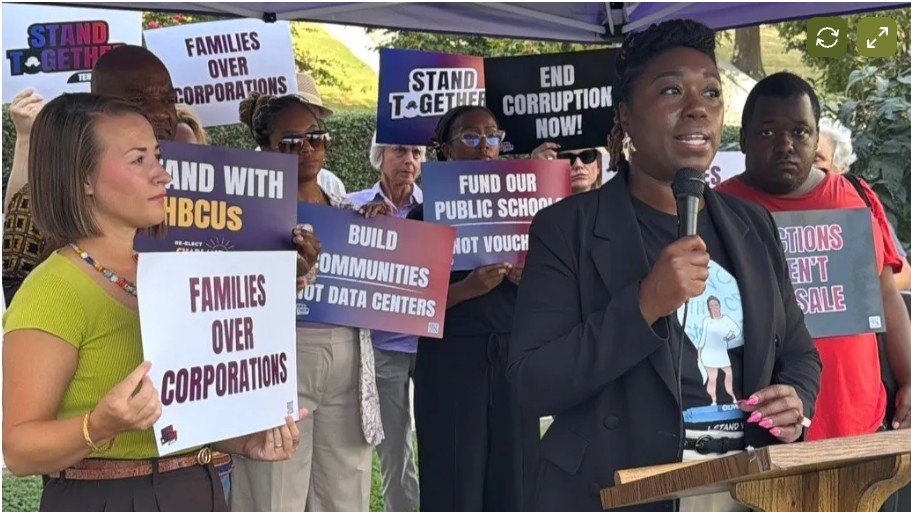
(photo courtesy of Tennessee State Democrats).
State Sen. Charlane Oliver, D-Nashville, announced plans to introduce legislation that would prohibit corporations from spending money in Tennessee state elections, arguing that large corporate contributions have given business interests too much influence over state government.
Oliver said she plans to introduce the Restore Power to the People Act when the General Assembly begins its next legislative session in January.

“Corporations and billionaires have bought their way into Tennessee’s statehouse,” Oliver said. “Meanwhile, Tennessee families are facing rising grocery costs, unaffordable housing, underfunded schools and crumbling infrastructure.”
Oliver cited campaign finance data compiled by the Tennessee Lookout as evidence of the amount of money businesses and other organizations spend attempting to influence state politics.
The Lookout’s Cash for Clout database uses publicly filed campaign finance and lobbying records from the Tennessee Bureau of Ethics and Campaign Finance to track political spending. Its analysis includes campaign contributions, independent expenditures and lobbying.
Oliver’s office said its review of the database found that 75 of Tennessee’s top 100 political donors over the past decade were businesses, business political action committees or nonprofit corporations associated with special-interest groups. Those organizations contributed a combined $58 million to state campaigns, according to Oliver’s analysis.
The proposed legislation is partly a response to the U.S. Supreme Court’s 2010 Citizens United v. Federal Election Commission decision, which held that the government generally cannot restrict independent political expenditures by corporations and unions.
Oliver said her proposal would rely on Tennessee’s authority to establish and regulate corporations operating under state law to restrict corporate election spending. Whether such an approach could withstand a constitutional challenge would likely become a central issue if the legislation advances.
“Right now, Tennessee’s state government answers to corporate donors, not to the families who live here,” Oliver said.
upporters of restrictions on corporate political spending argue that large contributions and independent expenditures give wealthy organizations disproportionate influence over public policy. Opponents of such restrictions have argued that political spending is protected expression under the First Amendment, a principle reflected in the Citizens United ruling.
Oliver was joined at the announcement by state Rep. Aftyn Behn, D-Nashville, state Sen. Heidi Campbell, D-Nashville, and community and civic leaders.
“The corporate hold over our legislature is killing us,” Campbell said. “We have problems with our schools, with infrastructure, affordability, and all that is driven by the fact there is too much money up here at the Capitol.”
Oliver also announced the launch of Stand Together Tennessee, a civic education initiative that she said will focus on campaign finance and issues including public school funding, eliminating the state grocery tax and transportation.
The proposal will face consideration by the Republican-controlled Tennessee General Assembly after lawmakers return to Nashville in January.