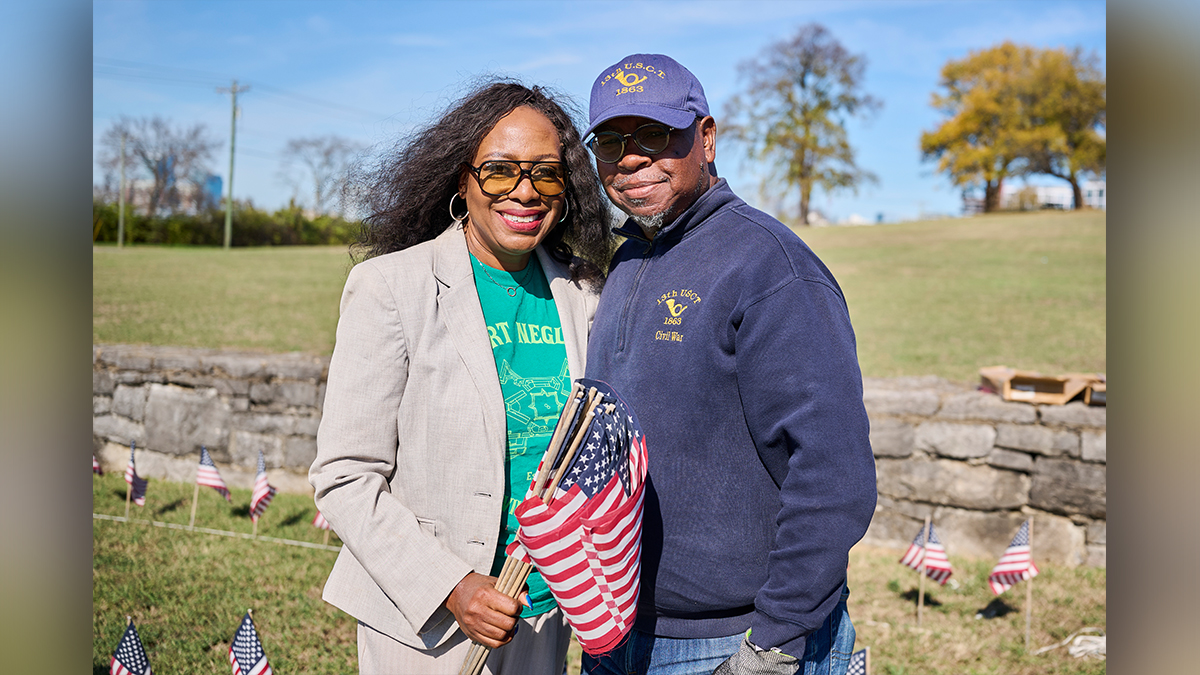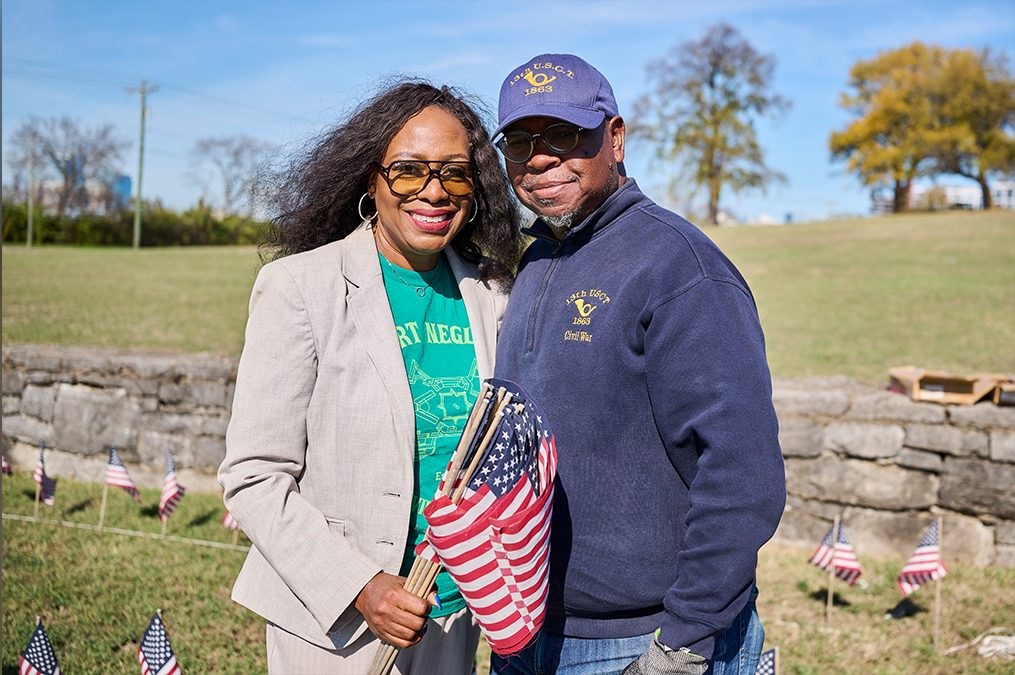
one of the Black laborers who built Fort Negley in 1862, during the annual flag-planting ceremony
(photo by Shane Potter, Metro photographer).
More than 160 years after thousands of Black Americans were forced to build one of the Civil War’s largest inland fortifications, Nashville residents gathered at Fort Negley on November 7 to honor the enslaved, self-emancipated and free Black men and women whose labor helped secure the Union Army’s control of the city.
The annual Fort Negley Laborers Flag Planting commemorated the 2,771 Black Americans who constructed the massive stone fortress in 1862, transforming what was then known as St. Cloud Hill into a strategic military stronghold overlooking Nashville.
Each of the 2,771 flags represented an individual whose contributions helped shape one of the city’s most significant historical landmarks, yet whose sacrifices were largely overlooked for generations.
The commemoration marked the 164th anniversary of Fort Negley’s construction, which took place between August 13 and December 7, 1862.
During those four months, thousands of Black laborers worked under extraordinarily harsh conditions to construct the fortification. Many were enslaved people who had escaped to Union-controlled Nashville seeking freedom, while others were free Black Americans or individuals pressed into service by federal military authorities.
According to historical accounts highlighted by Fort Negley Park, as few as 317 of the 2,771 laborers received payment for their work. As many as 800 are believed to have died during the construction period, underscoring the devastating human cost of the military project.

The workers cleared trees, excavated earth, hauled heavy stones and constructed defensive walls, often without adequate food, shelter or medical care.
Their labor produced what remains the largest inland stone fortification built during the Civil War, a structure that played an important role in the Union Army’s defense of Nashville.
The fort’s history is closely connected to the broader struggle for Black freedom during the Civil War.
After Union forces occupied Nashville in February 1862, the city became a destination for enslaved people escaping plantations and seeking protection behind federal military lines.
Many of those seeking freedom were classified by the military as ‘contraband,’ a term used during the Civil War for enslaved people who escaped to Union lines and were no longer returned to Confederate enslavers.
Although reaching Union-controlled territory offered the possibility of freedom, many Black refugees faced exploitation and dangerous working conditions as the federal government relied heavily on their labor to construct military defenses.
Fort Negley became both a symbol of that exploitation and a place associated with the pursuit of emancipation.
Some of the men who helped build the fortress later enlisted in the United States Colored Troops, the Black military regiments organized to fight for the Union after the federal government authorized their recruitment.
Their service helped strengthen the Union war effort while advancing the struggle to end slavery and secure citizenship rights for Black Americans.
The annual flag planting serves as a public reminder that Nashville’s Civil War history extends beyond military commanders and battlefield victories. It also includes thousands of Black Americans whose labor, suffering and determination contributed to the Union’s success.
Held at Fort Negley Park, 1100 Fort Negley Boulevard, the November 7 observance invited families, community organizations and individual volunteers to participate in placing flags at the park entrance and surrounding grounds.
The activity was designed to provide a visible representation of the thousands of people involved in the fort’s construction while encouraging visitors to reflect on their individual lives and collective contributions.
For Nashville’s Black community, the commemoration also highlights the importance of preserving historical sites that document the experiences of enslaved people and their descendants.
Today, Fort Negley stands as a reminder of the complicated relationship between the Union war effort, emancipation and the Black Americans who helped make both possible.
The annual ceremony ensures that the laborers who built the fortress are remembered not simply as an anonymous workforce, but as individuals whose sacrifices helped shape Nashville and the nation’s history.