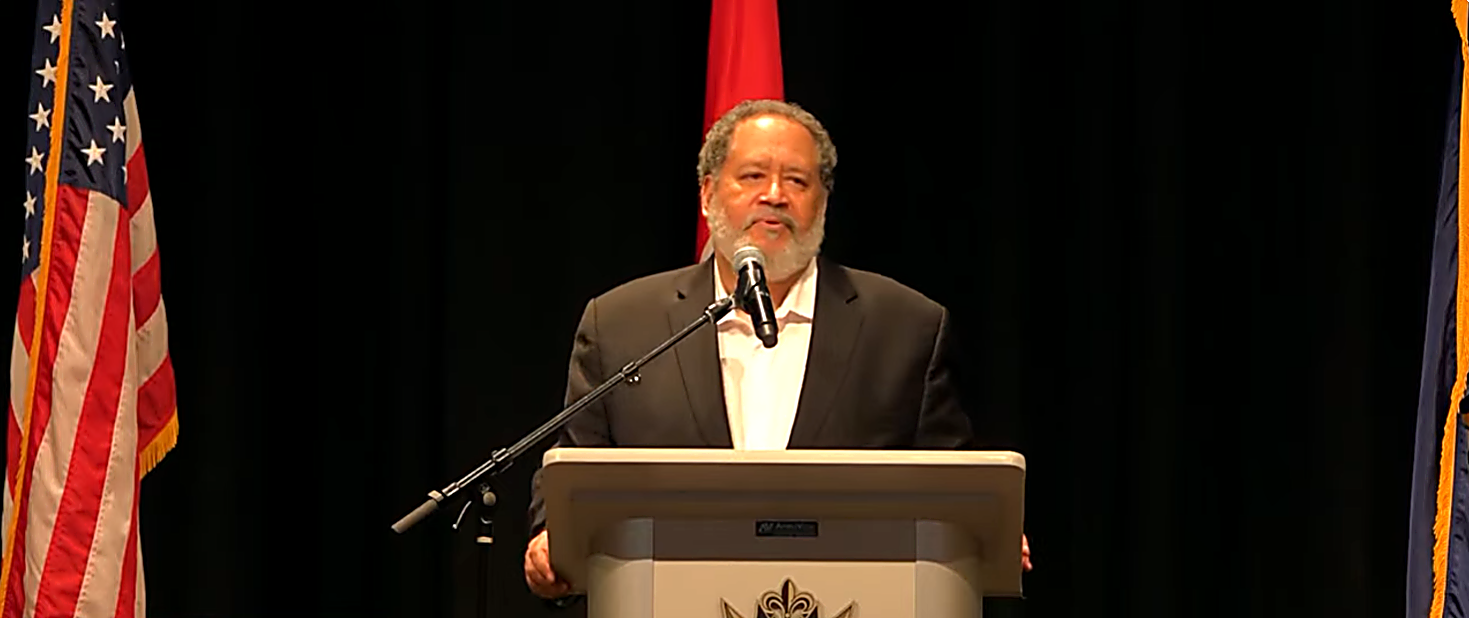
An individual claiming to be a relative of President James K. Polk provided the following testimony to the Senate opposing the proposed bill that would deny undocumented students access to public schools.
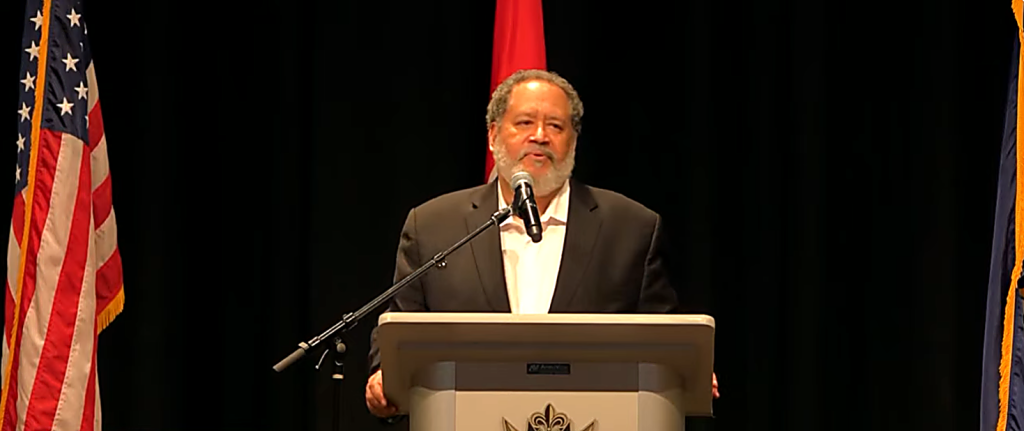
“My name is Jim Polk. Yes, before anyone asks, I am related to that fellow Tennessean, James K. Polk, buried out on the northeast slope of this hill. Yes, the fellow who slashed the line across a desert that became the United States’ southern border and greatly enlarged the country.

“My Tennessee ancestors arrived near Reelfoot Lake in the early 1820s, while many more Chickasaws were present. These ancestors include the leader of the first wagon train to penetrate the then-primeval wilderness; the owners of Troy’s general store from the 1830s to the 1930s; farmers; a sheriff; a member of this House of Representatives; schoolteachers and a principal; a newspaper editor/owner; and the secretary-treasurer of a short-line railroad company. Among all these folks who worked to create a strong, healthy community, I am thankful for a six-generation line of doctors who served their neighbors and countrymen through the Civil War, Spanish-American War, World Wars I and II, and who continue their healing work today.
“As for me? I am a retired public school community educator who worked for 30 years as happily as a chimney-top mockingbird here in Metro Nashville. During those decades, I was supported in visiting and studying community school programs nationwide—Honolulu to Boston, Minneapolis to San Antonio, Taos to Tampa.
“Long before that, back in high school, I made my first trip across the Mexican border and soon came to appreciate the generosity and resilience of the Mexican people. My first border crossing in 1963 was as a 14-year-old Explorer Scout from Union City. Our group traveled for 21 days by Volkswagen bus, mostly camping on the roadside all the way to Guatemala City. Sleeping one night in a shelter for boys in Puebla, I gained a new appreciation for the burdens some boys my age were carrying. As a surgeon’s son in Union City, I had my own air-conditioned bedroom with closets for toys and clothes. I shared a bathroom with one sister. These boys came out of alleys at sundown to a crowded shelter for a cup of soup, a few tortillas, and a stone floor to sleep on.
“Since the 1990s, my family has had the benefit of extensive travel and study in Mexico and Guatemala. In Mexico, we’ve traveled mostly by bus, a few times by air, and even once long ago by passenger train, visiting places with names like Tzintzuntzan, Cholula, Oaxaca, Dolores Hidalgo, and Querétaro. Both of our daughters saw terribly harsh realities in Nogales, Sonora, while living with Mexican families as part of the Border Links community there. In Guatemala, our older daughter served as a translator of monstrous horror stories for native mothers whose sons had “disappeared.” Many were tortured to death, some buried under the floor of the Catholic church they were visiting. The floor was being excavated by forensic pathologists before the mothers’ and students’ eyes.
Contrary to these tortured mens’ (and their mothers’) nightmare experiences, whenever our daughters were sick or injured in Mexico and Guatemala, they were carefully nurtured back to health by generous homestay mothers in Nogales and Quetzaltenango.
“For five years, my family and church friends spent a week or more each summer volunteering with the leaders of the Methodist Church of Mexico in Salamanca, Guanajuato. We did what we could to support their efforts to train youth to lead activities for children, as well as to build an alcohol and drug clinic. Again, we experienced amazing generosity while working with Mexican families and children who generally had far fewer resources than we did. We met dozens of beautiful, gentle, smart children who were struggling in perilous situations with very limited educational opportunities and little money.
“I wish there were time to tell those stories: a petite, smart little girl named Sarai, in her blue polka dot dress, who carried an injured dragonfly around all day protecting it—then died herself of peritonitis soon after we came home. A little boy with a cleft palate who came crying down a barren, rocky trail out of the mountains and got on the bus with his grandmother. Before getting off, he ran back, reached out his tiny hand, and blessed me before he left to walk up one more dusty, unmarked trail. What kind of future could there possibly be for him up in those rocks?
In Tequisquiapan, two elderly sisters gave up the only bed in their house and sat up all night in straight-backed wooden chairs so my daughters had a place to sleep. Near Cholula, a cute little girl took my wife and me into her care, soothing our fears just after we wrongly (but quite reasonably) thought we were being abducted by a taxi driver. The cutie smiled brightly, happily asked if we needed a guide, and led us into her church, whose walls were covered not with sculptures of saints but with images of children who had lived in the village in the 1600s.
“Now, here in Tennessee in 2025, since children’s eligibility for public education is being challenged on the basis of cost, I must point to something that many Tennesseans still believe overrides other arguments: ‘Jesus loves the little children, all the children of the world.’ Do you remember that from Sunday School, Vacation Bible School, and church camp? I certainly do. Somehow, I can’t see the Jesus who said, ‘Let the little children come unto me,’ throwing children out of school who are literally begging to be allowed to attend.
‘Let us learn! Let us learn! Let us learn!!’ echoes down the hallways of the Cordell Hull Legislative chambers. I hope it rings on and on in the ears, hearts, and consciences of senators and representatives until they answer the children’s call.
“Some of us talk about this being a Christian nation. I, for one, would be quite happy if we would follow that basic Christian principle: ‘Do unto others as you would have them do unto you.’ It seems to me that we should do our best to apply this principle in our treatment of other people and their children. Surely, this is a solid foundation for building better relations among all humanity, regardless of where we came from or are trying to go. I suspect that not only Jesus thought that, but probably Buddha, Moses, Chief Seattle, Lao Tzu, Muhammad, and the founders of many other belief systems, lifeways, and philosophies would agree.
“Why are we here at these Legislative Committee meetings? Sen. Watson’s stated reason is a concern about the rising costs of educating undocumented children. It appears there are legislators far more committed to saving money for essentially untaxed corporations than to supporting the purposes for which our public school system was formed. What has happened to the founders’ vision of an increasingly inclusive democratic society, built on the foundation of an informed, literate, and thoughtful public? The idea that all are equal?
“I don’t know about you, but I’m here as both a grandparent and a citizen concerned with the future of our Tennessee communities. Can we step back, reframe, and consider this from a different angle? Too often, in addressing one concern, we intensify and complicate many others.
“Here are some points to ponder:
- “Demographics: Where will the needed workers come from? We’re experiencing an aging population, worker shortages, and a loss of expertise. Statewide, the 65+ age group was the fastest-growing population segment from 2010 to 2022, increasing by 42.3%, while the 35-to-49 group declined the most.
- “Jobs: Undocumented workers are currently employed in HVAC and electrical work; elder and convalescent care; landscaping; cleaning; childcare; poultry processing; carpentry; painting’ roofing; driving (Uber/Lyft, etc.); herding/CAFO; plumbing; farming; highway and utility work; commercial construction; and more. What will be the likely economic impact if large numbers of these workers leave, are deported, or if their children are left uneducated and untrained?
- “Taxes: In 2022, undocumented people contributed $96.7 billion in state and federal tax payments. In Tennessee, undocumented individuals pay sales and property taxes, either directly or indirectly through rent. They also paid $26 billion into Social Security and $6 billion into Medicare—benefits they are not eligible to receive.
“If these bills become law, would Tennessee’s sales and property taxes paid by undocumented people be used to challenge the Supreme Court’s Plyler v. Doe ruling? Would you use the taxes they pay at the grocery store, gas pump, or through rent to take away their children’s right to a free public education?