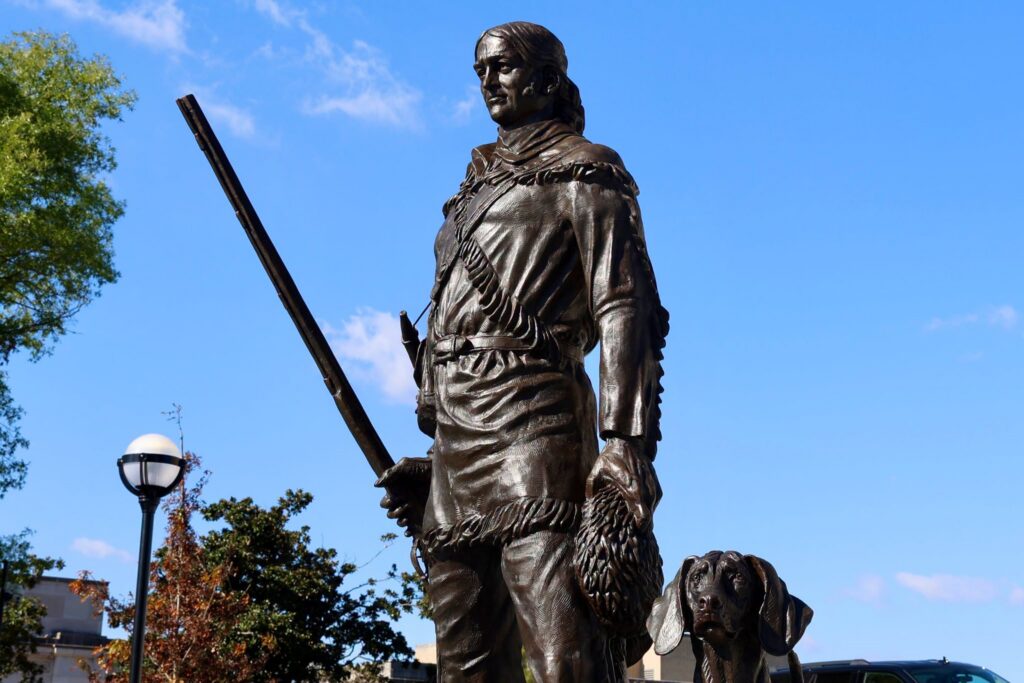
A new bronze statue honoring Tennessee frontiersman and former Congressman David Crockett was unveiled November 12 at the Tennessee State Capitol, replacing a monument to Edward Carmack that protesters toppled during racial justice demonstrations in 2020.
The unveiling marks a significant change to the Capitol grounds, where Carmack’s statue had stood since 1927 despite his history of racist writings and attacks against Black journalist and civil rights activist Ida B. Wells.
Gov. Bill Lee, House Speaker Cameron Sexton and other state leaders attended the ceremony, celebrating Crockett’s contributions to Tennessee history and his reputation for political independence.
Lee said the goal was to make the location “one that all Tennesseans are proud of.”
Crockett, who served in the Tennessee legislature and U.S. Congress, became nationally known as a frontiersman, hunter and outspoken political figure. He famously opposed President Andrew Jackson’s Indian Removal Act of 1830, breaking with much of Tennessee’s political establishment over the forced removal of Native Americans from their ancestral lands.
His opposition contributed to his political difficulties in Tennessee. After losing reelection to Congress, Crockett traveled to Texas, where he joined the fight for independence from Mexico. He died defending the Alamo in 1836 at age 49.
The new statue, created by West Virginia sculptor Jamie Lester, depicts Crockett holding a rifle and his famous coonskin cap, accompanied by two hunting dogs. Lester spent approximately two years completing the project.
According to the sculptor, the dogs symbolize the relationship between past and future, with one facing forward and the other looking back.
Lester also emphasized Crockett’s opposition to the Indian Removal Act as an important part of his legacy, describing him as someone willing to risk his political career over his convictions.
The statue’s location carries particular historical significance because of the monument it replaces.
Edward Ward Carmack was a former U.S. senator and newspaper editor whose statue was erected nearly a century ago in recognition of his support for alcohol prohibition.
However, Carmack was also a vocal White supremacist whose newspaper editorials promoted racial hostility.
While working as an editor in Memphis during the 1890s, Carmack publicly attacked Ida B. Wells, whose investigative journalism exposed the brutality and injustice of lynching.
Carmack called for violence against Wells, contributing to an atmosphere of racial intimidation that culminated in a mob destroying the office of her newspaper, the Memphis Free Speech. Wells was subsequently forced to leave Memphis.
Carmack’s monument became a focal point of criticism as communities across the country reconsidered public memorials honoring figures associated with racism and White supremacy.
In May 2020, protesters pulled down his statue during demonstrations following the murder of George Floyd by a Minneapolis police officer. Tennessee officials had already been considering its removal.
The replacement of Carmack with Crockett represents a shift in how Tennessee chooses to commemorate its history in one of the state’s most prominent public spaces.
The new monument stands above the Motlow Tunnel along Martin Luther King, Jr. Boulevard, near the entrance to the Capitol grounds.
For visitors, the statue offers an opportunity to reflect on Crockett’s complex legacy, including his opposition to Indian removal, while marking the end of a nearly century-long public tribute to Carmack.
The unveiling also reflects the continuing national conversation about whose accomplishments and values should be represented by monuments on publicly owned property.