If you haven’t picked up a copy of now is a good time to read it and let Simone reflect on her life, with her own enlightening words. If you haven’t seen the Oscar-nominated, bio-documentary film What Happened, Miss Simone, it’s on Netflix and it is very moving. Enlightening and moving are two descriptive words that will never be associated with the misconceived and misguided endeavor that is Nina.
This bio/film gained controversy early on for its unlikely casting of Zoe Saldana (Avatar). Photos of her darkened skin and prosthetic nose hit the Internet and . Why couldn’t the producers find a dark-skinned actress to play Nina? What difference does it make if an actress needs heavy makeup and special effects to play a role?

As the movie opens, Nina Simone (Saldana) is pissed. She’s broke and is not receiving royalties for her music. She and her manager Henry Edwards (Ron Guttman) are in her record company office when she confronts an executive, who in a very blasé tone tells her she signed away her rights a long time ago. Simone reaches into her purse, grabs a gun and points the muzzle at the quivering suit.
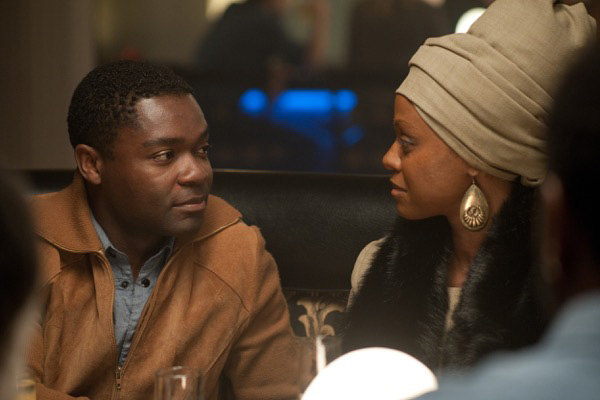
Next thing she knows she is in a psychiatric hospital, tied down because of her outbursts. Clifton Henderson (David Oyelowo), a young nurse, befriends her. Before he can barely give her an injection, she offers him a job as her assistant, at $2000 per week, and they run off to her home in the south of France. The formerly pleasant Nina turns into a tyrant, demanding champagne 24/7, refusing to take the drugs that manage her manic-depression and rarely eating. With her mood swings, it’s no wonder few agents and clubs will book her and when they do, she is a ticking time bomb.
In memories and recollections, the sixty-something Simone recalls her friendships with Richard Pryor (Michael Epps) and Lorraine Hansbury (Ella Thomas), her associations with Martin Luther King, Jr., and Malcolm X, her station on the frontlines of the Civil Rights movement. In present day, she is confounded that her relationship with Clifton is never more than platonic. She wants more, and clearly he can’t oblige. He becomes her manager and tries to resuscitate her career. Reluctantly she goes on that journey with him.
The rights and wrongs of Saldana’s performances are glaring. She infuses a rebellious nature, sadness, courage and craziness in her interpretation of Simone, successfully rekindling some of the temperamental artist’s spirit. Wisely, the production does not rely on Simone’s voice for the singing and lets the actress do her own vocals. Though she doesn’t sound like Simone when she talks or performs, her singing is sweet and jazzy. On the other hand so much of her performance seems affected and unnatural. The same can be said of her accent, which fluctuates with the wind. And she never looks like a 60-year-old woman.
Ethan Hawke created an unquestionable illusion of jazz great Chet Baker in Born to Be Blue, without ever physically looking like the trumpet player. Saldana’s acting lacks that kind of uncanny magic.
Questions: Why cast Saldana in this role in the first place? Why didn’t the producers scour Broadway and audition Black musical actresses who could sing and act the pants off this role? Why didn’t they hire someone who vaguely resembles Simone, like Viola Davis? If Nina Simone were alive today, would she like this movie? Food for thought.
Pity David Oyelowo. The Clifton character is so poorly written and shallow he has no material to work with. He looks like he’s ready to cry in most of the scenes, or like he’s a little boy who got lost in a department store. This is the man who played Martin Luther King, Jr., in Selma, a performance that deserved an Oscar nomination. He showed a tender side in Middle of Nowhere, a brazen nature in Lee Daniel’s The Butler. He can do anything given the right script. Vivie Eteme, as a young Nina refusing to play one note at a recital until her parents are placed in a good seat, is more reminiscent of Simone in a three-minute scene than Saldana is in the entire movie.
Ruy Folguera’s musical score is entrancing. On a small budget, cinematographer Mihai Malaimare, Jr. (The Master) makes visions of the hillsides in Nice, France or chateau interiors (set designer Jan Pascale and production designer Missy Stewart) look evocative. Assembling footage that scans several decades, mixing in stills and keeping the film’s length at just 90 minutes is both a blessing (not hard to sit through the film) and a curse (film feels like it was cut off at the knees) for editors Mark Helfrich, Susan Littenberg and Josh Rifkin. Magali Guidasci’s costumes, though fashionable, look more suited for a play than a film. The entire makeup department should return their paychecks. Saldana’s darkened complexion never looks even, it’s as if they caked on the makeup with a spatula and then covered it with house paint. The wigs Saldana wears must have been bought at a Halloween costume shop. Deplorable. Embarrassing.
Producer/writer Cynthia Mort (Roseanne, Will & Grace) makes her feature film-directing debut with this awkwardly conceived production, which is clearly out of her wheelhouse. Nina has no sense of drama, and what’s on view rarely rises above the highs and lows of a mediocre soap opera. Mort fails to pull consistent performances from the cast. The staging of scenes is weak and never inventive. It’s hard to pinpoint what the perfect tone would have been for this film, but you’d know it if you felt it, and you never feel it. And the direction is better than the script, which focuses too much on a relationship that lacks chemistry.
This film had a great opportunity to take a once-in-a-lifetime story about a troubled, legendary singer, and add insight. Nina, in the most frustrating way, bungles that mission. Simone’s autobiography and the do not.
Visit NNPA News Wire Film Critic Dwight Brown at DwightBrownInk.com and BlackPressUSA.com