(Family Features) In the spirit of Black History Month, you can empower yourself, educate others, and elevate your community’s heart health by becoming a CPR (cardiopulmonary resuscitation) and AED (automated external defibrillator) champion. Sharing the importance of these life-saving skills can help create a healthier future for generations to come.
According to the American Heart Association, Black Americans have the highest incidence of cardiac arrest outside of the hospital and are significantly less likely to survive. Cardiac arrest in Black neighborhoods is associated with low treatment and survival rates; studies have shown lower rates of both bystander CPR and bystander AED use in these neighborhoods.

In the U.S., health inequities are systematic differences in the health status of different demographics and are often the result of barriers such as racism, poverty, discrimination, lack of affordable housing, quality education and access to health care.
Black History Month serves as a poignant backdrop for the Nation of Lifesavers campaign from the American Heart Association, which aims to align the principles of empowerment, community engagement and health equity. While celebrating the rich heritage and resilience of the Black community, you can also recognize the importance of fostering heart health education and building a legacy of health.
You can champion the importance of CPR and AED training by sharing this important information in your community.
CPR
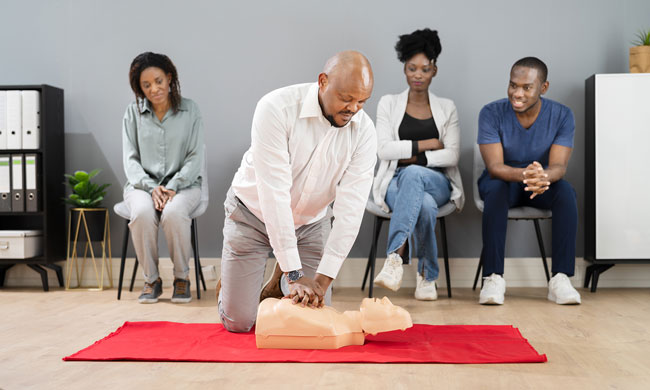
Because about 70% of out-of-hospital cardiac arrests happen in the home, learning CPR can save the life of someone you know and love. In fact, while 90% of people who suffer cardiac arrest outside of a hospital setting do not survive, you can double or triple a victim’s chance of survival by performing CPR immediately. It consists of two easy steps:
- Call 9-1-1 (or send someone to do so).
- Push hard and fast in the center of the chest.
AED
An AED is a lightweight, portable device that delivers an electric shock through the chest to the heart when it detects an abnormal rhythm then changes the rhythm back to normal. More than 15% of out-of-hospital cardiac arrests occur in public locations, meaning public-access AEDs and community training play a large role in early defibrillation. CPR combined with using an AED provides the best chance of saving a life.
Ambulances, law enforcement vehicles, many fire engines and other first-response vehicles contain AEDs. Additionally, they may be found in public areas, such as sports venues, shopping malls, airports and airplanes, businesses, convention centers, hotels, schools, swimming pools and doctors’ offices. You can typically look near elevators, cafeterias, reception areas and on the walls in main corridors where large numbers of people gather.
Follow these steps to use an AED:
- Turn on the AED and follow the voice prompts.
- Remove all clothing covering the chest. If necessary, wipe the chest dry.
- Peel away the backing from the pads and attach them to the person’s bare chest following the illustration on the pads.
- Plug the pads connector into the AED, if necessary.
- The AED will check to see if the person needs a shock and tell you when to give one. While the AED is analyzing, ensure no one is touching the person.
- Resume CPR if no shock is needed. If a shock is needed, ensure no one is touching the person and press the “shock” button then immediately resume CPR.
- Continue CPR until emergency personnel arrive.
Learn more and find out how to empower yourself and your community at heart.org/blackhistorymonth.
Photo courtesy of Shutterstock
SOURCE:
American Heart Association