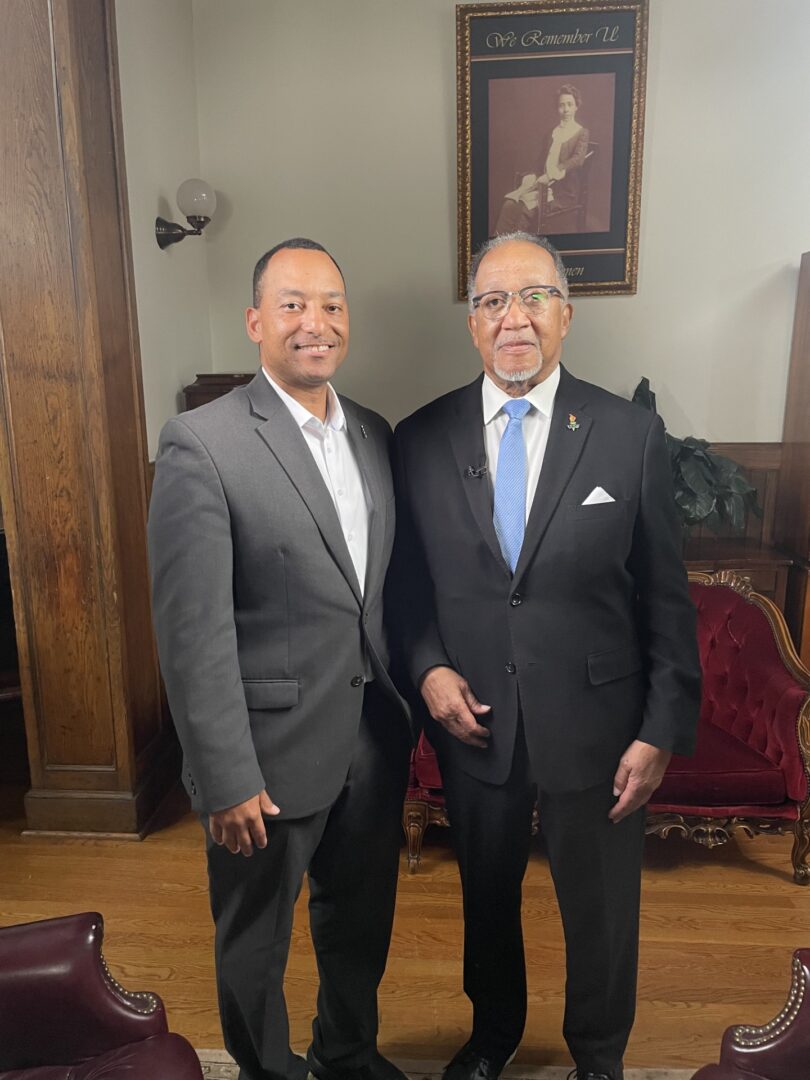
Dr. Tshaka Cunningham, a pioneering molecular biologist, has made an extraordinary journey from the Shaw neighborhood of Washington, D.C. to the cutting edge of precision medicine and genomics. Returning to his roots for an interview on the PBS show The Chavis Chronicles, Cunningham shared insights into his career, the importance of diversity in science, and his commitment to advancing genomics for the betterment of all communities.
Raised in D.C.’s historic Shaw area, Dr. Cunningham’s early exposure to science came from a deeply personal source: his grandmother, a cancer researcher who played a pivotal role in sparking his lifelong passion for molecular biology. “I was exposed to science at an early age from my grandmother, a cancer researcher,” Cunningham said before his 30-minute discussion with National Newspaper Publishers Association President/CEO Dr. Benjamin F. Chavis, Jr., the host of the Chavis Chronicles. “She sparked in me that intellectual curiosity of what caused a cancer cell to be a cancer cell. It’s fascinating to me.”

This fascination led Cunningham to pursue a career in molecular biology, a field that explores the fundamental building blocks of life. “The reason I became a molecular biologist is because the sum total of the organism that we are is a collection of molecules that know how to beautifully orchestrate the symphony that is life,” he said. A relentless curiosity and a desire to comprehend life at its most fundamental level led him from Princeton University, where he received his bachelor’s degree, to Rockefeller University for his Ph.D., and postdoctoral training at the Pasteur Institute in Paris and the National Institutes of Health in Bethesda.
But Cunningham’s journey was not just about academic achievements; it was also about overcoming the social challenges of being a ‘cool nerd’ in a community where academic excellence wasn’t always celebrated. “I liked playing sports and chasing girls,” Cunningham said with a smile. “But I remember growing up here in D.C., where it wasn’t cool to be smart back in the day, so I used to have to lie about my grades. But we have to make it cool to be a nerd and get good grades.”
Significant contributions to science and society have been a hallmark of his career. At the Department of Veterans Affairs, Cunningham played a critical role in overseeing national research programs in aging and neurodegenerative diseases. He also spearheaded initiatives to ensure minority veterans were well-represented in the VA’s Million Veteran Program, emphasizing the importance of diversity in genomic research.
Motivated by a commitment to making precision medicine more inclusive, Cunningham co-founded the Faith-Based Genetic Research Institute, a nonprofit organization dedicated to improving lives through genomics. His belief in the potential of science to benefit all communities is unwavering. “More of our people should be involved in science,” he said. “It takes a level of curiosity, tenacity, and resourcefulness to be a scientist. They call it research for a reason because you have to search and research and constantly fail in the lab. Our people are good at being resourceful and tenacious, and that’s what it takes to be scientists.”
As the co-founder and chief scientific officer of Polaris Genomics and TruGenomix Health, Inc., Cunningham is at the forefront of using genomics to tackle some of the most pressing health challenges, including PTSD. He emphasizes the importance of understanding diseases at the molecular level to develop effective treatments. “Some cancers we are getting there, and some we can cure,” Cunningham said. “In the next 20–25 years, that percentage will go up. Prevention helps us cure, but we have to understand at the molecular level what causes the disease, and that’s what people like me do—molecular biologists and researchers continue to do.”
His peers said Cunningham’s journey from Shaw to shaping the future of genomics is a testament to the power of curiosity, determination, and the pursuit of knowledge. His work is not just about advancing science; it’s about breaking down barriers and ensuring that genomics benefits are accessible to all communities.
“Not only as it pertains to communities of color but all humanity. These myths and stereotypes that are out here are from White supremacists, and they are not based on truth and facts,” Chavis said. “Science is based on truth and facts. If our nation was better informed, we would not be so divisive.”