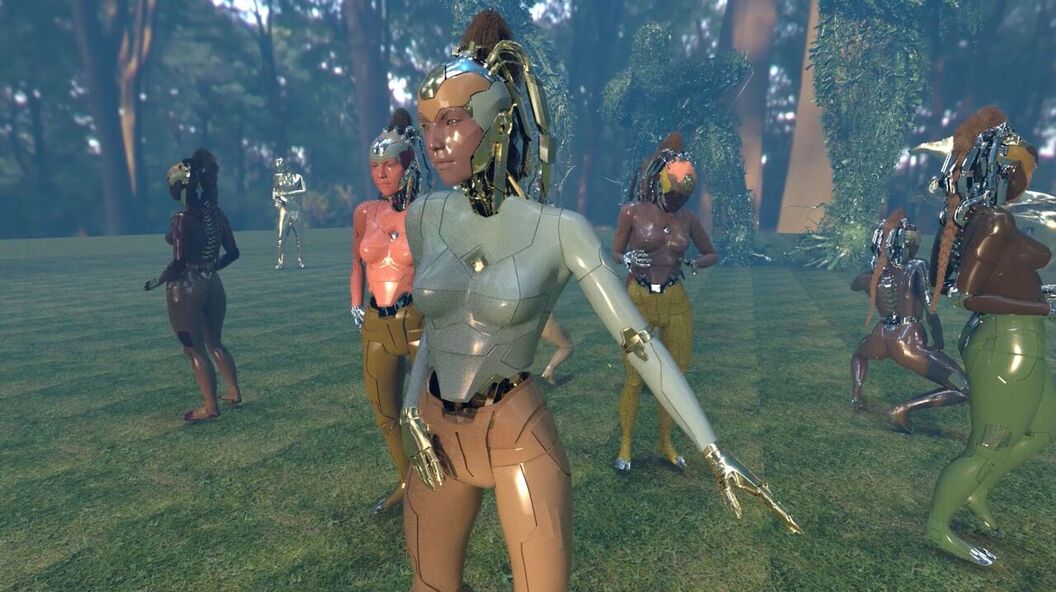
The Frist Art Museum presents “Shimmer: Dreaming the Posthuman,” an exhibition of works by 17 contemporary artists who use both analog and emergent technologies to visualize the vital interconnectedness between humanity, other species, and the earth itself. Organized by the Frist Art Museum, the exhibition will be on view in the Frist’s Ingram Gallery from September 25, 2026, through January 3, 2027.
“Shimmer” explores intersections of dreams and reality, the physical and the virtual, and human creativity and nonhuman intelligences. Using physical media ranging from deer hides to glass as well as digital tools such as CGI, augmented and virtual reality, motion capture, and generative software, artists Ian Cheng, Alexandra Daisy Ginsberg, Marguerite Humeau, Josèfa Ntjam, Jacolby Satterwhite, Saya Woolfalk, and others offer new ways of seeing the biological, psychological, and philosophical entanglements between humans and the more-than-human world.

Curated by Frist Art Museum Chief Curator Mark Scala, “Shimmer” is the final project in a series of contemporary exhibitions he has organized including “Matthew Ritchie: A Garden in the Flood” (2022), “Chaos and Awe: Painting in the 21st Century” (2018), “Phantom Bodies: The Human Aura in Art” (2015), “Fairy Tales, Monsters, and the Genetic Imagination” (2012) and “Paint Made Flesh” (2009).
“Although humans do have an outsized ability to control our environment, we have not always understood that this brings with it an ethical charge for care,” writes Scala. Though the title may suggest the aftermath of our species’ extinction, the term ‘posthuman’ refers to a philosophical rejoinder to the belief that human exceptionalism gives us license to destroy and exploit nature for our short-term benefit.
The title of the exhibition is connected to the 2018 film “Annihilation,” directed by Alex Garland, which is loosely based on the 2014 novel of the same name by Jeff VanderMeer. In the film, “the shimmer” is a wavering, iridescent portal. Upon crossing its threshold, the genetic materials of various life – forms combine and undergo metamorphoses. The results, whether marvelous or monstrous, signal future evolutionary possibilities; they are premonitions of bliss or terror.
When conceiving the exhibition, Scala was also inspired by the use of the word shimmer by anthropologist Deborah Bird Rose and her fellow researchers, who describe the transformation of the physical into the metaphysical in Australian Aboriginal sand paintings. When finished, these mystical maps lead into the Dreamtime, a sacred Indigenous continuum where relationships among species are fluid and connected.
“The works on view convey the quality of shimmer — a transient glow that makes things appear immaterial and otherworldly,” writes Scala. “In the gallery’s luminous space, extinct species virtually reappear; machines become entwined with amoeba, slime, and microbes; mysterious light-filled avatars float and dance through fantastic landscapes; and the earth reveals itself to be a living organism.”