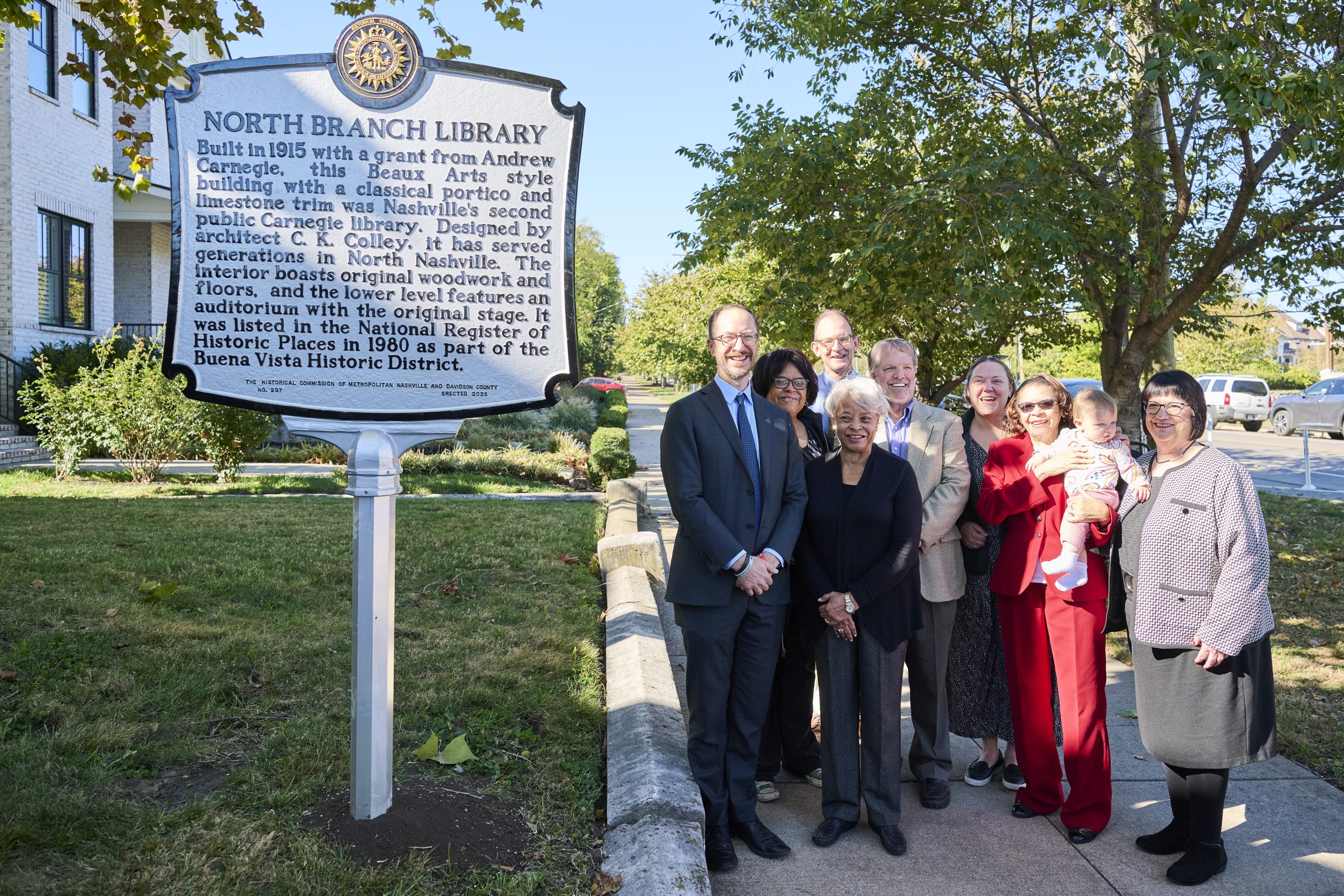
For more than a century, the North Branch of the Nashville Public Library has served as a center of learning, literacy and community connection in one of Nashville’s most historic neighborhoods. On Friday, October 23, city officials and community members gathered to celebrate that legacy with the unveiling of a new historical marker.
Located at 1001 Monroe Street in the Buena Vista neighborhood, the North Branch opened February 11, 1915, and remains the oldest operating branch in the Nashville Public Library system.
Mayor Freddie O’Connell joined representatives of the Nashville Public Library, Metro Historical Commission and longtime branch manager Cloreace Eppenger for the ceremony recognizing the building’s architectural significance and generations of service to North Nashville residents.
The library was constructed with financial support from industrialist and philanthropist Andrew Carnegie, whose contributions helped establish public libraries across the United States. A $50,000 Carnegie grant, combined with local fundraising efforts, supported the development of the North Nashville facility.
Designed by architect C.K. Colley in the Beaux-Arts style, the building retains many of its original architectural features, including hardwood floors, decorative woodwork, a stage and its historic checkout desk.
The structure was added to the National Register of Historic Places in 1980 and is one of only two remaining Carnegie-funded public library buildings still operating in Nashville.

For generations, the North Branch has provided more than books. It has served as a gathering place where residents could study, access educational resources, participate in community activities and develop a lifelong appreciation for reading.
Its continued presence is particularly significant in North Nashville, a historically African American community whose institutions have played important roles in education, cultural preservation and neighborhood identity.
Eppenger, who has managed the branch for approximately 25 years, reflected on the library’s ability to remain relevant while preserving its historic character.
“We are known as the little Carnegie library branch, yet we truly have a big heart for all people,” Eppenger said.
Despite its age and smaller size compared with newer library facilities, the North Branch continues to attract readers and serve neighborhood families.
During the ceremony, O’Connell highlighted the library’s ongoing popularity, noting that patrons had borrowed more than 9,800 books and other materials since July, representing a 13% increase compared with the previous fiscal year.
The mayor, who lives nearby and whose family uses the branch, also emphasized the importance of public libraries as welcoming community spaces where residents can gather outside their homes, schools and workplaces.
The unveiling of the historical marker recognizes not only the building’s architecture but also the people who have sustained the institution through decades of neighborhood change.
As Nashville continues to grow and develop, the North Branch stands as a reminder of the importance of preserving historic community institutions while ensuring they remain accessible to future generations.
More than 111 years after opening its doors, the small Carnegie library on Monroe Street continues its original mission of providing knowledge, opportunity and a welcoming place for the people of North Nashville.