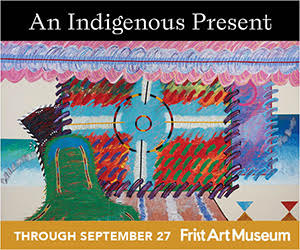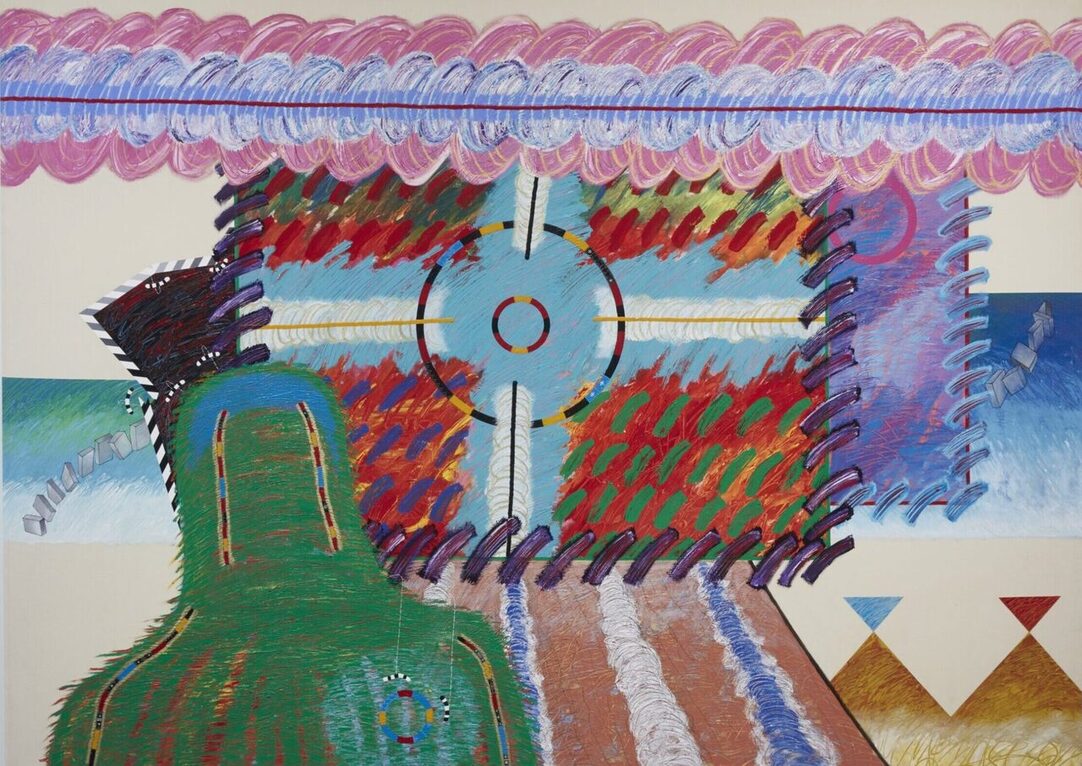
The Frist Art Museum presents “An Indigenous Present,” an exhibition that spans 100 years of modern and contemporary Indigenous art and includes 15 artists who pursue abstraction as a tool for liberated expression. Organized by the Institute of Contemporary Art / Boston, the exhibition will be on view in the Frist’s Upper-Level Galleries from June 26 through September 27, 2026.
“An Indigenous Present” is cocurated by artist Jeffrey Gibson (member of the Mississippi Band of Choctaw Indians and of Cherokee descent), whose work was presented at the Frist in 2023, and independent curator Jenelle Porter. It draws from Gibson and Porter’s landmark 2023 publication of the same title, which, through a collaborative process, brought together work by Native North American artists exploring diverse approaches to concept, form, and medium. The exhibition includes significant works by artists including Teresa Baker, Raven Chacon, Kimowan Metchewais, Caroline Monnet, George Morrison, Mary Sully, Jaune Quick-to-See Smith, and Kay WalkingStick, among others.

“We consider this exhibition a chapter in the project that is An Indigenous Present — hence our repetition of the title — one in which we envision the ways abstraction can dissolve the hierarchies and categories that confine making, seeing, and thinking,” write exhibition cocurators Jeffrey Gibson and Jenelle Porter.
In a conversation about the development of the exhibition, Porter states, “Abstraction is this incredibly flexible tool that allows artists a liberated field in which to make and think and see and hear. But we’ve included artists who use abstraction in ways that counter what is typically expected of contemporary Indigenous artists.” Gibson adds, “We chose artists who have pushed traditional forms of cultural abstraction into realms that don’t directly reference specific cultural traditions. They are experimenting with it, pushing it into places where it’s still tethered to where the reference originates from, but in a new format that can make it almost unrecognizable.
The exhibition, organized into five interconnected thematic sections, begins with the work of George Morrison and Mary Sully, two important forebears in the development of contemporary Indigenous art during the first half of the 20th century. Kay WalkingStick and Dakota Mace explore seriality and repetition in bodies of work realized in the 1970s and 2020s, respectively. WalkingStick’s Chief Joseph Series — dedicated to the heroic Niimíipuu /Nez Perce chief — presents a grid of 27 paintings that characterize the artist’s decades-long devotion to serial forms and storytelling. Mace’s So’ II (Stars II) is composed of 40 unique chemigram prints that draw on Diné (Navajo) design histories and heritage.
In another artistic dialogue, Morrison and Teresa Baker evoke the land and light of their own ancestral homelands through an interplay of color and form. Morrison, who trained alongside abstract expressionist painters in New York in the 1950s, is known for vibrant compositions, especially those inspired by the horizon near his Lake Superior, MN, home. Baker composes with yarn, paint, willow, and hide on irregularly cut artificial turf to create large-scale abstractions that convey her memories of place, such as the Northern Plains of her youth, as well as legacies of color field painting and collage.
Guests can access a podcast produced by the Institute of Contemporary Art/Boston and WBUR in the galleries to learn more about contemporary Indigenous art. In a series of conversations, the cocurators discuss the exhibition and are joined by artists Teresa Baker, Raven Chacon, Sky Hopinka, Sonya Kelliher-Combs, Caroline Monnet, and Anna Tsouhlarakis, and scholar Philip Deloria.